%20(1).avif)

Don’t fight fraud blind: 5 insights on cross-industry fraud intelligence

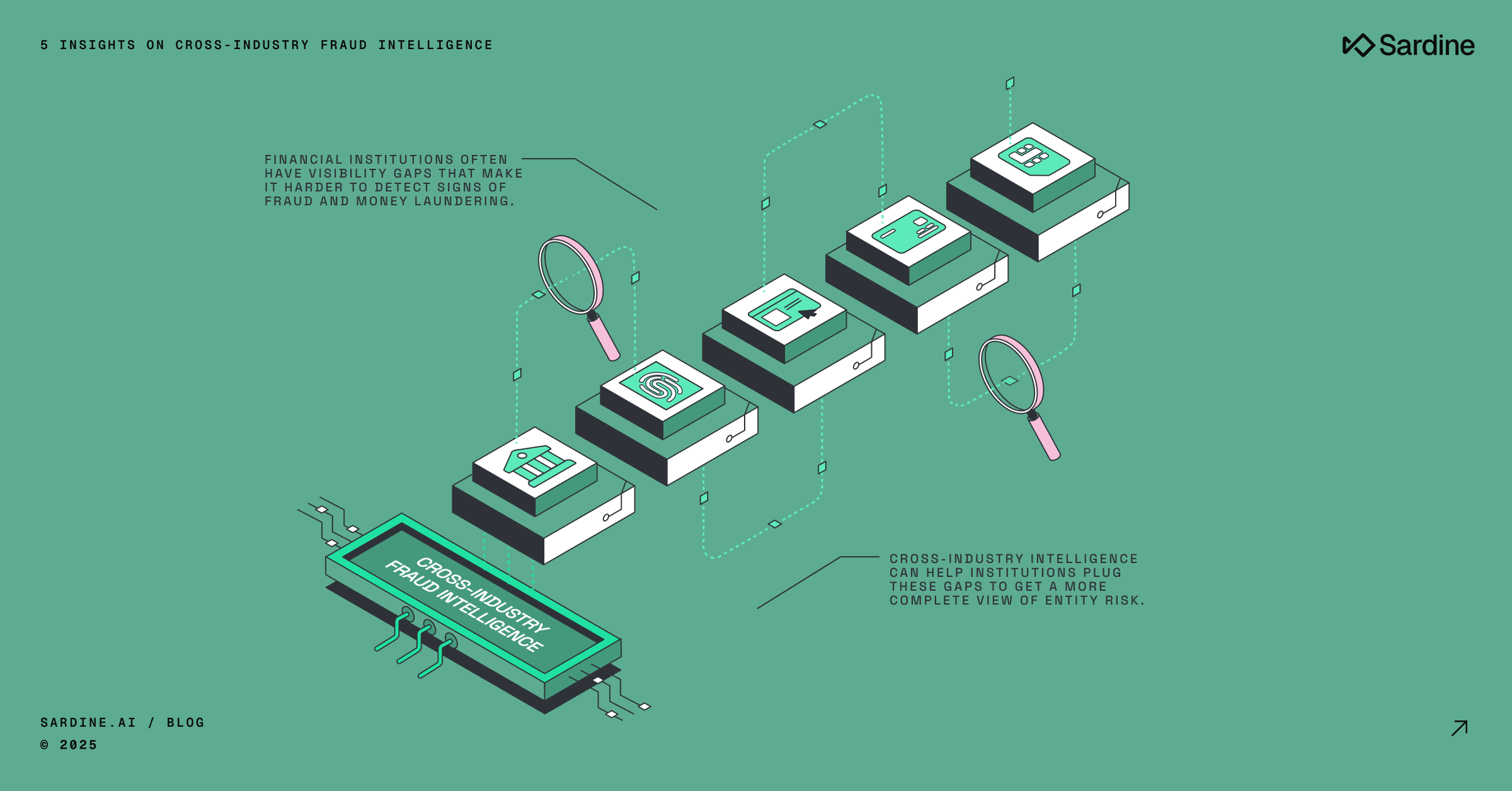
By now, we all know that fraud doesn’t happen in a vacuum. Instead, bad actors shift and jump across institutions, channels, and payment rails.
A transaction or account opening at one institution may seem normal, but when combined with risk signals from other industries, you may uncover that the entity has hidden risks that could be indicative of fraud or money laundering.
In our recent webinar, Ravi Loganathan, President of the Sonar consortium, joined us to discuss how this visibility gap impacts banks today, and why leveraging shared intelligence is essential for fighting complex fraud.
Here are the top five takeaways.
1. Financial crime entity attributes don’t stay within your institution
Fraud doesn’t start, stay, or finish within a single institution. Bad actors spend their days actively probing vulnerabilities across multiple organizations, jumping from fintechs to traditional banks and exploiting the visibility gaps between them.
What separates a legitimate user from a bad actor is not just a single fraudulent transaction, but their baseline attributes, such as device, email address, or phone number, and the patterns associated with each one.
With consumers transacting across a range of platforms each day, from traditional banks to crypto exchanges, marketplaces to neobanks, a broad view of an entity’s typical behavior and associated risk signals is critical.
Criminals will often rotate between banks, fintechs, marketplaces, and P2P services to avoid repeated detection. This makes it difficult for any one provider to differentiate a legitimate user from a high-risk entity based solely on its own data.
For example, a device may appear to belong to a trustworthy customer at account opening, but was linked to multiple failed KYC attempts at another institution earlier in the day.
Even low-risk behavior can mask patterns, such as a user maintaining a stable balance at a traditional bank while simultaneously cycling funds through high-risk transfers elsewhere.
These patterns are invisible without cross-industry fraud intelligence. Shared risk intelligence and behavioral risk indicators provide the broader view needed to understand how an entity behaves across the ecosystem. Tools that help fraud teams visualize an entity’s footprint can make it easier to identify coordinated fraud rings and hidden risk networks.
.png)
"I think no one institution is going to be able to prevent fraud,” said Ravi. “...and I think shared fraud intelligence and shared insights are going to become even more important."
2. An evolving payments landscape demands real-time risk signal insights
As the industry moves deeper into real-time payments, instant settlement, and new payment rails, real-time risk assessment must keep up. Traditional fraud models that rely on batch processing with days or months of lag time can’t keep up.
As Ravi explained, "This is not about lagged, backward-looking data. The infrastructure is built because we're thinking about this as infrastructure to facilitate real-time insights, and that facilitates inquiry response before a transaction is authorized."
Sonar, the independent member-driven cross-industry fraud intelligence consortium, addresses this through an inquiry - response - feedback loop. When an institution initiates account opening, funding, or payment transactions, they can call the Sonar Insights API about an entity and receive back consolidated risk signals in real time, all before authorizing the transaction.
The rise of real-time payments puts pressure on institutions to make accurate decisions within seconds. Traditional batch models provide no protection against attacks that unfold quickly. For example, a user may initiate a legitimate looking RTP transfer at one institution while simultaneously sending small, rapid transfers across multiple payment platforms.
Fraud rings also exploit delays between systems by pushing funds across different rails in rapid succession. These patterns appear harmless when viewed individually but form a clear picture when analyzed across the ecosystem. Real-time shared risk intelligence gives institutions the visibility they need to block high-risk transfers before funds move out of reach.
3. Sonar provides cross-industry fraud intelligence, not just banking data
Sonar is committed to bringing together participants from across the financial services ecosystem. Our members include crypto exchanges, marketplaces, and fintechs, and we plan to diversify that group soon. This cross-vertical approach is essential because entity attributes, for better or worse, are used across all of these channels.
Banking data alone rarely tells the full story of an entity’s behavior. A customer may present clean identity attributes during onboarding at a bank while exhibiting high-risk signals elsewhere.
For example, a device used to open a bank account may have been tied to multiple chargeback claims in a marketplace.
By connecting signals across industries, Sonar surfaces behavioral patterns that are invisible within any single provider. This context helps institutions make smarter, more informed decisions about entity risk.
4. Focus on fraud fighting, not vendor integration
Sonar was specifically designed to be vendor agnostic and easy to implement. Institutions can access curated risk signals through API calls, incorporating Sonar into their existing risk decisioning process and fraud stack.
Whether you have a modern tech stack that can integrate signals into machine learning models, or are more limited to rules-based approaches, Sonar can enhance your fraud detection capabilities. Plus with the Sonar Marketplace, you have access to third-party data vendors to enrich your fraud data, all through a single API.
With more than 3 billion devices and 120 million entities covered, members gain access to far more intelligence than they could reach with internal data alone.
Many institutions hesitate to adopt new risk tools due to complex integrations. Sonar avoids this issue by operating as a lightweight data layer that fits into existing tech stacks.
For example, a bank can add Sonar as an enrichment source for its existing model without reworking its entire risk workflow. A fintech using a simple rules engine can ingest Sonar risk signals as Boolean checks without restructuring its system.
Organizations with limited engineering teams can rely on straightforward API calls that return entity-level risk signals with minimal data inputs. Beyond ease of use, institutions benefit from network coverage that would take years to build on their own. Sonar provides instant access to ecosystem-wide patterns, allowing teams to focus on fraud prevention rather than infrastructure work.
5. Build trust with strong governance and regulatory frameworks
Though some institutions avoid consortiums due to data privacy concerns, Sonar has worked to establish comprehensive operating rules and governance frameworks to address this concern.
The consortium operates under the Gramm-Leach-Bliley Act (GLBA) for fraud prevention, and received 314(b) designation from FinCEN for anti-money laundering.
For example, GLBA allows members to share relevant information strictly for the purpose of preventing financial crime. Section 314(b) of the USA PATRIOT Act enables deeper collaboration on AML activity while maintaining strict guidelines about what can be exchanged. Regulators including the OCC, CFPB, and Federal Reserve Bank of Boston participate as silent observers in quarterly member forums.
Data signals are anonymized before being shared, which allows members to receive insights without exposing raw customer information. This framework reassures compliance teams that risk insights can be used safely without violating privacy expectations.
The governance structure is member-driven with rotating groups that determine data usage policies and product roadmaps. This helps ensure that Sonar continues to function as an independent industry utility, rather than a proprietary data moat, allowing members to confidently share and receive risk signals.
Advancing shared risk intelligence across the financial ecosystem
As we look to 2026, we’re excited to continue scaling Sonar through new partnerships and capabilities.
Our goal remains clear: to create critical infrastructure that empowers financial institutions with real-time insights, so they can fight fraud and make confident decisions about risk.
To discover how Sonar can help you stay ahead of fraud with consortium intelligence, visit joinsonar.com.
FAQs: Cross-industry fraud intelligence and shared risk signals
[faq-section-below]
- What is cross-industry fraud intelligence and why does it matter for banks?
Cross-industry fraud intelligence refers to sharing risk signals and financial crime insights across banks, fintechs, merchants, and payment providers. It helps banks close visibility gaps by revealing behavioral patterns and entity-level risk signals that are not detectable within a single institution, improving risk scoring and reducing losses from first-party fraud and APP scams. - How does Sonar help financial institutions detect hidden entity risk?
Sonar unifies fraud consortium data, network-level risk signals, and behavioral risk indicators to build a complete view of an entity’s activity across payment rails. This allows institutions to identify high-risk behavior earlier and strengthen their entity-based risk decisioning. - What types of visibility gaps does cross-industry data help close?
Cross-industry data closes institution-level, rail-level, and channel-level gaps, as well as attribute-level gaps tied to devices, emails, phones, and behavioral patterns. These are the areas where financial crime often hides, and sharing real-time risk signals helps expose them. - How does shared risk intelligence support real-time payments and instant settlement?
Real-time payments increase financial crime risk because funds move instantly, leaving little time for verification. Shared risk intelligence gives institutions access to cross-rail risk data and real-time risk signals before a transaction is authorized, improving safety for RTP, FedNow, ACH, A2A, and P2P networks. - Why is entity-level risk scoring more effective than transaction-level monitoring?
Transaction-level monitoring can miss coordinated behavior across institutions. Entity-level risk scoring uses shared risk intelligence, financial crime insights, and behavioral indicators to evaluate the overall risk of a person or business. This uncovers fraud patterns like mule networks and first-party fraud that cannot be detected from a single transaction. - How does Sonar protect sensitive information while enabling data sharing?
Sonar operates under GLBA for fraud prevention and Section 314(b) for AML, allowing members to share relevant financial crime risk data securely and legally. All data is anonymized and exchanged as risk signals rather than raw customer information, ensuring privacy and compliance. - Who benefits most from cross-industry risk signals?
Banks, fintechs, payment processors, merchants, and sponsor banks benefit from shared risk intelligence because it adds ecosystem-wide visibility. Teams across fraud, compliance, credit, onboarding, and customer due diligence gain stronger context for entity-based risk decisioning.