













How ZoomInfo blocks over 47% of bad actors at signup and grew its sales pipeline by 19%

ZoomInfo is a B2B intelligence platform that provides sales, marketing, and revenue teams with accurate contact and company data. With millions of professionals relying on its platform to source leads and power outreach, ZoomInfo operates across four distinct product applications, each representing a potential entry point for fraud.
The challenge: A fraud problem that went beyond payments
Most companies think about fraud at the payment layer. ZoomInfo had to think about it much earlier.
Because ZoomInfo's core product is high-quality B2B data, that data is uniquely attractive to bad actors. Fraudsters aren’t after a refund or a chargeback, they want a login. Verified professional contact data is like fuel for phishing campaigns, impersonation schemes, and social engineering attacks, making it worth pursuing through fraud rather than through legitimate means.
"Because of the value of that data, it’s incredibly valuable to individuals with less than sure motives behind it. Hackers, scammers, fraudsters, phishers: our data is really valuable for that."
The fraud patterns ZoomInfo faced fell into two main categories. The first was impersonation, where bad actors pose as real employees at legitimate companies to gain access. The second was fake company fraud, where fraudsters created entirely fictitious businesses, signed contracts, and submitted invoices they had no intention of paying, or used stolen credentials to pay upfront.
A third problem came from ZoomInfo's free tier, where bad actors regularly attempted to exploit free access to harvest data at scale.
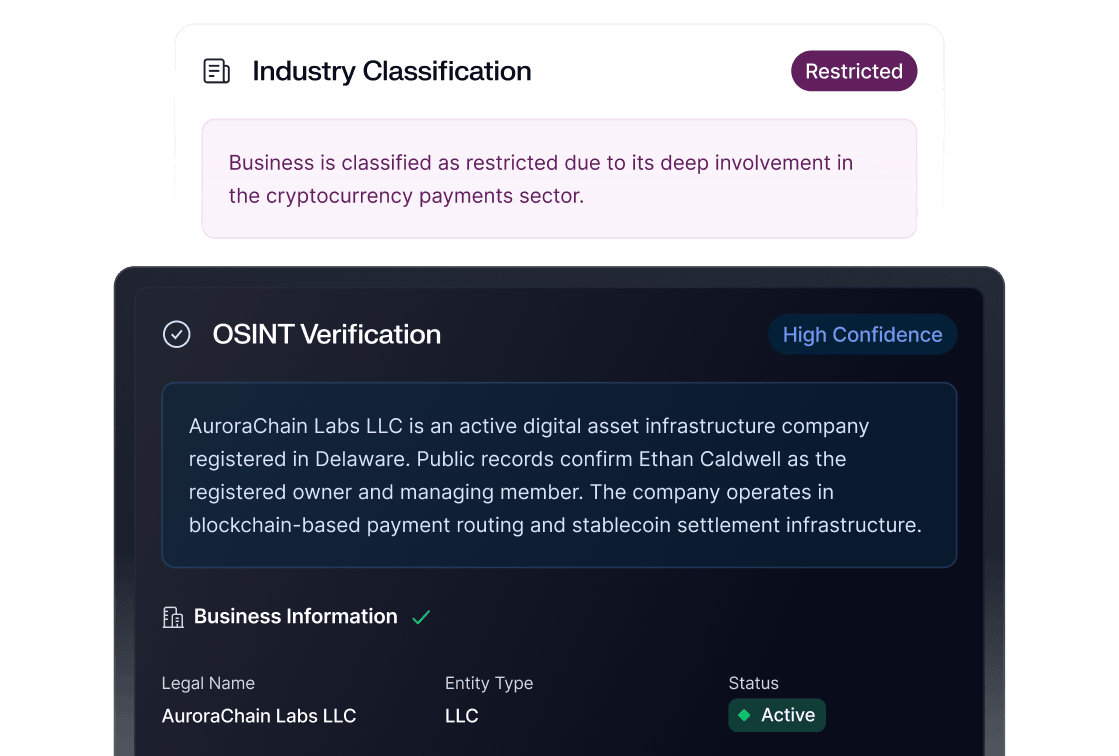
Megan Mahoney, Fraud Operations Lead, described the challenge plainly: "Our challenges are trying to understand: is this person who they say they are? Does the company exist? And does the person work at the company?"
The existing vendor stack wasn't built to answer those questions well. Risk signals were largely static with email age serving as the primary indicator. Device intelligence and behavioral biometrics were absent entirely. Analysts had to navigate multiple disconnected systems and synthesize the results manually before they could make a decision, a process that was slow and difficult to scale with a two-person team.
"Our last vendor just fell short," Mahoney said. "It didn't give us a lot of the signals that Sardine can. So the accuracy is much better, and the efficiency."
Why ZoomInfo chose Sardine
Mahoney ran a rigorous evaluation. Starting in January 2024, she reviewed more than 20 vendors, narrowed to 14, then five, then two. She attended MRC that year, using it as an opportunity to meet vendor teams in person and pressure-test how they thought about her specific use case.
Her framing was unusual for the category. Because ZoomInfo essentially extends access to data before collecting payment, she approached the vendor search less like an e-commerce fraud problem and more like an underwriting one.
"With it being digital goods and services, I thought about it as: we're essentially loaning out credits and hoping we get paid back for it," Mahoney explained. "I needed to find the key players in the industry that are really great at fintech and crypto, more of a financial protection approach than your standard e-commerce approach. And that's where Sardine really outshines most of the other vendors I talked to."
Several factors stood out during the evaluation.
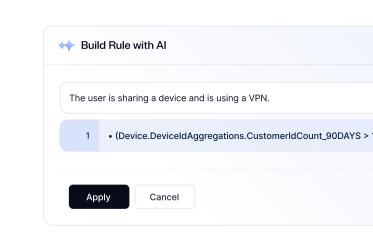
Device intelligence and behavioral biometrics: These were signals ZoomInfo simply didn't have before. Being able to enrich decisions with behavioral telemetry and device-level context, rather than relying on email age alone, represented a meaningful step forward in detection accuracy.
Third-party integrations: Sardine's partner ecosystem meant ZoomInfo could access identity enrichment and consortium signals through a single integration rather than stitching together separate vendor relationships.
The sales and pre-sales process: Mahoney valued genuine engagement with the problem over a standard pitch. "People were actually in it. They were asking a lot of questions to really understand the use case or problem statement. You don't often see that, especially in pre-sales."
The solution: Automated decisioning across onboarding with more visibility than ever
Sardine is currently live across ZoomInfo's free-tier onboarding flow (ZI Lite) and has recently expanded to additional product lines. The team's near-term goal is to replicate the same model across all four applications: automated risk-based decisioning applied as early in the funnel as possible.
Blocking fraud without slowing the business
Once Sardine was integrated into the onboarding flow, ZoomInfo configured automated decisioning to decline sessions flagged as high or very high risk. That automation immediately reduced the manual review burden on a small team while creating a more consistent, defensible decision process.
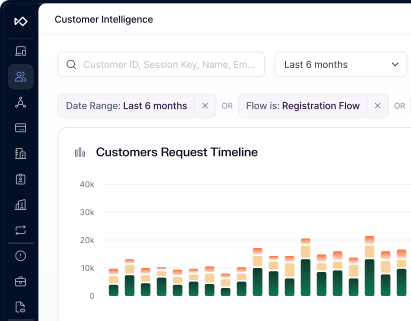
When fraud blocking first went live, it created visible friction on revenue. Mahoney used Sardine’s data to make the case for each threshold adjustment, walking go-to-market teams through the connections graph and showing them why flagged sessions were being declined.
"It's really easy to go into the data and analyze it," she said. "And it's really easy to share your screen and show people what you mean by the connections graph and why we think this person is bad. It's not an arbitrary feeling. It's all driven by data."
That transparency accelerated alignment across the org and allowed the team to refine thresholds quickly.
Early visibility into the sales pipeline
For ZoomInfo's demo and platform sign-up flow, where outright blocking would be too disruptive to lead generation, the team uses Sardine in a passive alert mode. High-risk sessions trigger alert queues that are reviewed and surfaced to sales before a demo takes place.
"We're able to prioritize, look into it, and have a meaningful conversation with sales," Mahoney said. "Not necessarily telling them what to do, but: hey, watch out for A, B, and C as you go into this conversation."
Sales gets context they never had before, without any interruption to pipeline flow.
The results: Cleaner signups, stronger pipeline, less fraud
47-54% of free-tier sign ups blocked automatically
Between 47% and 54% of suspicious sign-up attempts on ZI Lite are now automatically declined based on Sardine's risk scoring, which cover fraud patterns from fake company creation to impersonation to free-tier data harvesting. The team is in the process of financially quantifying that figure; a preliminary estimate puts prevented fraud losses at roughly $800,000 thus far.
19% increase in sales-qualified conversations
With fewer fraudulent users making it into the free platform, the conversion signal from free to sales-qualified is cleaner. The call-to-action for free users to initiate a sales conversation has increased by 19% since Sardine went live.
"We've had increases in every other meaningful metric," Thomas noted. "Conversations that go to sales [and the] quality of the data that our free service provides."
Reduced latency and no timeouts
Consolidating onboarding calls reduced signup latency, a metric the executive team tracks closely, and eliminated the timeouts that had occasionally occurred with the prior vendor setup.
Visibility into products that had never been addressed
Perhaps most significantly, ZoomInfo now has fraud visibility into parts of its product surface that had previously gone unmonitored.
"Even partially rolled out, we have visibility into components of our product and our services that we have never had before," Thomas said. "We're protecting our free platforms, protecting the data that lives within those products and doing it in an automated fashion, without taking resources."
Protecting a free product is hard to justify when it takes manual effort to do it. With Sardine’s automated decisioning handling the blocking, the team keeps coverage without the overhead.
What's next
ZoomInfo's current deployment covers onboarding across its primary free-tier product. Login and payment-layer integrations are in progress, as are deployments across the remaining applications in the product portfolio.
The team's strategic principle has stayed consistent: stop fraud as far upstream as possible.
"A lot of times people think about a fraud tool and only have it downstream at the payment layer," Mahoney said. "It's much more effective for everybody across the org to just stop it at the front door."
With onboarding addressed, each subsequent layer, login and then payments, is now expected to deliver compounding returns as the same model gets replicated across the portfolio.
The takeaway
When the platform itself is the target, the standard payment-layer fraud model doesn't fit. ZoomInfo's results came from treating onboarding as the first line of defense rather than an afterthought, which meant the downstream layers, login, then payments, each have a cleaner foundation to build on.
For fraud teams protecting high-value data products with small headcounts, that upstream investment is what makes automated, scalable defense possible.