
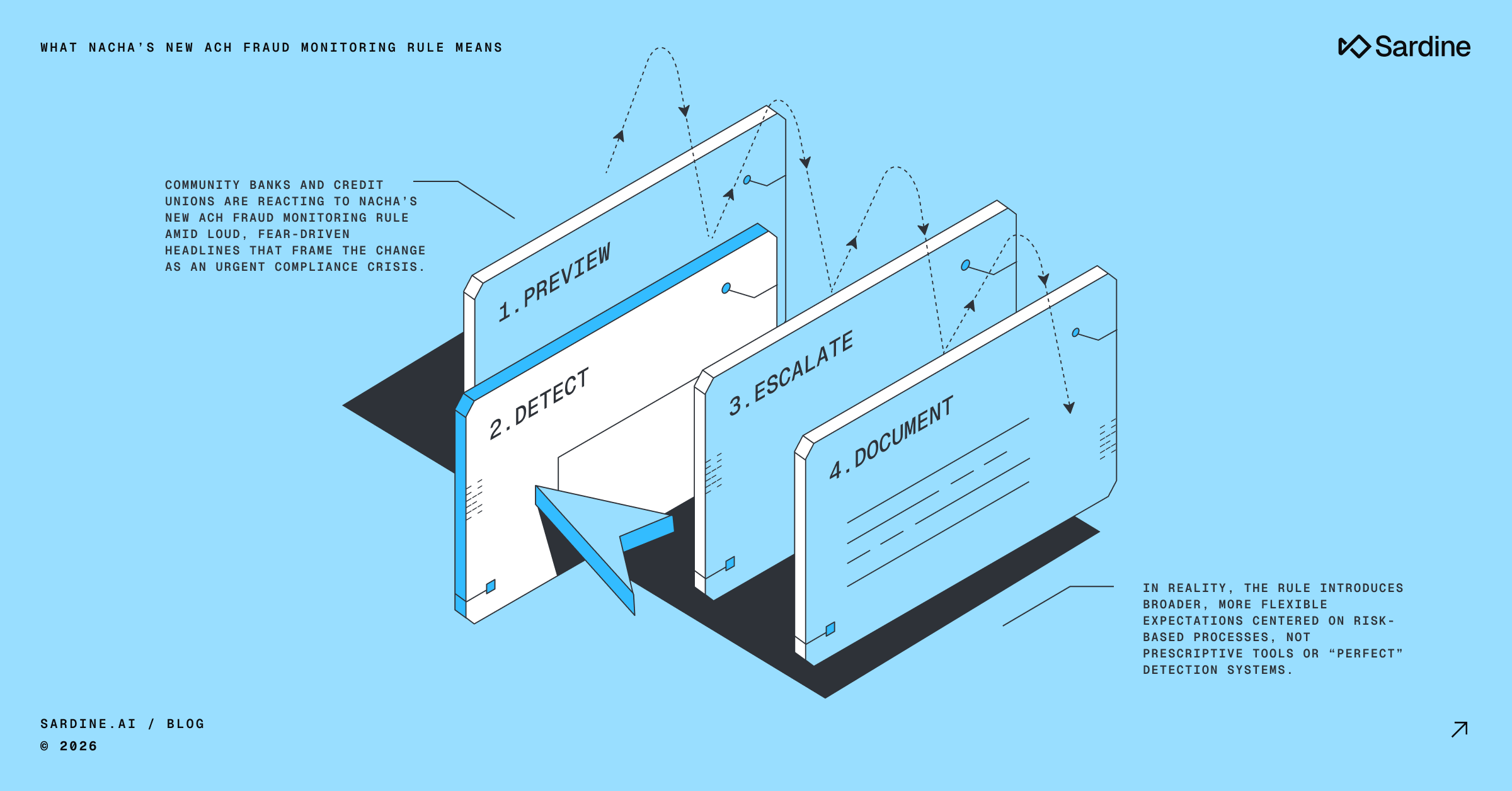
If you’ve been panicking over Nacha’s new ACH Fraud Monitoring Rule, and I want to start by saying this is not an existential, five-alarm, non-compliance fire for community banks and credit unions.
Yes, the rule introduces new fraud monitoring expectations. Yes, it expands responsibilities. The rule matters. But panic is not required.
Some of the headlines I’ve seen around these changes are, frankly, frustrating. Fear-driven framing isn’t helpful for bankers who are already juggling limited resources, staffing constraints, and very real fraud threats.
So let’s break down what Nacha is actually asking for, why the language feels uncomfortable, and how community institutions can approach this thoughtfully without overbuilding or overspending.
Why the new fraud requirements feel so unsettling
One of the biggest reasons this update is causing anxiety is the language itself, because it’s intentionally broad.
Phrases like “risk-based processes and procedures reasonably intended to identify credit Entries initiated due to fraud” are not prescriptive. Nacha doesn’t tell you what tool to buy, which alerts to run, or where to set thresholds. For institutions used to checklist-driven compliance, that kind of flexibility can feel risky.
But the ambiguity is a feature, not a bug. Nacha purposely made these changes because ACH fraud does not look the same at every financial institution.
A $200 million credit union with limited business ACH activity does not need the same monitoring approach as a multi-billion-dollar bank supporting high-volume commercial originators. One-size-fits-all guidance would miss the point entirely.
This rule is uncomfortable because it requires judgment. But that’s also where community institutions have more flexibility than they might think.
The changes actually give banks more control
One of the most important shifts in this rule is what Nacha intentionally moved away from.
The prior language referenced a “commercially reasonable detection system.” That phrasing implied technology-first thinking and, for many institutions, an assumption that sophisticated tooling was the answer.
The new rule replaces that with “risk-based processes and procedures reasonably intended to identify [ACH Entries] initiated due to fraud.”
That change matters. It signals that Nacha’s focus is on whether you understand your ACH activity, the fraud risks associated with it, and how you respond when something looks off.
More importantly, the new requirements don’t recommend a one-size-fits-all approach, so institutions have room to design monitoring that actually fits their environment. As long as the approach is thoughtful, defensible, and documented, banks have full control over what tools to use and how to design their fraud programs.
What this looks like in real life for ODFIs
If you’re an ODFI, even a small one, Phase 1 applies to you starting March 20, 2026.
That does not mean you suddenly need enterprise-grade transaction monitoring. That’s like me buying snow tires in South Carolina. (What even are snow tires?)
What it does mean is that you should be able to answer some very basic, reasonable questions.
Understanding your originators
At a minimum, you should know:
- Who your ACH Originators are
- Which ones present higher risk, based on volume, payment type, or industry
- What “normal” activity looks like for them
- How you would notice if something changed
This doesn’t require perfection, just awareness.
Reasonable monitoring practices for community institutions
For most community banks and credit unions, this looks like:
- Periodic reviews of originator activity
- Reports that help spot volume or velocity spikes
- Clearly defined procedures for contacting originators when activity looks unusual
- Documented escalation paths so staff know what to do next
How ODFIs are approaching originator monitoring in practice
Area | Lightweight / Ad-hoc | Reasonable and repeatable (Common for community FIs) | More automated |
Originator awareness | Basic list from processor or core | Periodic review of originator activity | Centralized originator profiles |
Risk segmentation | Informal knowledge | Grouped by volume, payment type, SEC code, industry | Dynamic risk scoring |
Understanding “Normal” | Staff experience | Documented typical ranges (volume, dollar size, frequency) | Behavioral baselines |
Change detection | Reactive discovery | Reports highlighting volume or velocity spikes, first-time files, new SEC codes | Automated anomaly detection |
Review cadence | As issues arise | Scheduled (monthly / quarterly) reviews | Continuous / near real-time |
Response when activity Is unusual | Case-by-case judgment | Defined procedures for contacting originators | Automated alerts and workflows |
Escalation path | Informal | Documented escalation paths and decision ownership | System-driven escalation |
Use of third parties | Assumed controls | Understood and documented reliance on TPSP/processor controls | Integrated monitoring across participants |
Documentation | Minimal narrative | Repeatable documentation of reviews, decisions, and reliance | System-generated audit trails |
Primary strength | Low effort | Proportionate, defensible, regulator-aligned | Scalable and consistent |
Primary limitation | Hard to evidence | Time and coordination | Cost and complexity |
For most community banks and credit unions, reasonable monitoring does not require exotic tooling. It requires intentional, repeatable processes and clear documentation of how originator activity is understood and monitored.
Working with third-party senders and processors
If you work with third-party senders or processors, there is important flexibility built into the rules.
Nacha explicitly allows ODFIs to consider the steps other participants in the origination process are taking to monitor for fraud when designing their own processes. You are not expected to duplicate controls that already exist elsewhere in the flow.
You do, however, need to understand those controls, assess how they fit into your overall risk posture, and document how you rely on them.
How layered controls may fit together
Layer | Example controls | Where they occur |
Upstream due diligence | KYC, originator risk assessments | ODFI / Processor |
Third-party monitoring | TPSP transaction monitoring, thresholds | TPSP / Processor |
ODFI oversight | Periodic reviews, exception reports | ODFI |
Contextual risk signals | Historical fraud events, industry trends | ODFI / Network |
Response and escalation | Contacting originators, investigation | ODFI |
No single layer has to do everything. What matters is that layered controls work together in a reasonable, risk-based way and that reliance on them is understood and documented. Blind trust without documentation is not the same thing as risk-based oversight.
RDFI ACH credit monitoring
Before we go further, it’s important to separate two very different roles you may play in the ACH network.
Some act only as RDFIs.
Others act as both ODFIs and RDFIs, often without separating those responsibilities internally.
The expectations and the risks are not identical.
If you are an RDFI Only
Historically, RDFIs have had limited responsibility for ACH credits received.
Five years ago, the common operating assumption was:
- Credits post automatically
- If nothing hits an exceptions report
- And nothing is force-posted or altered
→ Liability rests with the ODFI
That foundational principle has not disappeared. What has changed is visibility.
What RDFI credit monitoring looks like in practice
For RDFIs, ACH credit monitoring is not about approving or rejecting individual credits before posting. It’s about having post-posting awareness, recognizing when credits create risk at the account level, and responding appropriately.
Reasonable RDFI practices often include:
- Monitoring account behavior after credits post
- Identifying patterns consistent with:
- Mule activity
- Scam-related inflows
- Rapid movement of funds
- Reviewing:
- Unusual credit velocity
- Multiple inbound credits followed by rapid withdrawals
- Credits inconsistent with the account’s historical behavior
RDFIs are not expected to predict fraud at the moment of receipt but they are expected to notice when activity doesn’t make sense and respond appropriately.
If you are both an ODFI and an RDFI
Some financial institutions serve in both roles within the ACH network. In these cases, the expectation isn’t to merge responsibilities into a single process, but to apply two distinct and complementary lenses.
- As an ODFI, the focus is upstream: understanding originators and noticing when their behavior changes.
- As an RDFI, the focus is downstream: recognizing when posted credits create risk at the account level.
These roles aren’t interchangeable, and one doesn’t replace the other. They address different points in the fraud lifecycle and work best when they are understood as separate but complementary responsibilities.
How this plays out in practice
Focus area | ODFI lens | RDFI lens |
Primary question | Do we understand our originators and notice changes in their behavior? | Do posted credits create risk at the account level? |
Where risk shows up | At origination or file submission | After credits post |
What you’re watching | Volume shifts, new SEC codes, unusual files | Velocity, rapid movement of funds, mule indicators |
How monitoring happens | Originator-level reviews and exception reports | Account-level, post-posting monitoring |
Why it matters | Helps identify upstream origination risk | Helps identify downstream account abuse |
The real takeaway
If you don’t take anything else away from this, take this. Nacha is not asking community banks and credit unions to become something they are not. They are asking institutions to be intentional, thoughtful, and prepared.
And honestly, can you blame them?
I will never forget reviewing incoming Nacha files during the pandemic and watching payroll entries well into six figures post to accounts that had averaged under $100 for the prior twelve months. Sitting there, holding funds, waiting for permission to return them under R17, and wondering how the ODFI missed it in the first place. But that’s a story for another day.
For fraud fighters and operations specialists, this rule is less a burden and more an opportunity. It’s a chance to strengthen ACH governance, reduce real fraud losses, and improve coordination across fraud, payments, and compliance before something goes wrong.
Now is the time to take stock of what you already have, pressure-test existing processes, and evaluate vendors without urgency or fear. Start small. Think practically. Document your decisions. Build something that fits your institution, not a theoretical ideal. That’s how community banks and credit unions will win this one.
Want to go deeper?
We’re hosting a live webinar on February 11 where we’ll break down exactly how community banks and credit unions can meet the upcoming Nacha deadlines, without overengineering or overspending.
During the session, Stacey Gross from FIS and I will:
- Clarify what is and isn’t actually required under the new rule
- Walk through real ACH fraud and scam scenarios
- Explain how ATOs and scams factor into Nacha’s expectations
- Show how to build a clear, defensible, risk-based approach that regulators can understand
If you’re responsible for ACH operations, fraud, or compliance, or you’re simply trying to make sense of the noise, this session will give you practical clarity and next steps you can actually use. You can grab your spot here.