
What’s up fraud fighters! Welcome to Fraud Forward.
Today we are diving into a topic that many fraud teams are feeling right now but sometimes struggle to name clearly. First-party fraud.
Because unlike traditional fraud attacks where someone breaks into an account, first-party fraud looks very different. The account holder is real. The credentials are valid. The activity often appears legitimate at first glance.
But over time, patterns start to emerge.
Refund abuse.
Intentional dispute filing.
Repeated chargeback manipulation.
These behaviors are increasingly tied to legitimate customers who understand how institutional protections work.
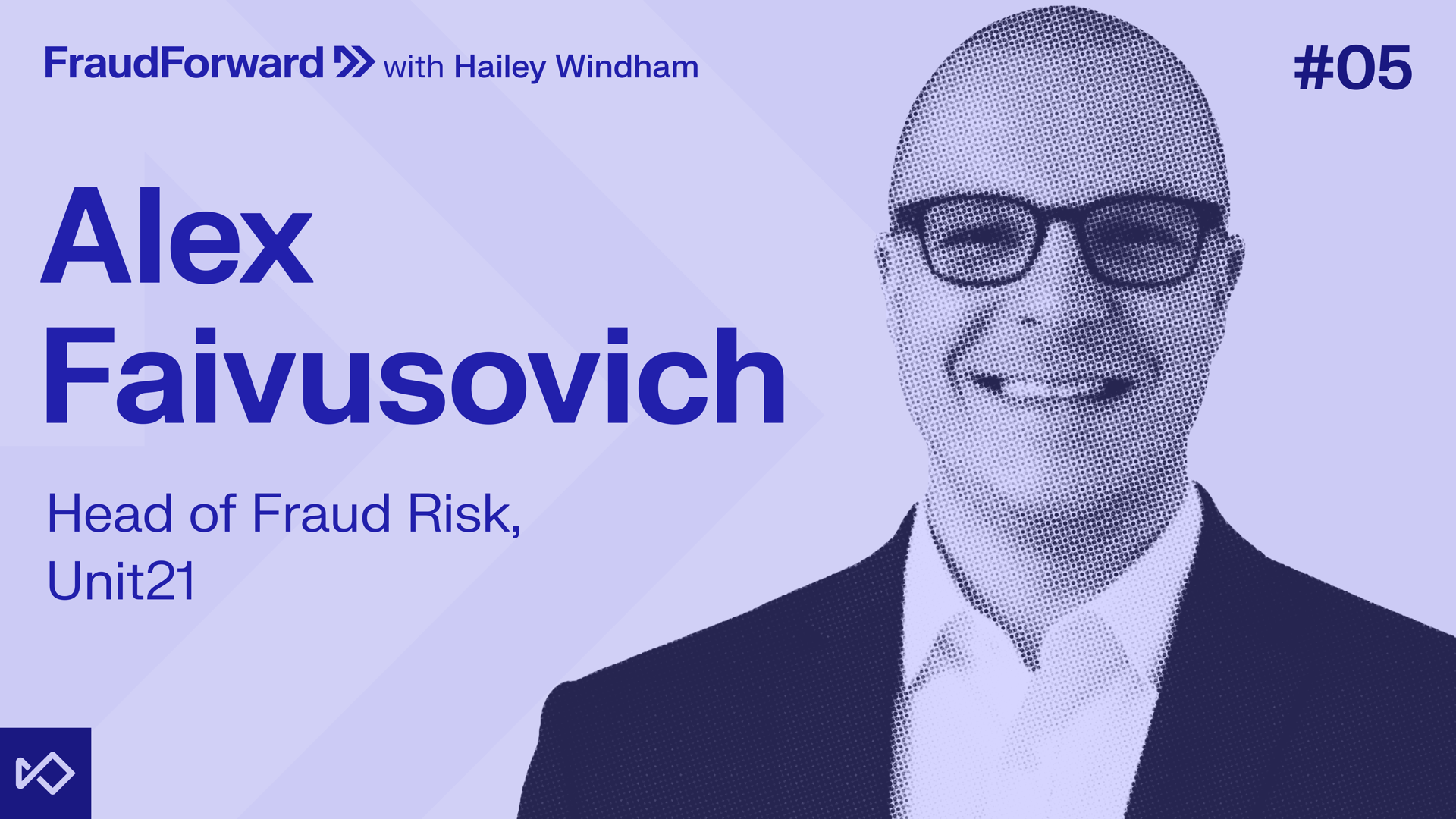
In this episode, I sit down with Alex Faivusovich to unpack how first-party fraud differs from external attacks and why it requires a shift in how we think about detection.
Instead of focusing only on single transactions, we talk about customer lifecycle monitoring and behavioral risk profiling.
Because when you zoom out and look at the entire lifecycle of an account, things start to make a lot more sense.
The pandemic accelerated digital adoption across financial services. Online dispute processes became easier and faster. At the same time, youth fraud trends and social media narratives around refund manipulation started spreading.
What used to look like occasional misuse has evolved into repeat patterns across accounts and institutions.
Alex and I explore how institutions can move beyond simple dispute misclassification and start looking deeper at:
- Account tenure risk analysis
- Onboarding behavior
- Cross-channel fraud behavior
- Refund abuse schemes that repeat across the lifecycle
We also talk about the ethical tension around broader fraud intelligence sharing and financial institution fraud accountability.
Because solving first-party fraud requires collaboration.
Data orchestration in fraud prevention, stronger KYC optimization, and real cross-functional collaboration help institutions respond in a balanced way while still protecting customers.
What you’ll hear in this episode
- The drivers behind rising first-party fraud across financial institutions
- Refund abuse and friendly fraud dispute patterns
- How customer lifecycle monitoring improves detection clarity
- The role of KYC optimization and onboarding risk signals
- Ethical challenges in broader fraud data collaboration
You should listen to this episode if
- Dispute management or fraud analytics falls within your responsibility
- Refund abuse schemes are increasing across accounts
- Lifecycle-based fraud controls are under review
- Your institution is evaluating customer lifecycle risk
If you liked this episode, be sure to subscribe and review the podcast on iTunes, Spotify, YouTube, or wherever you listen to podcasts. It really helps more fraud fighters find these conversations.
Episode notes & key takeaways
Before we double click on the notes, I want to reset the room for a moment.
First-party fraud can feel frustrating because it sits in a gray area.
The identity is real.
The customer is real.
The transaction is technically authorized.
But the behavior tells a different story.
First-party fraud Is behavioral, not accidental
One of the most important shifts we talk about in this episode is recognizing that first-party fraud is behavioral.
It is rarely impulsive.
Instead, it tends to evolve through repeated activity over time.
A typical pattern might look like:
- A small refund request or dispute
- A successful reimbursement
- A realization that protections work in the customer's favor
- Gradual escalation into repeated refund abuse or disputes
Unlike external fraud, nothing is technically compromised.
The identity is valid.
Authentication checks pass.
The account holder is the one initiating the activity.
That means traditional rule-based systems may not always catch these cases.
The signal is not inside one transaction.
The signal lives in behavior across the customer lifecycle.
When institutions treat each dispute as an isolated event, refund abuse and intentional dispute filing can quietly accumulate losses over time.
But when first-party fraud is evaluated through a lifecycle lens, patterns start to surface earlier and more clearly.
Leadership alignment also matters here.
When governance frameworks recognize first-party fraud as a defined behavioral risk category, teams gain clarity on how to investigate and respond consistently.
Customer lifecycle monitoring creates clarity
Managing first-party fraud effectively requires stepping back and looking at the full customer journey.
Customer lifecycle monitoring brings together signals from multiple stages of the account relationship, including:
- Onboarding behavior
- Account tenure risk analysis
- Dispute frequency
- Transaction patterns
- Cross-channel fraud behavior
Digital onboarding vulnerabilities and identity verification friction can shape early account activity.
For example, accounts that initiate disputes shortly after activation or show repeated refund behavior may indicate elevated lifecycle risk.
Individually, those signals might not look suspicious.
But when viewed together over time, they form a much clearer behavioral picture.
Data orchestration in fraud prevention plays a huge role here.
When onboarding data connects with dispute history and transaction monitoring signals, teams move from anecdotal observations to measurable patterns.
Decision-making becomes more grounded and far less reactive.
Without lifecycle visibility, institutions often default to short-term fixes.
With it, teams can address the underlying behavior.
Balancing accountability with trust
First-party fraud sits at a delicate intersection.
Institutions must protect themselves from refund abuse while still maintaining customer trust.
Move too aggressively and you risk damaging legitimate relationships.
Move too slowly and the misuse continues.
Friendly fraud disputes and intentional chargebacks often involve blurred intent.
That is why consistency matters.
Strong programs rely on:
- Clear dispute policies
- Documented review procedures
- Consistent communication with customers
- Lifecycle-based monitoring rather than single-event analysis
Losses from first-party fraud may not always appear dramatic in isolation.
But over time they compound.
Inconsistent handling can also create reputational risk and operational confusion.
Leadership plays an important role in reinforcing balanced accountability.
By investing in lifecycle-based controls and transparent governance, institutions reduce exposure while preserving long-term relationships.
And when teams view first-party fraud through the lens of behavior and lifecycle context, it becomes far more manageable.
Final takeaway
First-party fraud is not just a dispute management issue.
It is a customer lifecycle risk.
When institutions shift their focus from individual transactions to behavioral patterns across time, they gain clearer visibility into refund abuse schemes and friendly fraud disputes.
Lifecycle monitoring, stronger KYC optimization, and coordinated fraud data collaboration help organizations respond more effectively while still maintaining customer trust.
That balance is what sustainable fraud programs are built on.
The evolution of Banking on Fraudology
The mission stays the same:
- Elevate fraud prevention education.
- Strengthen banking community leadership.
- Support real operators inside community banks and credit unions.
- Build durable fraud community building frameworks.
- Advance fraud prevention thought leadership that is grounded, not hyped.
The future of banking fraud prevention depends on community.
The future of credit union fraud prevention depends on collaboration.
The future of fraud industry evolution depends on shared intelligence and values alignment.
We are leveling up.
And we are doing it together.
Stay vigilant, stay informed, and keep moving fraud forward.