


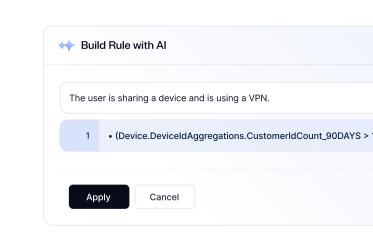


The rules engine is the system component that runs transactions and behavior against configured logic and thresholds to generate alerts. It is where scenarios, thresholds, and typologies actually get turned into working detection, and its configuration directly drives your alert volume, false-positive rate, and coverage.
What is a rules engine, in plain English?
A program's detection ideas are worthless until something actually runs them against real activity. The rules engine is that something: the system component that evaluates transactions and behavior against configured logic and thresholds, and generates alerts when the conditions are met. It is the machinery that takes an abstract typology and makes it fire.
Everything a program knows about risk gets encoded here as scenarios, thresholds, and rules. A concern about structuring becomes a rule watching for sub-threshold cash; a concern about pass-through activity becomes a velocity scenario. The engine is where those definitions live and execute, so its configuration is not a technical detail, it is the operational shape of the whole detection program.
Because of that, the engine's settings directly drive the numbers operators live by: how many alerts get generated, what share are false positives, and what risk is covered at all. A well-tuned engine surfaces real risk without burying analysts; a poorly configured one does the opposite, for better or worse.
How a change reaches production safely
- Propose — Define the change. A new scenario or a threshold adjustment is specified, with the risk rationale behind it documented.
- Test — Backtest and sample. The change is backtested against historical data, with above-the-line and below-the-line testing to judge its effect.
- Govern — Review and approve. The change goes through governance and sign-off, so no one edits detection logic unilaterally.
- Log — Record in the audit trail. The what, who, and why of the change are captured, so the engine's history can be reconstructed later.
What it looks like in practice
In practice
An engineer is asked to quiet a noisy scenario that is flooding analysts with false positives. Under pressure, they raise its threshold directly in the rules engine one afternoon, with no backtest, no review, and no log entry. Alert volume drops and everyone is relieved.
Three months later a look-back finds that the quiet edit did not just cut noise; it also switched off detection of a real structuring pattern that had been landing just above the old line. Nobody noticed because the change was never governed, tested, or recorded. Had the edit gone through backtesting, below-the-line testing, and the audit trail, the coverage gap would have been caught before it reached production.
Why it matters to operators
The rules engine is where detection is most powerful and most fragile at once. Its configuration decides alert volume, the false-positive rate, and coverage, so a good change can sharpen the whole program and a careless one can quietly cripple it. Undocumented rule changes and untuned thresholds are frequent causes of both missed activity and analyst overload, the two failure modes a monitoring program most wants to avoid.
The danger that keeps managers up at night is the quiet, unreviewed edit. A single change to the engine can silently switch off detection that nobody notices for months, until a look-back or an exam surfaces the gap. That is why changes have to be governed, tested with backtesting and above- and below-the-line methods, and logged in the audit trail. The engine is too central to let anyone tune it in the dark.
Operator notes
- Govern every change. No one should edit detection logic unilaterally; changes need review and sign-off.
- Backtest before you ship. Test a change against historical data, with above- and below-the-line sampling, to see its real effect.
- Log it in the audit trail. The what, who, and why of each edit must be recorded so the engine's history can be reconstructed.
- Beware the quiet edit. A single unreviewed change can silently disable detection nobody notices for months.
- Tune thresholds deliberately. Cutting noise by raising a threshold can also open a coverage gap; measure both sides.
Quick questions
How is a rules engine different from a scenario?
A scenario is a specific piece of detection logic, like a rule watching for sub-threshold cash. The rules engine is the system that runs all the scenarios against activity and generates alerts. The engine is the platform; scenarios are what you configure on it.
Why does engine configuration drive false positives?
Because the thresholds and logic decide what alerts. Set them too tight and you flood analysts with noise; too loose and you miss risk. The false-positive rate is a direct output of how the engine is configured.
What is the risk of an undocumented change?
A change that is not logged can silently alter or disable detection with no record of who did it or why. If it opens a coverage gap, the gap can go unnoticed for months until a look-back or exam finds it, and the missing audit trail makes it hard to explain.
How should engine changes be controlled?
Through governance and sign-off, backtesting against historical data, above- and below-the-line testing, and full logging in the audit trail. This ensures changes are deliberate, their effects are understood, and their history is reconstructable.
Can a rules engine use models, not just rules?
Yes. Many modern engines combine static rules with scoring models. Either way, the configuration governs alert generation, and both rules and models need the same discipline of testing, governance, and validation.
Go deeper
- FinCEN ↗ — The US financial intelligence unit. Bank Secrecy Act rules, advisories, and SAR and CTR guidance.
- FFIEC BSA/AML Examination Manual ↗ — The manual US examiners use to assess BSA and AML programs.