

Fraudologyへお帰りなさい。
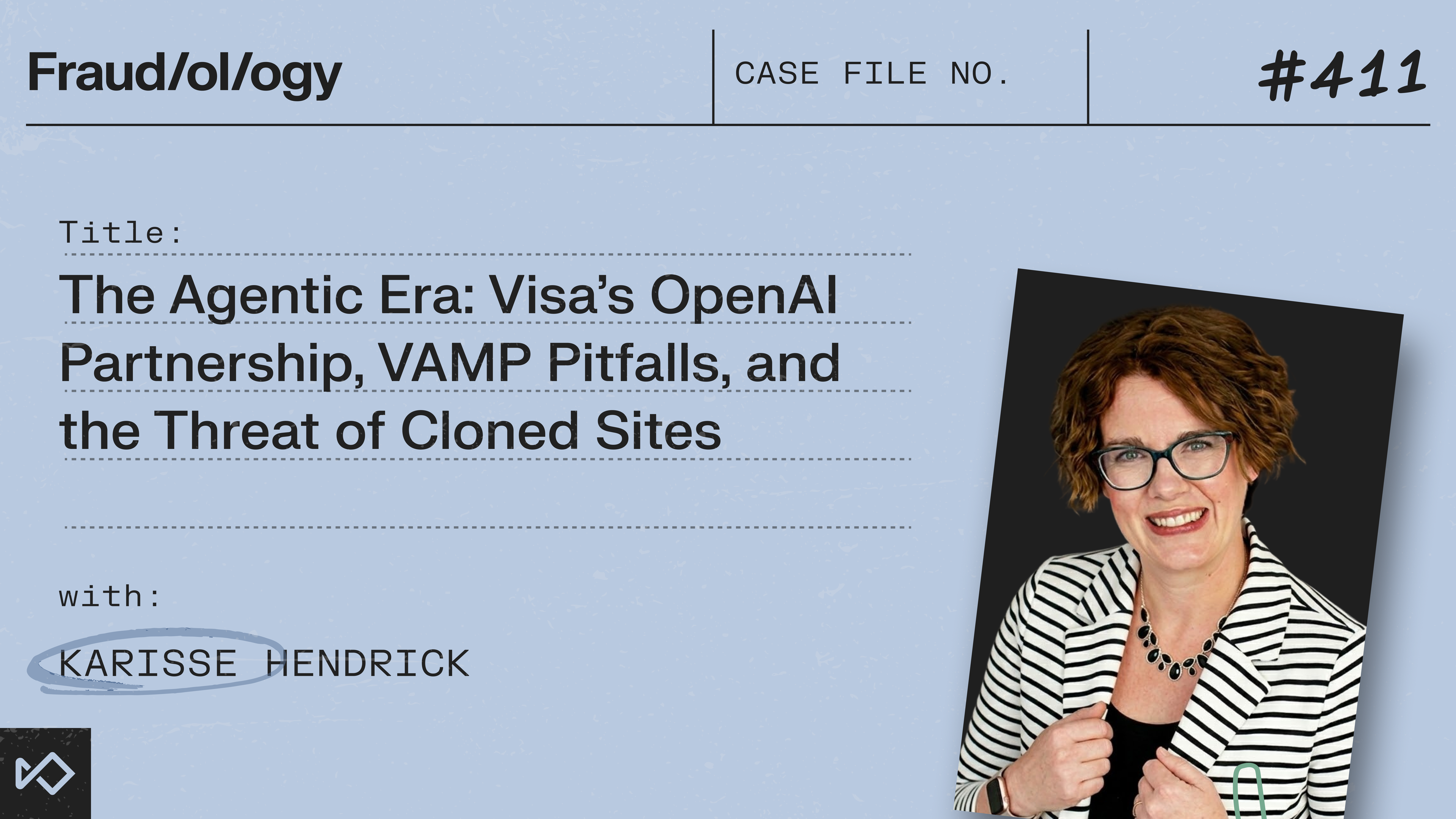
今回のソロエピソードでは、エージェント型のeコマース、特にAIショッピングエージェントが消費者に代わって実際に購入を行うようになったときに何が起こるのかについて掘り下げていきます。これはしばらくの間、とても未来の話のように聞こえていたトピックのひとつです。カンファレンスではパネルディスカッションが開かれ、大きな予測もたくさん語られ、「いつかこうなる」という話題も多くありましたが、不正対策チームが今すぐ具体的に取り組めることはあまり多くありませんでした。
その状況は、Visa と OpenAI が AI コマース向けの決済インフラを構築するための提携を発表したことで一変しました。Visa の決済機能が OpenAI の各種エクスペリエンスに組み込まれ、ChatGPT を使ったショッピングや AI 主導の取引がより現実的なものになっていくと、この新しいチャネルに伴う不正、チャージバック、責任範囲、そしてオペレーション上のリスクについて、加盟店は理解しておく必要が出てきます。
そして、ここで一度立ち止まり、非常に実務的な問いを投げかける必要があると私は考えています。AIエージェントがミスをした場合、誰が責任を負うのでしょうか?カード保有者がエージェントを承認したものの、そのエージェントが誤った商品を購入してしまった場合はどうなりますか?カード保有者が実際のチェックアウトから一歩離れた立場にいるとき、加盟店はどのようにしてその取引が不正ではなかったと証明できるのでしょうか?そして、エージェントによるeコマースのチャージバックやTC40関連の不正が、現在の仕組みでは想定されていない形で発生し始めたとき、VAMPの不正監視はどうなってしまうのでしょうか?
このエピソードの主なテーマは、すでに表れ始めている2つのリスクです。第一に、エージェント型eコマースの責任範囲とCNPチャージバックの責任範囲は、AIショッピングエージェントの振る舞いにまだ対応できていません。第二に、クローンサイト詐欺やAI検索を悪用したショッピング詐欺によって、カスタマーサービスの新たな頭痛の種やTC40関連の問題、そしてエンタープライズ向けeコマースチームにとってのマーチャントリスク管理上の新たな課題が生まれる可能性があります。
このエピソードでお届けする内容:
- Visa と OpenAI の提携によって、エージェント型 e コマースが加盟店にとってどれほど現実味のあるものになるのか。
- AIショッピングエージェントが、新たなCNPチャージバックの責任やフレンドリーフロードによるチャージバックを生み出す可能性。
- カード会員が自分で購入手続きを完了せず、代理人に指示して行わせた場合、なぜ加盟店はコンペリング・エビデンス3.0を活用するのに苦労する可能性があるのか。
- なぜエージェント型ECにおける責任問題には、損失が拡大する前に新たな枠組みが必要なのか。
- クローンサイトによる詐欺やオンラインショッピング詐欺は、AIエージェントが最安値を探すようになると、どのように深刻化し得るのか。
- なぜTC40不正やVAMP不正モニタリングが大手小売業者にとって重大な問題になり得るのか。
- 不正対策の責任者は、今すぐアクワイアラー、カードブランド、カスタマーサービスチーム、そしてITチームに何を尋ねるべきか。
このエピソードは次のような方におすすめです:
- マーチャント向け不正防止やEC不正対策に携わっており、AIエージェントコマースが今後どのような方向に進んでいくのかを理解する必要がある。
- チャージバック、VAMPモニタリング、TC40の確認、またはCNP不正対策の責任を担っている。
- 銀行、イシュア、カードブランド、または決済会社で働いており、なぜ加盟店が懸念しているのかを理解したい。
- エージェント型チェックアウトやAI決済、エージェント型決済が、不正対策業務をどのように変える可能性があるのかを理解しようとしている。
- ChatGPTコマース、AI検索を悪用したショッピング詐欺、クローンサイトのリスクについて、実務的な不正対策の視点を知りたい。
エピソードの概要と主なポイント
エージェント型eコマースは、もはや将来の話題にとどまるものではありません
しばらくの間、エージェンティック・コマースは、皆が話題にしているものの、実際に不正対策チームが次に何をすべきかを明確に示せる人がほとんどいないテーマのように感じられていました。予測や理論的な議論は数多くあった一方で、実務に落とし込める示唆はごくわずかしかありませんでした。
Visa と OpenAI の発表によって、その認識は私の中で変わりました。
Visa が自社の決済機能を OpenAI のエクスペリエンスに統合すると言い、さらに ChatGPT を使ったコマースが実際の AI 主導の取引に近づきつつある今、これは加盟店が真剣に受け止めるべき事態になっています。だからといって、明日からすべての消費者が AI ショッピングエージェントを使い始めるという意味ではありません。しかし、決済のレールが着々と敷かれているということではあり、そして一度レールが敷かれれば、不正やチャージバックの問題はたいてい非常に早い段階で顕在化します。
エージェント型のeコマースにおいてこれが重要になる理由は、AIエージェントが人間とまったく同じように振る舞うわけでも、従来型のボットと同じように振る舞うわけでもないからです。AIエージェントは、消費者の指示を受けて行動し、指示内容に適応し、複数のウェブサイトを横断的に検索し、価格を比較し、購入手続きまで完了させることができます。これにより、カード保有者と加盟店のあいだに新たなレイヤーが生まれるのです。
現在のチャージバック制度は、AIショッピングエージェントに対応できていない
エージェント型のeコマースについて私が最も懸念している点の一つは、現在のチャージバックの枠組みがその前提で設計されていないことです。現状では、取引がカード非対面(card-not-present)の場合、一般的に責任は加盟店側にあります。これは従来型のCNP不正のシナリオでは理にかなっているかもしれませんが、AIエージェントが実在のカード名義人の代理として行動する場合、状況ははるかに複雑になります。
カード名義人がエージェントに「2つ買って」と指示したのに、エージェントが20個購入してしまった場合、加盟店はいったいどうすればよかったのでしょうか? エージェントが間違ったフライトを予約したり、不適切な商品を選んだり、利用者の指示を誤解したりしたとき、加盟店は購入時点でそれをどうやって知ることができたでしょうか? 加盟店に超能力があるか、不正対策チームの隣に霊能者でも座っていない限り、それが将来紛争になると事前に見抜く現実的な方法はほとんどないかもしれません。
だからこそ、エージェント型eコマースにおけるチャージバックは、これほどまでに懸念されているのです。
加盟店は、カード会員が「自分はエージェントに指示したが、その後気が変わった」あるいは「エージェントが誤った購入を行った」と主張する異議申し立てを受ける可能性があります。こうしたケースは、現在の不正利用、フレンドリーフラウド、あるいは Compelling Evidence 3.0 のいずれのワークフローにもきれいには当てはまりません。そして、加盟店が既存の再提示要件を満たせない場合、たとえその購入がカード会員により承認されたエージェントによって行われたものであっても、資金を失うことになります。
それが責任のギャップです。
カードブランド、エージェント型プラットフォーム、決済ネットワークがAIによる購入に関する責任の枠組みをより明確に整備しない限り、加盟店は本来防ぎようのなかった損失を抱え込まされることになるでしょう。
VAMPのリスクにより、エージェント型eコマースは加盟店にとってさらに危険性が高まる
これは、個々のチャージバックで損失が出るという問題だけではありません。より大きな懸念は、これらの紛争がVAMPの不正監視にどのような影響を及ぼすかという点です。
VAMPはすでに加盟店にとって深刻な問題となっています。チャージバックやTC40は実際の財務リスクを生み出す可能性があり、以前のVisa監視プログラムで加盟店が慣れ親しんでいたような猶予期間は同じようには存在しません。いったん加盟店がしきい値を超えると、罰金や手数料が急速に積み上がっていく可能性があります。
そこにエージェント型のeコマースがさらに重なってくるのです。
もしAIショッピングエージェントによって紛争が増え、たとえ加盟店に何の落ち度もない取引であっても、チャージバックは依然として加盟店の不利益としてカウントされる可能性があります。支払いフローの中でエージェントによる取引が明確に識別されていない場合、加盟店はそれらの取引を別のリスク区分に切り分けられないかもしれません。さらに、AIが起点となる取引に対して新たな責任分担の変更や異議申し立て(リプレゼンテーション)のプロセスが用意されていなければ、加盟店は、自ら識別することすら難しいチャネルから生じるリスクを抱え込むことになります。
今まさに注意を向けるべきなのは、その部分です。
Visa、Mastercard、OpenAI、そしてその他すべてのAIコマースプラットフォームは、損失が拡大する前に、この問題のマーチャント側についてよく考える必要があります。エージェント型プラットフォームがミスを犯した場合や、消費者がエージェントを承認したうえで結果に異議を唱えた場合に、マーチャントが自動的に金銭的な責任を負うのは筋が通りません。
チャージバック制度はこれまで決して完全に公平だったわけではありません。しかし、これは新しいチャネルであり、新しいチャネルには新しいルールが必要です。
マーチャントには、エージェントによる取引を識別する手段が必要です
もう一つの問題は可視性です。現時点では、ほとんどのマーチャントは、その取引が人間、ボット、あるいはAIショッピングエージェントのどれによって行われたのかを確実に見分ける手段を持っていません。
取引の種類を特定できなければ、それに応じた別のリスク戦略を構築することはできません。異なるルートで処理することもできません。チャージバック率を測定することもできません。エージェント型チェックアウトがモバイルチェックアウトやウェブチェックアウトと異なる挙動をするかどうかを検証することもできません。エージェント型の支払いを通常のEC取引と切り分けることもできません。そして、見えないチャネルに対して強力な加盟店向け不正防止戦略を構築することもできません。
一部の新興ベンダーはAIエージェントの検知に取り組み始めていますが、レガシーツールを使っている多くのマーチャントには、エージェントによるトランザクションを明確に識別する手段がありません。タイミング情報だけでは、これらのAIエージェントが消費者行動を模倣できるため、十分とはいえません。デバイスシグナルも、エージェントが実在するデバイスIDやエミュレーターを利用する可能性があるため、分かりやすいとは限りません。また、決済フローそのものからは、トランザクションがエージェント由来であることが、まだマーチャントに伝わらない場合があります。
だからこそ、将来的にはエージェント主導のコマースを、独立したチャネルとして考える必要が出てくるのではないかと私は思います。
私たちはすでに、ウェブとモバイルを別物として考えています。エージェント主導のeコマースも、同じように切り分けて考える必要があるかもしれません。AIエージェントは、人間と同じようにウェブサイトとやり取りしないため、異なるチェックアウトフロー、異なるリスクフロー、そして異なる種類のシグナルが必要になる可能性があります。ボタンの位置を誤って「幻視」してしまうかもしれません。ページの内容を誤解するかもしれません。間違った商品を選んでしまうかもしれません。マシンには筋が通っていても、現在の加盟店の不正防止コントロールとは噛み合わない経路をたどる可能性もあります。
販売業者がチャネルを特定できるようになるまでは、まったく別の世界向けに作られたツールでエージェントによるリスクを管理しようとして、行き詰まり続けることになるでしょう。
クローンサイトは、最もお得な取引を見つけるように訓練されたAIエージェントの存在により、より大きな問題になる可能性があります
このエピソードで取り上げる2つ目の大きなリスクは、クローンサイトによる詐欺です。
詐欺師たちは昔から、偽の通販サイトや偽の加盟店サイト、フィッシングサイトを好んで利用してきました。これは新しいことではありません。変わってきているのは、ウェブサイトをクローンして、それらしく機能しているように見せることがどれほど簡単になったかという点です。AI は、詐欺師が商品ページや画像、チェックアウト画面、ブランドの見せ方を、これまでよりはるかに速く複製するのを助けてしまいます。
それにAIショッピングエージェントを組み合わせてみてください。
消費者がAIエージェントに「この商品で一番お得なものを探して」と指示したとき、そのエージェントはいったい何を最適化しているのでしょうか?多くの場合、それは価格です。そして偽の通販サイトは、実際には本物の商品を届けるつもりがないため、最安値を提示するのがとても得意です。彼らの狙いは、カード情報を盗み取ったり、個人情報を収集したり、不正な取引を処理したり、購入者を詐欺に誘導したりすることなのです。
それは非常に明白な問題を生み出します。
AIエージェントは、ある商品の最安値版のように見えるものを見つけ、消費者をクローンサイトへ誘導してしまうかもしれません。消費者は、それがAIツールのおすすめであるために信用してしまう可能性があります。そのサイトは本物のように見えるかもしれません。価格も驚くほど魅力的に見えるかもしれません。そして消費者は、自分が本物の販売業者から購入したのだと信じてしまうかもしれません。
その後、商品が届かなかったり、偽物の商品が送られてきたり、カード情報が不正利用されたりする可能性があります。
そして最初にその被害を耳にするのは誰でしょうか?多くの場合、本物の販売業者のカスタマーサービスチームです。
たとえその加盟店が取引を処理しておらず、代金を受け取っていなかったとしても、顧客は自分がその加盟店から購入したのだと信じてしまう場合があります。その結果、加盟店にはオペレーションコストの増加や顧客の不満、ブランドイメージの毀損に加え、解決に協力しなければならない新たな不正被害という問題が生じます。
TC40 不正利用と偽のディスクリプタは、あなたの売上でなくても VAMP の問題を引き起こす可能性があります
クローンサイトの問題は、単なるカスタマーサービス上の課題にとどまりません。TC40 や VAMP の問題にも発展し得ます。
TC40 はマーチャント ID だけでなく、ディスクリプタにも紐づけられています。つまり、不正な加盟店が、大手小売業者の名前に似たディスクリプタに余分な単語や数字、修飾語を付けて使用した場合、本来は自分のものではない TC40 の発生が、正規の加盟店側で記録されてしまう可能性があるということです。
それは大手小売業者にとって大きな問題です。
偽サイトが本物のブランド名で始まるディスクリプタを使用した場合、正規の加盟店はそれらの取引を特定し、自社のものではないことを証明しなければならない可能性があります。VAMP 環境では、そのタイミングが重要になります。加盟店は、自分たちが VAMP リストに載った場合に、アクワイアラがどれくらいの早さで通知してくれるのかを把握しておく必要があります。なぜなら、アクワイアラに通知された時点でカウントダウンが始まり、加盟店がその事実を知らされる時点ではない可能性があるからです。
つまり、加盟店は主体的に行動する必要があります。
VAMPの不正監視を担当している場合は、今すぐアクワイアラーに相談してください。どれくらいの速さで通知を受け取れるのか確認しましょう。どのようなTC40データを受け取れるのか尋ねてください。不正なディスクリプタを特定できるだけの詳細情報が得られるかどうか確認しましょう。あなたのマーチャントIDに属さない取引を削除する手続きがどうなっているのかも必ず聞いてください。
なぜなら、エージェント型のeコマースによって、AI検索を悪用したショッピング詐欺やクローンサイトへのトラフィックが増えると、加盟店のTC40データにノイズが増える可能性があるからです。そして、そのノイズがすぐに除去されなければ、コストがかさむ恐れがあります。
カスタマーサービス、IT、そして不正対策チームは連携して備える必要があります
このエピソードから得られる最も実践的な教訓の一つは、この問題を不正対策チームだけに任せておくことはできないという点です。
エージェント型のeコマースやクローンサイトによる詐欺がより大きな問題になった場合、カスタマーサービスチームは自分たちが何を見ているのかを理解しておく必要があります。お客様が「あなた方のウェブサイトで注文したはずだ」と主張して連絡してくるのに、あなたのシステム上にはその注文が存在しない、という状況が起こり始めるかもしれません。事前にクローンサイトの問題について説明されていなければ、これはお客様にとっては混乱を招き、サポートチームにとっては大きなストレスになります。
偽のウェブサイトは、DNS やホスティングのチャネルを通じて報告・エスカレーション・削除を行う必要がある場合があるため、IT チームもこの議論に参加する必要があります。法務、ブランド保護、不正対策、カスタマーサービス、セキュリティなどの各部門が、迅速に連携しなければならない可能性があります。
顧客とのコミュニケーションも同様に重要です。
特に買い物が集中する時期や新商品の発売時期、ホリデーシーズンなどには、加盟店は顧客に対して公式サイトや公式アプリに直接アクセスするよう注意喚起する必要があるかもしれません。そうしたメッセージだけで問題を完全に解決することはできませんが、リスクの一部を軽減することはできます。
ここでは、マーチャントのリスク管理を部門横断的な取り組みにする必要があります。エージェンティック・コマースは単なる不正対策の問題ではありません。決済、チャージバック、カスタマーサービス、ブランド保護、IT、法務、そして顧客体験にまで関わるものです。
最終的なポイント:
エージェント型のeコマースは、理論段階からインフラ段階へと移行しつつあります。そして一度インフラが整えば、不正行為が必ずついてきます。
Visa と OpenAI の提携は、AI を活用したコマースをより簡単かつスケーラブルにする可能性がある一方で、エージェント型 e コマースにおける責任、AI による購入の責任、CNP(カード非対面)チャージバックの責任、そして VAMP における加盟店のリスクといった重大な論点も提起しています。同時に、AI 検索を悪用したショッピング詐欺やクローンサイトによる不正は、AI ショッピングエージェントを、見た目は正規で価格も魅力的だが、消費者と加盟店に深刻な被害を与える偽の小売サイトへと誘導してしまうおそれがあります。
ですから、もしあなたが加盟店側の不正対策責任者であるなら、今こそ耳の痛い問いを投げかけ始めるべき時です。あなたはエージェントによる取引を見分けられますか?エージェントによる決済と、通常のウェブやモバイルでの取引を切り分けられますか?チャージバック担当チームは、エージェント型ECに関するチャージバックへの対応方法を理解していますか?VAMP関連の問題が発生したとき、アクワイアラは十分なスピードであなたに通知してくれますか?あなたのチームは、TC40データの中から偽のディスクリプタを特定できますか?存在しない注文について顧客から電話があったとき、カスタマーサービスはどう対応すべきか理解していますか?
このチャネルは確実にやって来ます。問題は、加盟店、イシュア、アクワイアラ、カードブランド、そしてAIプラットフォームが、損失が拡大する前にルールを整備するのか、それとも拡大した後になってからなのか、という点です。
エピソードのリソースとリンク
つながるKarisse Hendrick | LinkedIn
- Fraudologyポッドキャストのホスト
- 受賞歴のあるサイバー詐欺対策の専門家
- Eコマース不正防止コンサルタント
- スタートアップアドバイザー、基調講演者、そして
- フォーチュン500企業のマーチャント向けコンサルタント
Episode transcript

Karisse Hendrick
00:02
Welcome to Fraudology Podcast, where we dive into the science and study of online fraud from the perspective of an e-commerce fraud fighter. I'm Karisse Hendrick.
Karisse Hendrick
00:12
Welcome back to the Fraudology Podcast. This will be another solo episode. I think if you've been listening along in chronological order, you can guess that I've been kind of doing every other one with a guest and one on my own today. There's a topic that I want to dive into, and that is AI agentic commerce, specifically. So purchases made by AI agents in the online world. And if you work for a bank and you're like, oh, this is for merchants, hold tight because this will impact you as well. And if you're from a card brand, please listen because we need your help. Before that, I'm just going to do a reminder that the Merchant Fraud Alliance first inaugural conference. So I guess that's a double, double meaning there. So inaugural conference is October 6th and 7th in Chicago. We have some pretty optimistic goals for how many people are going to come, but we also have some really killer ambassadors that have from companies such as Booking and Best Buy and Walmart and Google and so many more that I can think of that have stepped up to be part of the planning committee and the board essentially, and have also pledged to come to the conference. So we have a great group of people that are coming already. They'll also. A lot of them will be speaking as well. We just met for a second time this past week, going through all the topics and starting to address some of the speakers. And we have, you know, someone from PlayStation, someone from Booking talking about how they're integrating AI into fighting fraud and training their analysts to utilize AI in different ways, whether it's for data analytics, reporting, dashboards, things like that. We have someone from Best Buy talking about working cross functionally with other departments. She literally is the best person, I think, that could speak to this topic. A good friend of the podcast, Holly Sandberg, is going to be talking about creating an executive score chart or scorecard for your executives and really explaining managing up and really quantifying fraud for them in ways that they understand. I had a chance to see her speak on this topic at the Assertify User conference last month, and it was really good. So those are just off the top of my head, a few of the sessions I can think of that you'll want to be there for. We're also doing an AI bootcamp on October 5, the day before the conference starts. And that's only open to people that register. You know, it's in the order you register. We're going to have about 50 slots, so I know that there's a few more spaces open. So make sure that you register soon. And if you're listening to this before July 1st, tickets are only 495 for merchants. We aren't selling vendor tickets. We have a select number of sponsor companies that are attending, but we won't be selling vendor tickets. This is for merchants only. Okay, that's enough of a plug for my conference, but that is literally all that I'm like breathing and doing right now. So I had to give a little bit of an update. I want people to show up. I want it to be as good of an experience as it can be for everyone. If you have known me at all. I try to make sure that everyone gets their time and their money's worth of anything that I work on. And this podcast is a good example. It's free and I still give out a lot of information. So, you know, just assume that the conference will be even better than a podcast episode. All right, I really am going to turn to agentic commerce now. I've, you know, I've had Robbie McDermott on the podcast talking about liability for agentic commerce. I've talked a little bit about it here and there, but I've kind of shied away from it for a few reasons. One is there was a conference in the spring that really focused a lot on agentic commerce, but there wasn't any news. It was all kind of pontification and future forward looking. And you know, the feedback I heard from almost everyone I talked to about it was there was no, there were no takeaways because we just aren't there yet. Then we saw OpenAI scrap their project. And I think, I think I made mention of that on the podcast on a solo episode a few weeks ago where they scrapped their project for, I can't remember what they called it, but it was where they had AI agents finish a purchase. So they were going to be the merchant of record. And I think they realized that liability rules as well as other issues. They didn't want to get involved, so they scrapped that project. I think also adoption was really low, so all of those things combined. I haven't really talked about it because I haven't felt like there's been a lot to say. I haven't known if it's actually going to be a thing. Yes, it's been talked about a lot. But it, you know, is going to be adopted by more than 5% of consumers. Those of them I open questions. But then an announcement came out about two weeks ago that made me think, okay, this is probably happening. I'm going to go ahead and read the LinkedIn post that I wrote about it to start just because I think I did a pretty good job of summarizing this. Last week it was announced that Visa and OpenAI are partnering to build infrastructure designed to make AI commerce secure, scalable and seamless. That's in quotations. Those are their words in this statement. Visa also said that Visa's payment capabilities will be integrated into OpenAI experiences, giving developers and merchants a streamlined way to accept Visa payments initiated by AI agents. They also said Visa will deliver the underlying global network payment tokenization authorization, agent identification and fraud monitoring infrastructure to support secure and trusted AI initiated transactions. So I'll stop there from my post and just say that, you know, the fraud monitoring isn't necessarily from the merchant perspective. It's just the general fraud monitoring that Visa does, you know, looking for card testing, that type of thing. Also on the issuer side, their fraud monitoring, I it doesn't say that Visa is doing anything new as far as fraud monitoring. So I wouldn't take that statement to mean, oh, they're going to do fraud monitoring on agentic transactions so I don't have to.
Karisse Hendrick
06:39
I would not at all read in that into it. So now that Visa and you know, OpenAI, who you know is behind ChatGPT, are partnering with each other. That's a lot of power. That's a lot of brand power, but also just a lot of, you know, they're lending the visa rails to OpenAI transactions, to transactions that are initiated in ChatGPT. So some of the use cases would be, you know, if I wanted to book the best flight for the cheapest price. But I didn't want to search all of the, you know, travel agent online travel agency sites. I didn't want to use Google. I and maybe I had a little time, so maybe I had a week. I could create a prompt in ChatGPT to ask it to, you know, create an agent to look for the best Airline price from Seattle, Washington to San Francisco, California. And you know, you can set as many parameters as you want, right? Like I want my departure time to be after 10am. I want my arrival time to be before 9pm. I want, you know, a window seat, I want an aisle seat. But a lot of people aren't going to do all of those qualifiers. You can, but they may not. So you know, that opens it up to a lot of issues right. What if my, you know, and then my final prompt for that would be, find the best rate in the next week and book it on my behalf. Here's my card information. Here's, you know, my TSA pre check number or whatever you need to do, just do it for me. Others would be around, you know, sale prices, the best, you know, best deal on a sweater or a pair of shoes, or what if there's a drop coming of new sneakers. It's kind of similar to a bot, but it's different where you're directing an agent to do it for you rather than a bot, so it can adapt more. There's a lot of issues that I see with this and we're going to talk about another issue after I talk about this first one. But, from a chargeback perspective, this was really scary to me because at the end of the day, the VISA infrastructure does not support agentic e-commerce chargebacks.
Karisse Hendrick
08:50
There's no process for them, there's no verbiage for them. There's nothing. There are chargebacks that are going through right now to merchants that are very obviously, you know, were initiated by an agent. Either the, you know, cardholder says so in their statement or the merchant can tell it was created by an agent and not a person. There's no guidance for. So the merchant is getting those chargebacks. The liability is working the way it always has where it's, if it's card not present, it's on the merchant. There's no additional liability. You know, hey, if it's, if the agent makes a mistake or it books something that the cardholder didn't want it to, or it orders 20 items instead of two, all of those different scenarios. There's no additional guidance for where liability goes. So it falls on the merchant. And I'll read what I wrote in my LinkedIn post and then I'll go a little bit further about this too. So I said there are two things I want to highlight about this announcement from the merchant perspective. Number one, and this is a little, you know, a little bit what I just said. But there are no stated changes to the chargeback liability framework for CMP transactions. This most likely means that when mistakes are made, like an agent orders the wrong thing or too much of one thing, these cardholder disputes will fall to the merchant to repay to the consumer. Even if there was nothing a merchant could have done to know it was a mistake or prevent it at the time of a transaction. The reason I said that is the whole point of the CMP liability Rules has been, well, merchants should be able to detect fraudulent transactions before they occur. So therefore they have the liability rules. In this case, it's similar to what we call friendly fraud. Right. If the cardholder information validates and it looks like the cardholder initiated the transaction, and the cardholder was involved in the transaction they initiated the agent, that type of thing, it still falls on the merchant.
Karisse Hendrick
10:50
Even though there was nothing, aside of having superpowers or a psychic on hand, there's nothing they could have done to say, oh, that one order is going to come back as a chargeback, or, you know, the cardholder told the Agent to buy two, not 20, so we should cancel 18 of these. There's nothing a merchant can do. However, they're still liable. So I said, we also need to consider that more chargebacks for merchants equals a higher risk for VAMP infractions. This could mean more fines, fees, and issues with acquirers that are outside the scope of prevention for CNP merchants. So with VAMP, which man did we have a good webinar with Anoush at Visa for MFA? It was a couple weeks ago. I think it's available through About Fraud. I actually haven't asked PJ or Ronald about that, but it was recorded. I know that it was so good. And we're actually going to have a second one in August because there were just. There was so much engagement from the audience that we didn't get through everything that we needed to or wanted to or that the merchants had asked us to. Anyway, that's a side note about VAMP, but, you know, VAMP is real, and your acquirers are now managing your risk. And the more chargebacks you have, the higher risk for VAMP infractions. Vamp is not cheap. And there's no. There's no trial month. There's no safety month. That used to be that you had two to three months before the VFMPs or VDMPs would charge fines. That doesn't happen anymore. There's now, it's the first month that you go over that 1.5%, you occur $8 per TC, 40 and per chargeback. And that adds up real quick. So there's, you know, there's no wiggle room. There's no safety time. It's just instant. So it is something to be considered. But then I put my take and I said, my hope in asterisks is that visa and OpenAI rework the liability for these circumstances to require the agentic platform OpenAI in this case, to take financial liability for agent mistakes.
Karisse Hendrick
12:56
Do I know that that is extremely optimistic and probably not likely. Yeah, I do, but I at least need to call it out. I felt the need to call it out and say, hey, merchants shouldn't be responsible for agentic mistakes. What if it's a mistake on the developer's side? You know, there's nothing a merchant could have done to stop that, but yet now they have to pay back the transaction. Doesn't make a lot of sense, doesn't seem fair, which, I mean, the chargeback system has never been fair. My grandmother used to say if I ever said something wasn't fair, she would say, you know, the fair only comes once a year, meaning that nothing's fair and the county fair is the only thing that exists. I know the chargeback system isn't fair, but we're opening a new channel. I just saw a good presentation from a startup recently where they talked about, you know, we have the e-commerce channel or the web channel, we have the mobile channel and now we're going to have the agentic channel. And the agentic channel should go through a different flow because it doesn't, you know, recognize the website in HTML format the way that human eyes do. And you know, they often will hallucinate where a button is or it will, you know, order the wrong thing because they think that button's over here or it just. Agents can't navigate websites the way that humans can. And so there needs to be a more agent friendly site where maybe humans can't understand it, but agents will know exactly, exactly what to do and where to go. I thought it was an interesting take because then also your fraud and risk decisions would be different as well if you are able to parse out the agentix transactions into their own bucket and look at the data on those. So yeah, that is something to, you know, consider. Right now we don't have an agentic channel. There is a company trying to build one right now. Visa doesn't have any way for merchants to identify in the payment flow that a transaction was initiated by an agent. Maybe that will change once their partnership with OpenAI goes through, but right now they don't. I only know of maybe two vendors on the merchant side that are really able to identify agentic orders.
Karisse Hendrick
15:12
Most of the merchants using legacy tools, if not all of them, have no way of, you know, they've done so many tests, transactions on every different agentic site and then, you know, looked on the back end for any identifiers of what, you know, how they can tell that an order was placed through ChatGPT. And timing doesn't matter anymore because these agentic platforms are trying to mimic consumer behavior so the transactions are approved so they aren't moving fast. Otherwise they get caught up in bot detection. There's no device difference. They're using real device, you know, IDs and emulators. There's no way right now to identify it. Unless you have maybe one of two tools that are still pretty new. Yes, Sardine is one of them. I got a one on one demo from Supes, actually the CEO of Sardine, while at a conference this spring on exactly how they can detect an AI agent. And it was really fascinating. But I know of another company that is able to do that as well. But my whole point being right now there's no way to tell if it was an agentic transaction on the merchant side. And there's no additional liability shift for merchants when errors occur or when fraud occurs or anything like that. And that needs to be looked at. My other concern, and this is, this kind of, this goes hand in hand, right? Because if you don't know that an agentic transaction is coming in, you can't do anything to stop it or prevent it. There are currently no provisions for chargeback represented by a merchant. When an agent initiates a transaction on behalf of a cardholder, a cardholder can change their mind, claim fraud, or state that the wrong item was purchased. And there is no way for merchants to dispute these claims or reverse the debited funds. Merchants are currently receiving these chargebacks and are automatically losing them. Once OpenAI and visa partner up, these losses will skyrocket. My take before this partnership goes live is that it's imperative that Visa and MasterCard as well. But right now it's about Visa. At least give merchants an opportunity to prove that these purchases were not fraudulent and that the cardholder authorized their agent to make this purchase. If changes aren't made to the liability structure of CMP transactions and to the ability for merchants to dispute chargebacks, the financial losses will be astronomical. So yeah, that's some big news. But you know, if you have a Visa rep that you work with, bring this up to them, ask them what they're doing about it. I have been in touch with my contact at Visa who said, you know, this is such a new thing. They don't know if this has been considered yet, but that they were going to do their best to run it up the flagpole for consideration. I don't know if there will be any motivation to change these things if there's not a little pressure so, you know, be aware that this is the case. I already know of one merchant that lost a pretty big dollar transaction when the cardholder said I directed my agent to the purchase, but I changed my mind. That was in the cardholder documentation of the chargeback. The merchant highlighted that along with their terms of service and you know, all the other things that were required for that specific chargeback reason code. And they were given an automatic decline because this is agentic e-commerce, and it didn't fulfill the compelling evidence 3.0 requirements. You know, an agentic transaction may not even fulfill the C2. O requirements because the cardholder technically wasn't involved, but they directed it. So the cardholder is one removed from the transaction now, which makes it difficult.
Karisse Hendrick
19:10
This episode is brought to you by Sardine. One of the things I enjoy about working closely with Sardine is the ability to learn more about identifying and preventing fraud and scams. For instance, I've learned that the best way for a bank or fintech to detect a scam is to look at the five seconds before a transaction. Most fraud in AML controls focus on the transaction itself, but it's those things immediately before it that help you stop scams. That's in the preauth signals. That's why user, device, and behavior are so crucial. In those five seconds you can identify if another user is driving that device from a remote desktop access. Or you can learn that the phone making a transaction is upside down and not actually in use. You can also identify the behavior of the person behind the device and what their true intentions are. It's those little details that all add up. For more information about this or any of the other products within Sardine, go to www. Sardine. AI to read more information or to request a one on one product.
Karisse Hendrick
20:13
So I'd love to know your thoughts other than oh crap. If you're on the banking side, the issuer side, be aware of this. I would love for you to not forward these on to merchants when you see mention of an agent. But obviously I know you have cardholders to appease and everything else. And that's why I really do think that the agentic platform should have liability on these transactions, especially for errors. But I don't know how they would be able to do that because obviously OpenAI and any other agentic platform is going to lobby to keep playability the way it is. So that is something to be aware of as we start talking about agentic AI. Those are two concerns and two things that I think we all need to be aware of there is no liability shift for merchants. It's always on them. And there's no way for them to win those transactions because there's no provisions in the chargeback documentation about agentic transactions. Obviously, agentic commerce is moving very quickly. There wasn't even a lot to report in March, you know, so now there is right now in June. We're like, oh, okay, Visa and ChatGPT are gonna, you know, join forces. That sounds big. MasterCard has made a similar announcement, but not with a large, it's not in partnership, it's like their own thing. And I mentioned a few weeks ago another solo podcast that amex has said that if a cardholder uses their agents and their rails for a transaction, that the cardholder won't be liable for that. They don't say that it won't be turned on to the merchant. They just say that there's consumer protections on those transactions. So I don't know if they're planning to take the hit or pass those on, but, you know, the ball is moving already, is what I'm trying to say. So along that note, another issue that I see for agentic e-commerce, and this was something I thought of kind of right away when I started wrapping my head around what agentic e-commerce is, is that agents will be trained to look for the best price or they'll be, you know, trained to look for the best location or the best timing or, you know, whatever it is. If it's for concert tickets, it's the, you know, the best seating. It's the best, you know, whatever those things are, they're trained to look for those. But I would say the majority of them are looking for a deal. There are a lot of fishing websites out there, especially because of AI, because it's so easy. And Matt Vega on the podcast a month or two ago, talking about how easy it is to clone a website, he clones MasterCard's website right in front of me as we were talking and recording the podcast. He did it in about five minutes, and he was able to harvest people's information off of that. So had he made that website go live? Had he, you know, attached it to Google SEO or other search engine optimization for other browsers, he could advertise and people could think, oh, that's MasterCard's website. I have no problem putting in all of my information. But then later down the line, their identity is stolen or their credit card is used. So, you know, it's easy to make fake websites. We know that fraudsters love to create fake websites and replicate merchants. So duplicate their websites. So say, I'm not going to pick on one particular company, but like Merchant A, for whatever reason, sorry, I couldn't come up with like a creative name that wasn't real. Merchant A has, you know, sells furniture and they have, you know, proprietary photographs of all their furniture on their website. They have, you know, it's. It's their website and then it allows consumers to interact with it, to put things in their cart, to visit their cart, to, you know, then check out. Fraudsters can now duplicate not only the, they used to be able to duplicate the pictures they would copy and paste, they would scrape the websites, etc. But now they can make those functional. They can say, hey, make it possible for a cardholder to order this item and purchase this item.
Karisse Hendrick
24:28
And then chances are they're harvesting credit card numbers and the person that you know, placed the order never gets the item. Or if they do, it's something that's really fake. It's not the real item that they thought they were ordering. Well, with agentic e-commerce, those agents are looking for the best deal possible. Those phishing websites are known for giving the best prices ever. I think we've all seen, you know, especially around drops or holidays, big purchase times. I'm sure we've all seen Facebook ads or Instagram ads for $20 Nikes or, you know, $50 airline tickets or whatever it is. You just have to click their website. Well, chances are that website isn't real and it's going to look like it's coming from Costco or United Airlines or it's going to look like it's coming from Nike themselves, but it's not. So what's going to happen is a lot of those agents are going to choose the lowest price, which is going to go to a fake website. A fake website that now has actions that can now collect credit cards, that can sometimes in some cases process credit cards. That's going to cause a lot of fraud. It's going to cause a lot of issues. The types of issues it'll cause are at your call center. You'll see more calls with people saying, hey, I ordered this item on your website, but it never came, or I got a pair of fake Nikes instead of real ones or whatever it is that is going to cause, you know, going to take time for your customer service to research it because there won't be an order on file for that cardholder.
Karisse Hendrick
26:03
And the cardholder will be really confused because they're very certain that they made the purchase on your website. The other issue it has is for TC40s. TC40s are based on the descriptor, not the merchant ID. So if this fake company selling $20 Nikes created a website called Nike123 chances are the real Nike would get the TC40s for those. And that adds up to their VAMP very quickly. They would get the TC 40s and the chargebacks for those. Now Visa does allow a 10 day window between the time that your acquirer is notified that you're on the VAMP list. So it's a ticking clock from when your acquirer was notified, not from when you were notified. But they allow 10 days of grace for you to pull all the reporting and say oh, 430 of these were not for us, they were for a fraudulent descriptor. Um, or maybe it's, you know, 2,000 of these were for a fraudulent descriptor. It's Nike 1, 2, 3, not Nike.com.
Karisse Hendrick
27:04
Sorry to Nike that I'm picking on them. It was just the easiest example I could think of. It happens to every large retailer. So I'm, no one is immune from this. So you know, when the cardholder realizes that they made an, place an order with a fake website, they're going to issue a TC40 because they want their money back. And unfortunately if you don't have the time to manually go through all of the TC data or if your acquirer doesn't provide it to you, because I know some of you are still in that boat, you can't see the printout or the, you know, the data that says this is not for us, this is for a different company that added on letters after our company name. And you know, it might be Nike DAILY sale. It doesn't have to be a number, it can be all kinds of things. But as long as it starts with Nike, they're gonna put it under Nike's, you know, account. And so it is important to dedicate some time when you get, if you are put on VAMP to look at those TC 40s and verify that they are coming for your website. But I really believe that as agentic commerce continues to grow, this is going to become a major problem because agents don't have a way of deciphering a legitimate website from a fake one. So they're just looking, if they're just looking at price, they're going to go for the $20 Nikes either because they were stolen and that's still profit for the fraudster or more likely you're not going to get those shoes ever, but your credit card is going to be stolen down the road or you were charged for those items if the fraudster was able to get a merchant account. And then that means chargebacks. So it's not going on your med, it's not going on your, you know, you, you won't be responsible for that chargeback amount. That's the good news. But for VAMP counts, those will be applied and the only way to take them out is to. Very quickly, when you're notified that you're on VAMP, look through every single CC40 or search for it. Maybe you can use ChatGPT for this. Actually, you know, look for any descriptor that isn't yours and make sure they subtract those from the total. However, it is challenging because acquirers are sitting on these notices.
Karisse Hendrick
29:21
They're not always providing them to the merchant within just a couple days. So it is important to talk to your acquirer and say, hey, if I get on the VAMP list and if you're going to find me, how quickly do you notify merchants of that? I need to be notified within two to three business days of when you're notified because I need to be able to highlight these transactions for Visa that shouldn't be under our name. So that's my big overview. But I found an article that talks about this too. And, you know, this has been kind of my. So what I just talked about was kind of my take on it and like, what I thought would happen. And this article from the Guardian actually says that I'm right. And like I always say, when it comes to fraud, I don't like to be right necessarily. I don't like to be called the fraud psychic. It's just, you know, those of us that have been in fraud for a long time, we know the cause and effect of it and we know, you know what's going to happen if you change something upstream and how it's going to impact the downstream. So this article is titled Cloned Sites, which is just what I was talking about. The shopping scams that led ChatGPT to fake stores, or that lead ChatGPT to fake stores. Buyers are ripped off, assuming online stores were genuine, because they are recommended by an AI tool. You want to buy a new bag and you ask ChatGPT for help. You always liked Russell and Bromley, so you asked ChatGPT what is popular there at the moment. The AI assistant gives you a crossbody shoulder, casual, informal options with the prices listed beside them. You click through from the sources to what looks like the official Russell and Bromley site and buy your new bag, which is conveniently on sale. The item will never arrive, however, you have handed money over to a scammer and your bank details have been harvested through an elaborate fraud where fake sites are created to look convincingly like real retailers. Ask Silver, a scam checking service, says clone sites have been showing up in search results on ChatGPT. The ones it has seen are rip offs off of Russell and Bromley and furniture retailer Dunelm. This must be in the UK because those are brands I'm not familiar with, Anna Jones of Ask Silver says. In this instance it looks like scammers are taking advantage of the fact that Russell and Bromley went into administration in January of 2026 and was absorbed by Next.
Karisse Hendrick
31:45
So there is no longer an official Russell and Bromley website, but potential customers will likely still be searching for it. Louise Baxter, the head of scams team at National Trading Standards, said people should not assume a website is genuine just because it is recommended by an AI tool. And that's the same for Internet browsers as well. When they come back with results. You can't assume that all of those websites are real either. Consumers are increasingly turning to AI tools to ask for advice and recommendations, but criminals are adapting just as quickly. The fact that scam websites can appear in AI generated results is worrying and a stark reminder that fraudsters will exploit any new technology that helps them reach potential victims, she said. The Ask Silver research asked ChatGPT a general question. What are the popular Russell and Bromley purses and bags? The results include details and prices of different bags, trends and what bag was good for what occasion. Among the sources for the answer were two fraudulent Russell and Bromley sites. These sites look credible. In one case there are huge discounts, up to 80% offered on a bag. In reality, it is likely that if you buy something, fraudsters will make off with your money. The cloned website will often have a similar address to one that you may expect a legitimate store to have. Ask Silver identified the Russell Bromley official and Russell Bromley London, Russell Bromley Online UK and Russell Dash and Dash Bromley as some of the names of the fake sites. The legitimate Russell and Bromley store sits within the next website, so there isn't actually a Russell and Bromley website anymore dedicated to them. What you can do when shopping online, watch out for clone sites by looking at their address. Legitimate UK sites will often use .co.uk or .com. In the US it would be you know .com or maybe .co.us. Sometimes and beware of extra words in the title such as official or deals. Fraudulent sites will often only take payment by bank transfer, which is an immediate red flag and have large discounts on them. So large fees on them. Go directly to retailers websites when you can rather than following the sources. That's my big suggestion. A spokesperson for Dunelm said we encourage our customers to only engage with our official website, www.dunelm.com or via the official Dunelm app. He said that when the retailer became aware of a fraudulent site, it worked hard to ensure its removal as soon as possible. If you find that you have handed over your financial details, reported bank and report fraud, that's in the uk. There's not really a place to report fraud here in the US like that. Next, which brought Russell and Bromley in January, said that it was aware of the situation and had been working to have the sites closed down. A spokesperson for ChatGPT said it had removed the fraudulent websites from its search index. Users of the AI tool can report sites that violate its policies through this form that requires consumers to notice that it's fake and that's, you know, the onus shouldn't be on them, in my opinion.
Karisse Hendrick
34:57
This article and its headline were amended on 12 June to remove the suggestion made by Silver that the large language model powering ChatGPT may have been poisoned. This is a specific term that applies to the manipulation of AI training data rather than AI simply providing false research results and that is it. So basically the website said what I was saying, but just a little bit more because you know, we're aware of the VAMP program and having received those TC 40s from those fake sites can be really detrimental and can add up and then you can be fined for them. But also the impact on your customer service is big. You know, they're expecting their item and they are mad at you. They're not mad at some scammer. They want their money back. Well, they can't get it back from you, it's going to be a lot of headaches. So if I were a fraud leader now for an enterprise e-commerce, I would first notify customer service that this may be happening and explain what's happening. You know that there are most likely scam websites out there, you know, that are depicting and look very legitimate to be your website. You know, let them know that's happening. Contact your IT department to have them try to take it down through the DNS servers. That can take a little time but they can, you know, do what they can there and then the other thing is, you know, really encourage your consumers as much as you can through messaging and other, you know, maybe creative ways. You know, maybe you meet them on social media, maybe you meet them, you know, you meet them where they are.
Karisse Hendrick
36:30
Right. So it's important to educate your consumers that they need to be going to your official website. The challenge is going to be that ChatGPT and other, you know, large language models are going to keep directing their consumers to the lowest price. It would be very good if they had the same type of thing that Google put in place when they had this problem, which is a registry for the legitimate websites and not allowing the fake websites to do much. But the combination of being able to clone a website along with these large language models looking for the best deals tells me that this is going to be a real big problem for e-commerce merchants in the next few months and ongoing years. Again, you won't receive a chargeback for them because it'll be on a different M ID if they did charge their card. But you will receive customer service complaints and you will most likely receive TC 40s that you don't deserve. So those are just two of the things from Regenta Commerce that are impacting e-commerce fraud today or that will impact e-commerce commerce fraud. I would love to hear from you if you feel like I'm missing anything or if you have any questions or comments about the two topics that I shared today.
Karisse Hendrick
37:46
That's it. That's really all that I wanted to talk about today. We might take a break next week for the U. S. holiday of the Fourth of July. I have not decided yet, but that's a possibility. So if you don't see a new episode next week, that's why. And then the next episode's going to be with a really good guest. You're not going to want to miss it. We're going to talk all about marketplace places and market volatility and how market volatility impacts marketplaces in their fraud and abuse. It'll be really interesting. We've already had a pre-call and I had a lot of fun geeking out and it's someone that's a friend of mine that I think you guys will all enjoy learning from and hearing from too.
Karisse Hendrick
38:29
So you have that to look forward to either next week or the week after. I hope that you are enjoying a great summer if you are in the Northern hemisphere, and I will look forward to speaking with you more next week.
View full transcript