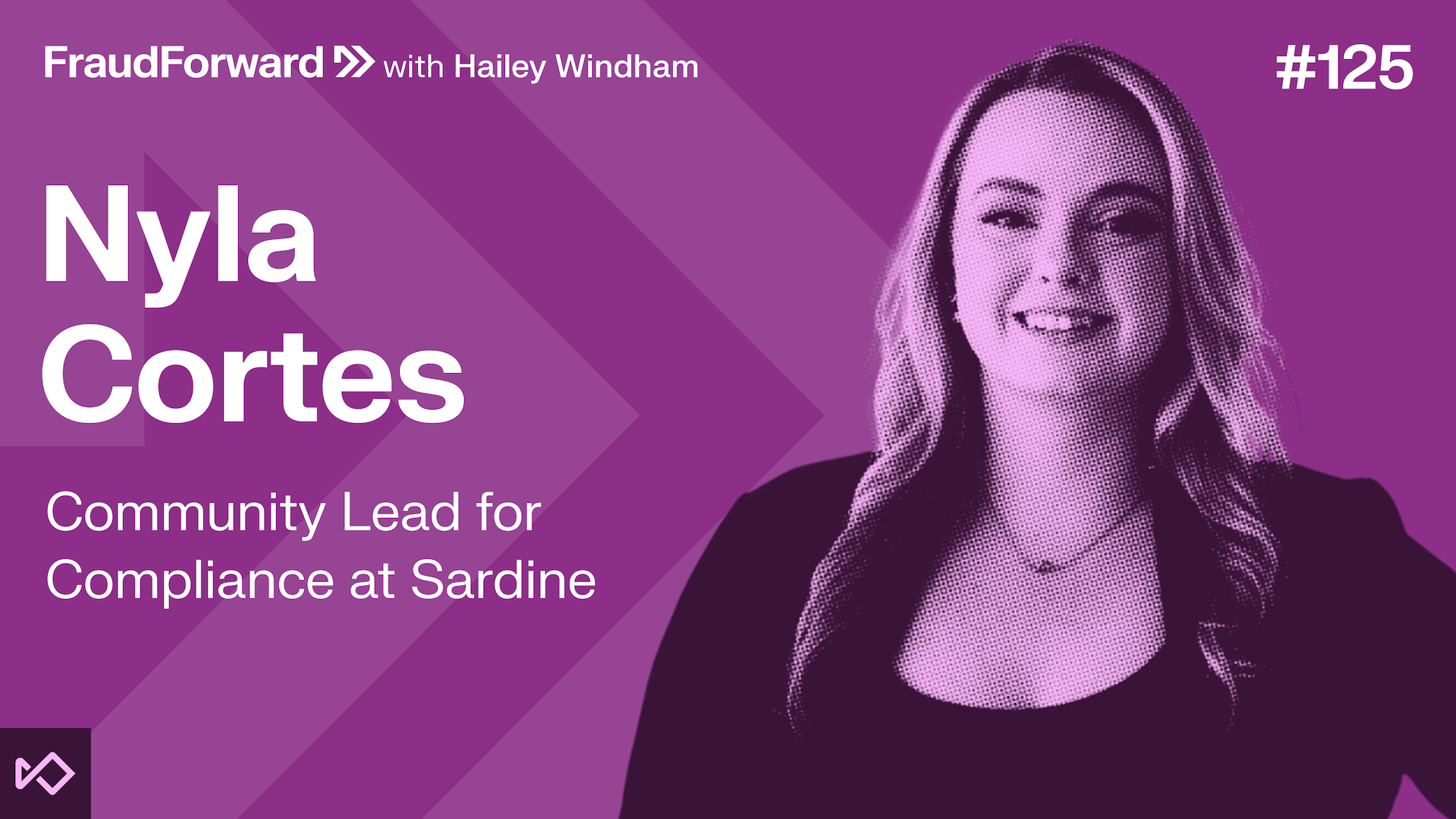
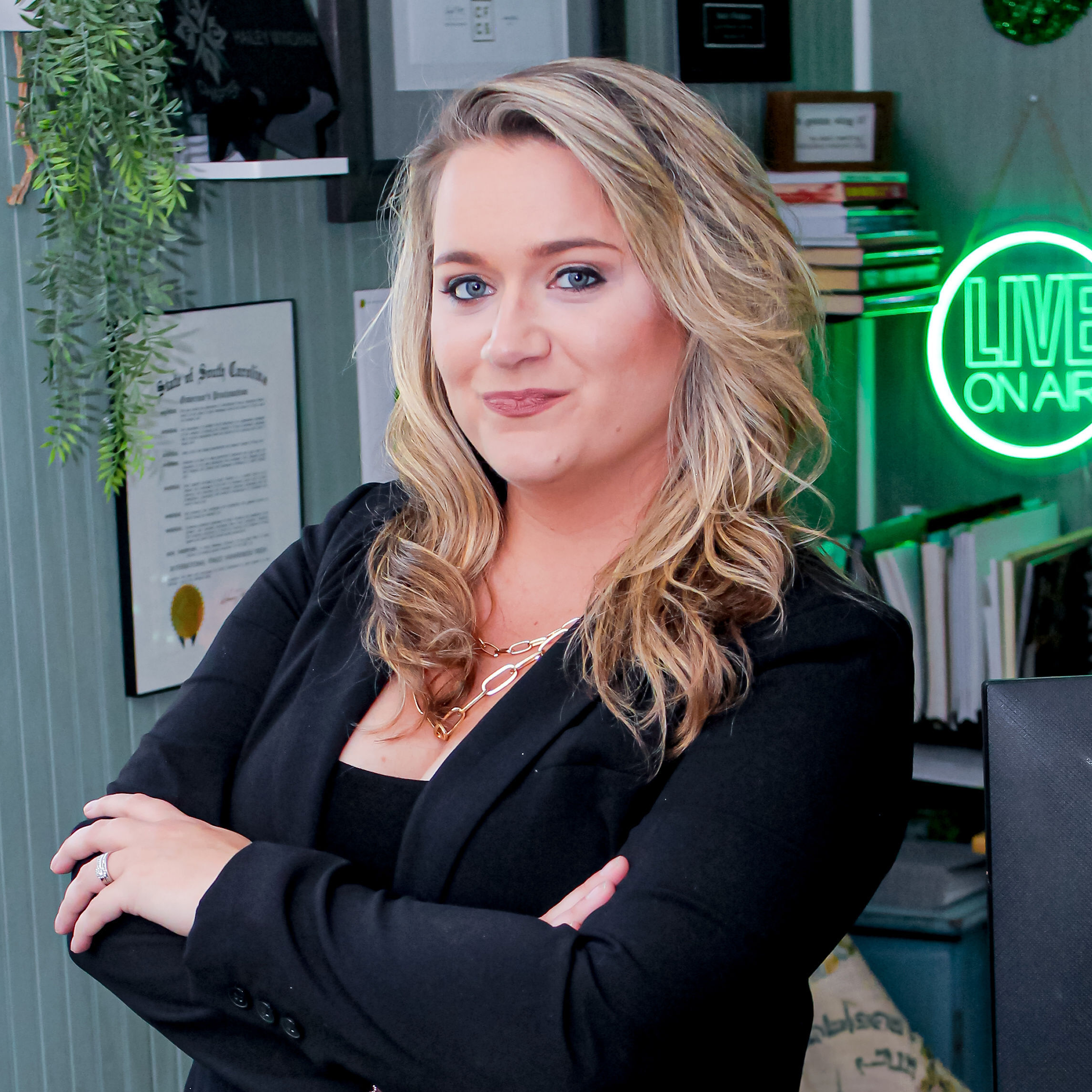
Nyla, I am so glad that you are here with me.
We are live at Money 2020 in person.
Like, look, you're really here. And and wait a minute.
Both of these say Sardine.
Reunited. And it feels so good.
We're getting the band back together. Oh, so glad you're here.
I I always uh love having you on normally, but this
this moment just feels a little extra special.
It really does. I'm so excited to be here, Hailey.
It kind of brings back some old memories.
You and I. Uh for those of you that do not know, and only the OG
OG OG uh fans of the show, um and not this show will know.
Um Nyla and I um when we formerly worked together
at a credit union, we had our own podcast.
And it was called Hailey Windham and Nyla Cortes (1:06): The TEA
Um and it stood for training, education, and awareness.
We did it also because for two reasons.
One, we were the fastest friends ever in the work environment.
Like you guys, this one I started working in uh November and
then they did secret Santa and she was my secret Santa.
It was the sweetest thing.
Actually, she was my secret Santa.
Um and I would come in daily and there'd be these little
things on my desk and I was like, "Oh my god, somebody
loves me and they don't even know me. "
I loved her. We literally were desk mates.
Like literally I if we heard a conversation that we wanted to roll
our roll our eyes about we'd lean back and look at each other and
you know you you know you have those um those are the best.
So okay we had the TEA and we have a commercial that
I'm hoping we're going to be able to input here.
Welcome to THE TEA where we steep down the compliance jargon into real
We have to spill the tea on all things fraud.
Oh my gosh, you are right. Okay, we do talk about fraud, too.
I'm so sorry. Okay, let me start again.
Welcome to THE TEA, where we steep down compliance
and fraud jargon into real world understanding. My name is Nyla
We are your hosts of this employee exclusive podcast. ]
Okay, so you guys just heard it.
So, that was where we spilled the or we What is that?
We turned we spilled the tea for sure, but then we turned
compliance and fraud jargon Hailey Windham and Nyla
Cortes (2:49): Into real world understanding.
Um, which is what we are doing now obviously.
Um, and again, just so excited to have you back on.
We'll be doing some things together obviously.
Um, and then there will be a few things
that you'll be doing on your own. So, I would love to know.
Um, let's see. Uh, we did have a couple of fun things.
Um, so if THE TEA had a theme song, what would it have been?
And what do you think about that?
At the time, I really think that our theme song would
have been the Scooby-Doo intro theme song.
We mo more Hailey than I, but we were
very in depth into the Scooby-Doo.
I mean, if any of you obviously watching her podcasts or any of her
um Friday 5 minutes of fraud, you see Scooby in the background.
You know, it used to be an even bigger thing that it is now.
Um, this girl used to give out Scooby snacks to people
that were able to um detect or even prevent fraud from
happening in the branches at our credit union. It was just so amazing.
Um, and he taught me uh, you know, monsters are just
people hiding behind mask and what's the difference
with a fraudster hiding behind a computer screen.
You know, um, so I'm I'm out to prove a point
and Scooby's going to help that out.
I mean, it it's amazing what a little bit of appreciation will
do for your team and and you know, that's one of those things,
too, where you kind of go where where you're needed.
Um, and when unfortunately, and we're no longer at that
credit union, but we know we've left it in good hands with
with some of the things that we've put in place.
Um, and then, um, I was going to say, uh, also for a theme
song, do you remember Robin Big from MTV when they did
their people, let me tell you about my best friend?
That's what I thought it was going to be.
But, um, but Scooby-Doo works, too. That's a good one.
Um, that could be yours. That could be yours.
Um, and then who, um, let's see, who was
our most loyal listener um, back then?
Oh my goodness. Okay. I definitely think it was Dylan.
Dylan, we miss you so much.
Dylan was our biggest supporter, our biggest advocate.
Just from day one, she was so excited for us when we launched
THE TEA at our credit union and she listened every
single week and she just gave the best feedback.
She was so supportive of us. I We miss you so much, Dylan.
We hope you're, I hope you're doing good, Dylan.
Yes. Yes. And uh which fun fact, Dylan went on to be a trainer.
She went from fraud to being a trainer.
Um and I loved watching her grow. That is just
She's an amazing trainer.
One of those one of those full circle moments.
And we're so proud of you.
We're so proud of you, Dylan.
And now we're back here and we get to talk about you because
people know you and now they'll want to know you.
Okay. All right. Now, I have a question for you, Hailey.
I have really always wondered this. Okay.
What is one moment in your career where someone made
the rules feel just extremely clear for you?
I could count the ways that they weren't they weren't extremely
I think we all can count those ways. I was like multiple hands.
Um I can remember a time when you me and Dylan argued about reg e.
I mean countless times. Speaking of Dylan.
Um so there were a couple of times in my career that um you know
the rules still kind of felt like this gray box of like we know we
know these are the rules but we don't know why they're the rules.
Um and for me being someone that's kind of really hands-on a visual
learner but also someone that I I have to have that practical
understanding of something that's really hard for me.
Um, and it's one that caused me a lot of uh grief in
my career because I would spend the time arguing my
point of like, "No, this is how I interpret it.
" Because in plain English to me, this is what it says.
But then to have someone who wouldn't like explain
it and just say, "No, this is wrong.
This is what you're supposed to do.
" Versus having someone that would take the time.
So, I don't want this to be a cliche episode, but there was
this person that I worked with who was a desk mate.
Um who I'm sitting with right now.
That I just remember, you know, we were I think
it was a one of the elder fraud cases we were working
uh through our case management system.
And I just remember like as a fraud person, I was
like I we have to do something about this.
But unfortunately, the way that our process was the elder
financial exploitation went directly through BSA.
And so it would come through you guys.
And then from there you would, you know, do
adult protective services or whatever.
But then on my side, I had a hard time understanding
why I couldn't be more involved.
And then when you and I were able to like collaborate on
like what could be why I couldn't do something in the beginning
versus being able to say, Hey, you know what?
Now that we're aware of this, BSA is going to actually
inform fraud, to say, Hey, this is a we know
that this is elder financial exploitation.
We know that this person is a vulnerable adult.
We have contacted adult check services and all the things.
However, the account is still open, still being used.
We on BSA side can't touch it.
But fraud, here's your unusual activity referral.
Now, you can do something about it.
And so having it where I knew I couldn't step in immediately.
I had to wait on that and getting that explanation from you
of like, hey, no, because the policy states this, it has to
come through me first, but I will refer it over to you.
Let me know that like, hey, there it's not just going to fall
into this box of uh, you know, maybe a SAR gets filed, maybe
it doesn't, maybe they get called, maybe they don't.
I will have the opportunity to intervene.
And so that was that was one of those moments for me that it it
took being able to understand why the rule was the way that it was.
Um that that made it a way for me to move kind of forward. I guess
Honestly, to everyone listening, I did not expect her to say me. Um,
What would you expect I mean,
No, truly like I I was honestly just using it as a segue
because I that is literally what I am all about and I'm
so happy that I was able to provide that for you.
Because not only the connection between fraud and BSA teams being
still extremely just there the two separate entities are so siloed
um and there's really no conversation happening between the two.
So in cases of um elder financial exploitation or identity
theft where a lot of the cases really do cross over between
BSA and fraud and there is no conversation happening.
It makes it extremely hard not just on the BSA
side but on the fraud side too on both teams.
Everyone's doing double work. Nobody wants to do double work.
So I am just so glad that I was able to do that for you.
But also what made that whole that whole process so easy was that
you were so open to collaborating and bridging the gap the tea.
Yeah, that was the slogan. Bridging the gap. Yep.
Bridging the gap between BSA and fraud. And it's I'm just so happy.
I'm just so happy that that was a good moment for you.
And I think that was one thing you and I have talked about it
before on a previous podcast where it was, you know, do you think
that we were kind of at an advantage that other teams don't
get because we liked the person behind the process first.
Um whereas if you do have uh you know where maybe you don't have
the same personality as your BSA officer or or your compliance team
or your internal audit and you feel like they are kind of
untouchable, unfriendly, like they live in their little department.
I I always thought maybe we were at just in a little bit of an
advantage because it was like, well, I I like this person.
I want to number one be our friend. I want to be helpful.
Do we have that across every department with everybody?
Sometimes we really don't. But you know what?
Just because friendship isn't on the table
doesn't mean collaboration can't be.
And I think if you just learn to speak the other person's
language, you can always build that build that bridge.
So true. Okay. So, let's play a game.
Um, so we're going to do fraud or compliance. You answer.
I'm going to give you some scenarios.
So, one device logs into a dozen accounts in an hour.
Fraud spots it, compliance work wants to know
if it ties to a pattern worth reviewing.
And I think it really just plays into because I you have a you
have a case for either side, fraud or compliance on this.
I honestly think both. Like but seriously.
And I know people are like, Oh yeah, you
guys were just talking about that. Roll my eyes.
But like seriously, both need to be involved in this
because as you stated in your question, compliance
wants to know if it ties to a pattern, right?
And fraud, they're the one that spots it and they're also
the ones that track the actual pattern itself and they're
also the ones that need to know because if it's a bigger
thing than it actually just this one instance,
Yeah, that's I think it's important to make sure that
there is that understanding between the two of like,
hey, here's something that I've spotted.
Here's a way that I'm kind of intervening, but at
the same time, you as compliance need to know about
it to understand the risk of the product.
Um, and also to understand, hey, right now, our
current processes don't allow for interjection
or they don't allow us to stop something.
Can we work together to to fix that?
Can we bring in the payment team to let them look
to see about their current process as well?
Like when they spot something or maybe it's even tying it back
to the vendor relationship of, hey, this is this is abnormal.
Is this something you can catch?
And if not, maybe we look to see if there's another alternative.
How about um a customer says they never authorized a transfer.
Compliance cares about the clock and the customer's rights.
Yes. So we see this it reg e claims, right?
This is basic reg e claims.
Your compliance is your clock, your timing, are you getting your
notices out, are you doing exactly what you need to, are you
giving provisional credit in the right amount of time.
Fraud is concerned about the investigation.
They're concerned about patterns.
They're concerned about if the merchant is doing this
to multiple other customers at the same time.
So another great example of why it's so important certain
that compliance and fraud are are in conversation.
What I also love about that particular scenario is that it's not
it's almost like that dual control, but um where it's compliance
isn't coming in to say, "Hey, you didn't do your job right.
" Compliance is coming in to say, "Hey, our members, our
customers, first of all, legally, we need to make sure
that we are complying with the right timelines.
" But second of all, this is a this is a customer win.
This is a member win of if we get them their their either
provisional credit or whatever on time while we conduct our 10-day
investigation before it turns into a okay, you've got your
provisional credit, but now we need additional 30 days.
You know, 45 days, you'll get your answer.
Um I I like that it's more on making sure that the consumer is
taken care of um while protecting the financial institution.
And then sometimes what also comes from that is process efficiency.
Like you look at it at a thing and you're like, Okay,
you guys have, you know, 50 cases coming in a day.
You're a staff of three. You're not meeting the deadlines in time.
This is another way that compliance can help advocate for either
additional resources, new tech, anything like that.
So, I think that's an opportunity where sometimes we forget that.
Because it kind of feels like you're the older sister and
you're tattling on me, mom, and I'm really sick of it.
But instead, you're like, No, I I want to help,
but we have to first accept that that there are
some some things that we do have a few gaps.
There are a few vulnerabilities. Let's address those together.
And and it becomes a real cultural win,
I think, for the organization.
I I love the way that you said everything because at the end
of the day, Reg e is a consumer protection law, right?
Like reg e, as much as we all hate it in this space, we hate it.
We hate all the rules, all of the nitty-grittiness, all
the little details that come with reg e and how much
we truly just it can grate on investigators nerves.
It is at the end of the day a consumer protection law put
into place so that banks are not wronging the consumer.
And and I think that it shows just the the overall
uh responsibility of the organization too.
Um and and for clarity on this uh episode when we
say compliance what department are we saying? What is compliance?
What is represented in that compliance?
Yeah, compliance bubble can be BSA compliance. It can be risk.
It could be sometimes fraud in some cases.
Um just depends on your organization itself and how it's structured.
Um, but yeah, big at the end of the day, regulatory compliance,
consumer protection compliance, lending compliance, risk management,
all of those kind of fall under our compliance bubble.
Love that. Okay. Uh, last last little scenario for you.
So, money comes in and goes straight
back out with no clear purpose.
Compliance sees monitoring,
Uh, fraud teams see mule risk.
Um, I know you and I specifically have this
exact scenario come up in our path.
Um, so I'd love I'd love to hear your thoughts here.
Yes. So, this is one where the hair will always be split.
I don't think that either team is going to really agree.
And I think what's really going to drive this decision
for any organization is going to be your policy.
Um, it's one of those scenarios where it has to be defined very
clearly in your policy what it is, whether that's your BSA policy
or whether that's your fraud policy, who owns it, right?
And I hate that, you know I I want to say again
that both kind of hold the umbrella or hold the
torch for this because it's a different risk.
Until you have more evidence leaning more one way than the other.
Uh, from the fraud side, I can remember arguing, "But I know
that they're doing something nefarious with this money. "
Like, why is he coming in with $30,000 of cash in his pocket?
It's not in a zipper bag. It's literally bills in his pocket.
Um, and I'm like I can remember literally
going, "I think we should call the law.
" And you're like, "No, we shouldn't.
You're like, This is not going to help anybody if we do that
right now because we have to understand the pattern.
We've got to make sure that like, hey,
maybe this is a one-off thing.
But if it in the event that it's not a one-off
thing, this could lead to something bigger.
And that was one of the biggest lessons that you taught me because
I remember, you know, when I finally got the authority within my
role to uh prevent and and intervene, I was like, Shut it off.
Convenient service. They don't need that. They don't need that.
And so for these particular types of scenarios where money
is coming in, we have no real explanation, we know in like
our heart of hearts something nefarious is going on.
But we can't prove that the number one the money is not theirs.
Number two, like if we define what fraud is, right?
A fraud being taken without authorization.
But you've got an actual customer member that's
walking in with a handful of cash. They leave.
They are transacting through their online banking,
through their debit card, whatever.
We can see that it is actual authorized transaction.
There is no technical fraud.
Maybe something nefarious is happening, but we have
to first identify a pattern, report it, and what you
guys are filing your CTRs and things like that.
But for me, that was one of those light bulb moments of,
hey, you know, Hailey, you're a bigger picture person.
Like, you like to think holistically.
You're not thinking holistically right now.
You're thinking of the individual account at this individual
financial institution and not the overall you know broad
ecosystem of what else is happening after this.
So if we can help law enforcement or the regulators whoever I
identify what's going on and they can connect pieces on their
side then we're doing our part that actually is helping.
Fraud fighters if you're anything like me, your
list of things to read keeps growing.
Your time to read them though, probably not so much.
That's why I write the Monday Fraud Fix.
It's the newsletter companion to Fraud Forward.
So, every Monday I'm sharing fraud trends that made me pause,
what I'm reading, conversations happening in our community,
and the fraud fighters that I think you should know.
I also bring my take, you know, what it means for the people
doing this work, and the questions we need to be asking.
Every now and again, I might leave you a
little Scooby snack to start your week.
You know, I just can't help myself.
You can find the Monday Fraud Fix on Substack or tap
the link in the episode show notes and subscribe.
I'll see you in your inbox, fraud fighters.
Okay, so Nyla, obviously we're going to wrap this up because
we are live at Money 2020, but I have it on good authority
that there is a an announcement coming.
So, and we're going to use a Fraud Forward, Thank you, by the way.
Um, as your announcement uh platform
I'm getting the exclusive. I told you I needed that press badge.
Here's your exclusive Money 2020 on the Fraud Forward podcast
because let's be honest, Hailey is my best friend.
So, there was no one else that I could honestly announce this with.
I feel like I need to do one more little take here and go.
Okay, this is your exclusive big news happening
here live on Fraud Forward in Money 2020. All right, Nyla, go.
Oh my gosh. Okay, my news.
I am just so excited and so nervous because this has been
something that I've been working towards for years. For years.
And I am just so excited to announce that I am
launching a podcast just like Fraud Forward.
Um, but for me, it's going to be called Regulated with Nyla Cortes.
We're going to be covering everything BSA regulations,
consumer protection regulations. I am just at risk.
Oh, all everything that I just my bread and butter.
If you know me, you know.
Um I just I love making something that can be so complicated
and feels so out of reach for so many people, feel
just so broken down and so easy to understand.
And I I I just I'm so excited.
Yeah, you have a really great way of doing that.
I'm very excited for this.
You're uh one of the first people that I talked
to Sardine about when they were like, "Hailey,
do you uh do anything on compliance in BSA?
" And I was like, "I can talk fraud compliance.
" Um but as far as like reading those very long boring
documents, that's not that's not a Hailey thing.
Um but I know I know someone. Um and so I love that.
But also like just as a as a normal practitioner,
I had a very hard time digesting regulations and understanding what
our role was, what my particular role was in in any instance.
And so whenever I would have to revert
back to, well, what does the reg say? What is this?
I'd go, hey, Nyla, what does that reg say?
Like I'll read it on this paper, but let me tell
you, it's like translating Greek to me.
I feel like, you know, Percy Jackson whenever
he's like looking at the the Greek side.
That's how so many people feel. That is how so many people feel.
And that's why I'm that's why Regulated is coming to fruition.
Because I will be not humble in saying that I have a gift in really
translating all of those regulations down into plain English.
And I am just I'm so excited to help the
next generation of compliance people.
Yeah. So who who was or who is Regulated uh for?
It's for your compliance analysts. It's for your compliance officers.
It's for your BSA people.
It's for the new people walking into this space.
You know, I I walked into the compliance world 11 years
ago and I you you would think I was like one of those
cartoons with my eyes bugging out of my head.
Because it is that intimidating. It is that scary.
And then to hold the title of compliance officer and just
truly be the person that your organization is relying on
to know and to understand and to break these down and explain
it in plain English to the rest of the company.
That is so intimidating and so incredibly hard.
And part of the reason why so many compliance officers have
such a hard time integrating and staying in compliance.
Because it just is that hard.
So being able to have someone that could turn those
uh compliance jargon Hailey Windham and Nyla Cortes
(24:08): Into real world understanding
Um so uh I just want to ask about like format.
What is um you know how how is it different from the
compliance content that's already out there?
Yeah. So um this is going to be on a more reachable platform.
Uh we're doing not only the Regulated podcast,
but I will also be doing blogs and articles.
Um breaking down not just um what's coming and
what are the regulators talking about. But also past regulations.
Like we were just talking about reg e earlier and how
nitty-gritty that one is and how hard and difficult
and tedious that one is to really understand.
So taking the time to go back to the beginning and break those down.
We're also doing webinars.
I'll be at conferences just like this at Money2020.
Um, and I am just so excited.
Uh, we're so excited to have you.
This is a a piece of um our Sardine Media that
that we've been hoping to expand on.
Um, and you're the the perfect person for it.
So, thank you for joining me on Fraud Forward.
Thank you so much for having me
Thank you so much for bringing us this exclusive piece of news.
Um, and for letting uh my platform be the one to announce it.
Uh, looking forward to the rest of the conference with you.
Um, if you are uh a follower of Fraud Forward,
be sure to check out Regulated with Nyla.
Uh, we will link her um content, her LinkedIn
and everything in the show notes.
And yeah, really looking forward to continuing
having conversations this week. And thank you again so much.
Thank you so much, Hailey.
Thanks for listening to Fraud Forward.
Remember, every conversation, every connection, and every insight
moves our industry one step closer to stronger fraud defenses.
If today's episode sparked an idea, share
it with your team or tag me on LinkedIn.
I love hearing how you're moving Fraud
Forward in your own organization.
Until next time, stay curious, stay resilient,
keep moving Fraud Forward.