
This is the third post in our 2026 Fraud Ops series, where we explore the practices that help fraud teams operate with greater accuracy, confidence, and speed.
If you missed the first two posts, catch up here to learn 5 creative ways to use AI right now, plus how to release new fraud rules safely.
Fraud prevention moves to the rhythm of fraud spikes. The constant ebb and flow of fraud attacks emerging and then subsiding is a rhythm that any fraud team is familiar and comfortable with. And yet from time to time, a fraud attack hits that is so vicious in its repercussions that it requires special attention, resources, and communication.
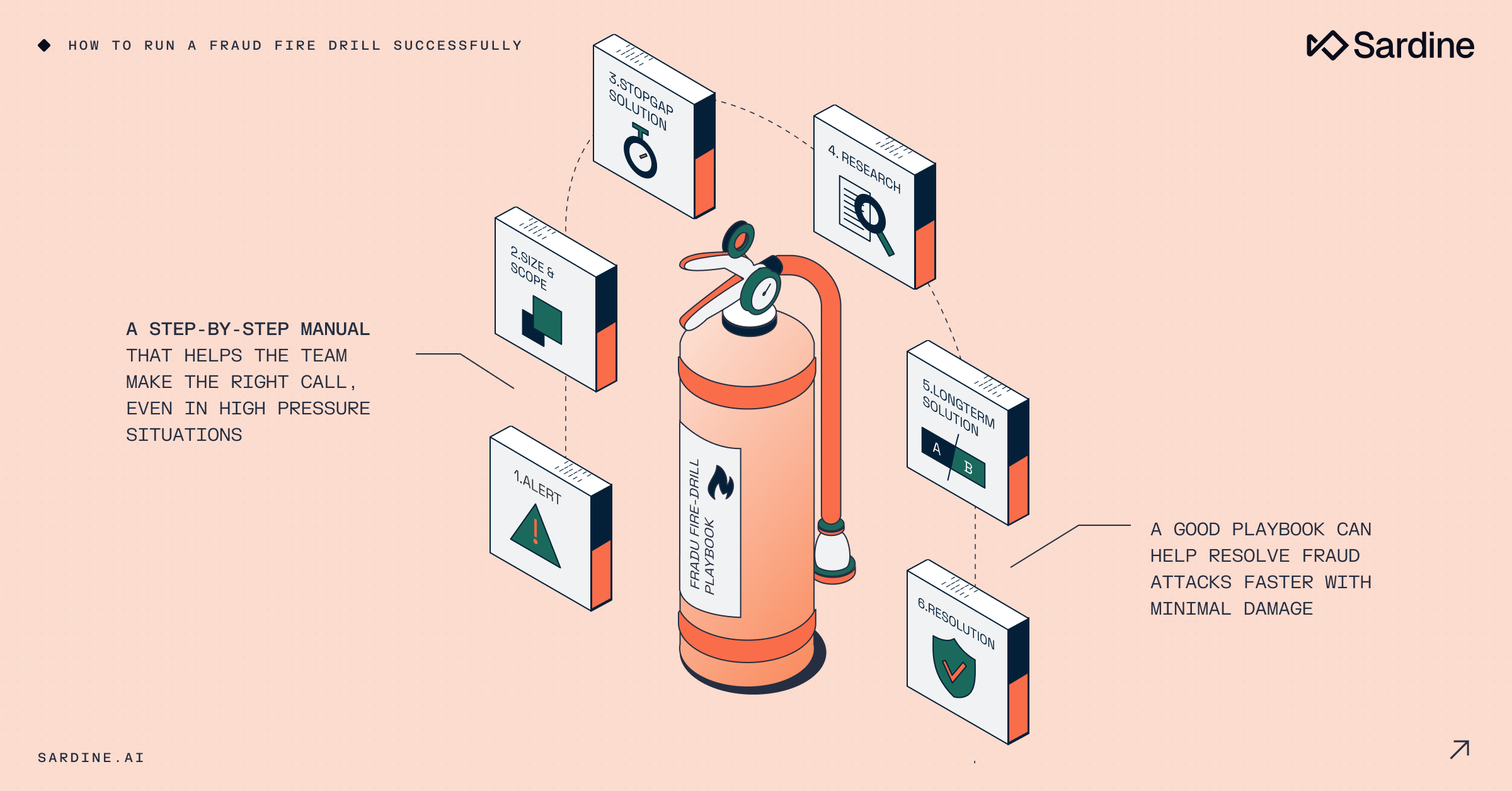
These “Fraud Fire Drills” (a more positive term than “incident” or “emergency”) require a playbook, or a step-by-step manual that helps the team make the right calls even when the pressure is high.
Because every business is unique, from its business model and product to its fraud patterns, so is their fraud fire drill playbook. But even though you cannot simply download a ready-made copy that works for your business, you can still follow a clear set of best practices to create your own.
A good playbook will not only make sure you resolve fraud attacks faster and with minimal damages. It also helps you create clarity throughout the process, which elevates the general sense of confidence that you have in your team, and that your stakeholders and clients have in you. A higher degree of confidence can also mean less distractions and interference in your work in the midst of an intense time.
So you don’t have to start from scratch, I’m sharing the basic tenets of a fire drill playbook, including the overall process and stages of a fire drill, how to effectively manage communications, and what roles you should define in advance.
Fire drill playbooks are never a one-size-fits-all kind of exercise, so be sure to make the appropriate modifications and additions to fit your specific needs.
The six stages of a fraud incident response fire drill
From alert to resolution, each fire drill should follow the same steps in the same order so your team knows what to expect.
Stage | Primary goal | Key actions | Output / decision |
1. First alert (Fraud signal detection) | Identify abnormal behavior that may indicate a fraud spike or systemic issue | Monitor alerts from fraud systems, chargebacks, customer support signals, and decline patterns. Validate whether the signal is unusual versus normal variance. | Initial determination that further investigation is required |
2. Size & scope (Incident scoping) | Determine whether the issue qualifies as a fire drill and how severe it is | Estimate financial impact, identify affected accounts or transactions, assess likely fraud or false-positive drivers, and prepare an initial affected-client list | Fire drill declared (or dismissed), scope defined, stakeholders engaged |
3. Stopgap solution (Containment) | Rapidly contain losses and stabilize impact | Deploy temporary controls such as aggressive rules, friction, blocks, or model adjustments to immediately reduce exposure | Losses stabilized and time bought to investigate root cause |
4. Research (Root cause investigation) | Identify the underlying cause of the incident | Conduct deeper analysis across data, flows, models, and controls. Coordinate with engineering, product, or vendors as needed | Root cause identified and long-term solution designed |
5. Deploy long-term resolution | Replace temporary controls with a durable fix | Validate, test, and deploy permanent fraud controls or system changes. Gradually ramp down the stopgap solution while monitoring for regressions | Long-term solution live and stopgap safely removed |
6. Resolution & retrospective (Post-incident recovery) | Restore normal operations and strengthen future readiness | Complete remediation (unfreezing accounts, reversals, client comms), document learnings, and run a cross-functional retrospective | Incident closed, trust restored, playbook improved |
Each fire drill should move through these stages in order. Predefining the steps reduces decision-making under pressure and creates clarity when it matters most.
Step 1 - The first alert - Fraud signal detection
To kick-off a fraud fire drill, we need to know there is one, and for that we need to get some sort of alert that something abnormal is happening.
This doesn’t necessarily need to be an actual alert you get from your risk engine. It can also be an alarmingly large chargeback file that you just received, or CS reporting that the call center is flooded with inquiries about suspicious activity. On the other hand, alerts can also relate to elevated declines from your risk engine, which might signal a growing concern about false positives.
But what if alerts are a daily occurrence in your fraud team? How do you know you’re dealing with a fire drill and not just a local issue? Sometimes it's hard to make this distinction immediately, especially if you’re not getting clear spike signals within the very first day of an attack.
If that is the case, we need to move to the second stage: Size and scope.
Step 2 - Size and scope of incident
Whether you’re seeing a fraud attack or elevated false positives, you need to properly size the incident so you know what you’re dealing with. A real fire drill will likely demand unanticipated attention and resources, and teams such as engineering, product, customer support, or finance will need to know if and when to jump in and help.
To assist with organizational prioritizing, it’s critical to correctly size the problem and attribute it a dollar value. This also helps draw the scope of the issue and roughly determine the root cause. Are we dealing with an ATO attack? A misbehaving fraud model? A breached security measure?
Even without knowing exactly where the issue originates or the pattern of a potential attack, you can at least answer some basic questions just by looking at the affected accounts.
Keep in mind: there’s no need to be overly accurate at this point. It doesn’t matter if the attack will potentially lead to $1.2M or $1M in losses. It’s better to have a quick, rough estimate you can make decisions with, rather than delay the resolution for the sake of being precise.
Finally, by scoping the actual accounts that were affected by the issue, you can prepare an initial client list on which you can later act. Whether this includes reversing payments by means of a batch process, freezing those accounts, or sending out any sort of communication, you’ll want to have that list of client IDs ready.
By the end of this stage, you should have a clear understanding of the scope of the issue, and whether or not it’s a fire drill.
Pro tip: When building your playbook, agree with your stakeholders what size levels warrant declaring a fire drill. After all, the point of the playbook is to minimize the decisions you need to make in real-time.
Step 3 - Stopgap solution
Fire drills are by definition time-critical. Every second counts as losses mount, more customers are affected, and cleanup efforts grow in cost. The first order of business is to design and deploy a stopgap solution that resolves the standing issue, or at least a significant part of it.
What is a stopgap solution? A stopgap solution can include any crude, inefficient way that would temporarily address the issue and give the team time to implement a proper, long-term solution. It’s like applying a tourniquet to a limb injury. It’s not designed to last forever, just enough time to get the injured to a hospital so they can receive proper treatment.
And exactly like a tourniquet, stopgap solutions can create damage in and of themselves if left in place too long. In fraud fire drills, stopgap solutions can be anything from increased customer friction for verification, to aggressive rules or model settings that block lower-risk activities. The cost of a stopgap solution is lower than that of the core issue itself, but they are still undesired long-term.
Why bother with a stopgap solution at all? The simple truth is that in nine out of ten cases, a long-term solution requires an extended period to research, test, and deploy, time you don't have during a crisis. Not only do you lack that time, but leadership is demanding fast remediation. A stopgap solution's main goal is to buy you and your team the breathing room needed to develop a proper long-term fix without constant worry about escalating impact or distraction from anxious executives.
Once a stopgap solution is in place and the hectic first half of a fire drill is behind us, the team can shift gears and start thinking about quality over speed. Now that the impact has stabilized, it’s also time to enact some remediation steps on the affected accounts.
Step 4 - Research - Root cause investigation
By this stage, we’re expected to reduce the tempo of operations from hourly developments to daily developments. We still have time pressure (our stopgap solution is likely making a lot of folks unhappy), but not so much that we cannot conduct a few days’ worth of analysis.
A deep-dive analysis is exactly what’s needed to develop a long-term, quality solution. A solution that patches the root issue that caused the fire drill in the first place, with minimal collateral costs (such as increased false positives), and one that ideally lasts for years to come.
This solution can come in the form of a new set of fraud rules, a new fraud model, plugging in a new vendor, or even fixing a “leaky” user journey. In many cases, it’ll require the continued effort of multiple teams besides the fraud team, which likely means the continued disruption of executing your roadmap. Even though the tempo is more relaxed, the organization should still be highly focused on delivering a final resolution.
Step 5 - Deploying and implementing a long-term fraud resolution
Once a long-term, quality solution has been identified, it’s time to replace your stopgap solution.
First, validate, test, and deploy the new solution according to your usual company policy. In case your stopgap solution was very effective at stopping fraud, it might be difficult to test your new solution in a live environment. If that’s the case, make sure to A/B test on a small chunk of the population to make sure your long-term solution works as intended.
Assuming the deployment is successful, now is the time to ramp-down your stopgap solution. But unless you have a high degree of confidence in the results, you shouldn’t just wholesale remove it.
Start with ramping down its coverage (maybe during A/B testing) and validate that no unforeseen effects are taking place. Running the two solutions somewhat in parallel shouldn’t last days; you can validate the new state in hours and sometimes minutes. The point is that only when it looks safe can you remove your stopgap solution and move on to the final step of the fire drill: resolution.
Step 6 - Resolution - Post-incident recovery and retrospective
nce a long-term solution has been put in place, you’ll want to clean up any remaining remediation items. This can include actions like unfreezing accounts, reversing funds, and delivering client-facing communication.
It’s also the ideal timing to hold a cross-functional retrospective discussion about the fire drill. Following your playbook, this should include:
- The root cause
- What went well, and what didn’t
- What was missing
Tip: Treat your fire drill playbook as a live document that gets better each time you run it.
Conducting a retrospective discussion on a system failure can be uncomfortable. But it’s also a test of how your team deals with failure. Teams with a high degree of psychological safety perform better long-term, so it’s important that this discussion reinforces instead of undermines that foundation.
Setting up communication streams for fraud incident response
We already discussed how a fraud fire drill is an intense, high-visibility exercise to run. During this time, it’s imperative to manage both your internal and external stakeholders in a timely and transparent manner. Doing so instills confidence that you're resolving the issue as efficiently as possible. This confidence is crucial, as it protects your already stressed team from what can easily become a relentless torrent of "is it fixed yet?" questions.
You might assume that trust can only be damaged in these situations. But the truth is that if you perform well, and more importantly, communicate well, you can actually build even stronger trust with your team, peers, leadership, and clients.
That's why your fraud fire drill playbook should account for different communication streams and predefine what they look like, so your stakeholders (at least the internal ones) know what to expect.
Specifically, consider the following communication streams:
Internal taskforce stream
This is how you manage the group actively working to resolve the fire drill. This is likely to include large parts (if not all) of your fraud team, plus members from other teams in Engineering, Product, Customer Support, and Operations.
Each fire drill is different and will require a different solution, and therefore a different team. But that doesn’t mean that you can’t predefine how this team communicates: How frequently will they meet for updates and coordination? What’s the set agenda of those meetings? Which Slack channel will they use to communicate asynchronously? When will they issue updates upward and outward?
You also want to define these elements according to which stage you’re in. For example, the decision to assemble a fire drill taskforce likely happens in stages one or two. Coordination also needs to be much tighter and more frequent in stages one through three, then can shift in stages four through six.
Internal leadership stream
Separately from the working group, establish an upward communication stream to keep the senior leadership team updated on developments. This is crucial for maintaining trust when facing a system breakdown and for preventing them from directly engaging with the working group.
For that very same reason, ensure the leadership team receives succinct, clear, and timely updates. Ask yourself the same questions we described earlier: Who’s on the leadership team? How will you communicate with them? What template will you use for progress reports? Will you host update meetings?
As a general advice, consider two parallel upward communication streams, one for immediate, short announcements (such as “stopgap is now live” or “fire drill is over”), and one for more comprehensive reports.
One important consideration is communicating all learnings, action items, and remediation progress after the fire drill ends. Leadership trust can take a hit even after a successful resolution if there’s no clear indication of how the team will prevent the situation from happening again. The same applies to sharing learnings without following up on remediation progress itself.
Fraud leaders need to resist the urge to “move on” quickly after a fire drill in hopes that everyone will forget about it. The reality is that fire drills come and go, but presenting clearly how the team is making the business more resilient is what separates teams who gain trust from teams that get the blame.
External clients and partners stream
Whether you need external communications, and to whom, is highly situational, depending on both your business and the core issue. When dealing with B2B clients or partners, especially if they’re affected by the fire drill, think in advance about how you’ll manage communications with them.
A client being affected isn’t just about whether the core issue impacted them, but also if your stopgap solution did.
Some businesses opt for a centralized communication procedure governed by the communications, partnerships, or account management team. Others deliver updates through individual account managers to reinforce trust during this delicate moment of the relationship.
Regardless of who sends out the communications, think about what type of messages you need to send at each stage of the fire drill (if at all). A best practice is to follow general incident management procedures with an alert message, at least daily update on progress, and a resolution report.
Just as with senior leaders, the key is maintaining your clients’ and partners’ trust. Be forthcoming and transparent about what happened, what failed, the extent of the damage, and what was done to remediate the issue. Stay attentive to client needs and help them with any data inquiries they may have.
Stakeholders and ownership
Your fraud fire drill playbook should clearly define the roles and responsibilities of each taskforce member. What are they responsible for delivering at each stage? What should they be informed or consulted on? (A RACI matrix can be extremely helpful here.) Charting this in advance means that even when ad hoc team members join the taskforce in specific situations, you have a framework for defining their role.
More specifically, appoint two roles to streamline the taskforce's coordination:
Taskforce lead
The taskforce lead’s responsibilities are very simple: follow the playbook, coordinate the working group’s tasks and work streams, and assure a timely and successful resolution of the fire drill.
Predefine which decisions they are authorized to make themselves, and which require them to go up an escalation path (especially when it comes to the severity of the stopgap solution).
The taskforce lead is usually assigned to the Head of Fraud, but it can also be carried out by other (willing) stakeholders such as team leads, project managers, and product managers.
Communications lead
The communications lead will make sure that all aforementioned communication streams are up and running effectively. This is especially true when it comes to leadership and external comms streams. In the heat of the moment, it's easy to put your head down and shift into pure execution mode, so you want someone on the team primarily focused on communications.
For that reason, even though the taskforce lead and the comms lead can be the same individual, it’s best to separate them between two persons. For example, if the Head of Fraud is the taskforce lead and is taking care of the internal taskforce comms, the VP Risk can be the communications lead and make sure leadership is up to date and help inform client-facing teams about external communications.
The real test of fraud leadership
Navigating a fraud fire drill tests more than your technical skills; it reveals how well you lead under pressure. The difference between teams that emerge stronger and those that lose trust isn't just about stopping the attack. It's about how clearly you communicate, how thoughtfully you've prepared, and whether you treat the aftermath as seriously as the crisis itself.
The playbook you build today determines how your team, leadership, and clients will trust you tomorrow.
But here's what many fraud leaders miss: the work doesn't end when the fire drill does. Resist the urge to move on too quickly. Instead, use each incident to refine your process, document what you learned, and show stakeholders exactly how you're making the business more resilient.
So ask yourself: if a fire drill hits tomorrow, would your team know exactly what to do? Would leadership trust your process? Would you be able to focus on solving the problem instead of managing chaos?
If the answer to any of these is no, it's time to build your fraud fire drill playbook.
Frequently Asked Questions
What should a fraud fire drill look like in a smaller or resource-constrained team?
While the full playbook may be scaled down, the fundamentals still apply. Prioritize clarity over complexity. Define thresholds for escalation, assign clear roles (even if overlapping), and focus on fast containment strategies you can actually execute. The goal is structured decision-making under pressure, regardless of team size.
How does a fraud fire drill differ from standard incident response protocols?
Standard incident response often spans broader security or infrastructure events. A fraud fire drill is more focused, typically led by fraud and risk teams, and optimized for rapid signal detection, monetary impact analysis, and customer-facing resolution. The tempo, stakeholder set, and KPIs tend to differ from IT-led responses.
What makes a fire drill successful beyond just stopping fraud?
Drills that restore trust, document learnings, and lead to durable process improvements are more successful than those that just end the attack. Clear communication, fast remediation, and strong post-incident follow-through separate high-performing teams from reactive ones.
How can fire drills improve stakeholder confidence over time?
Every fire drill is an opportunity to demonstrate operational maturity. When leadership and clients see consistent processes, thoughtful tradeoffs, and transparent updates, it increases confidence in the fraud team’s ability to manage future events. That trust is often more valuable than the technical fix itself.
Where does Sardine fit into this process?
Sardine supports fraud teams at every stage of the drill lifecycle. From early signal detection and real-time policy enforcement to post-incident investigation and compliance alignment, Sardine’s unified platform allows teams to act quickly, reduce losses, and close the loop with speed and clarity.