


In a past episode of the Fraud Forward podcast, I sat down with Becky Reed, a 30-year credit union veteran, former CEO, and author of Credit Unions and DeFi: A Financial Renaissance.
For years, credit unions and the crypto ecosystem have operated in a state of mutual misunderstanding. While credit unions focus on the mission of people helping people, they often view crypto through the lens of volatility and scams.
Conversely, the crypto world often views traditional finance as a collection of rigid gatekeepers.
As Becky and I peeled back the layers of the credit union mission, we found that these two worlds share a common DNA.
By bringing these perspectives together, our conversation highlighted why the industry remains reactive despite the wealth of data at its fingertips. Current systems are separated by information silos: credit unions monitor account ledgers while the crypto world builds transparent, immutable records. This conversation marked a shift toward a collaborative, digitally native future for fraud prevention.
The honey pot problem and the case for decentralized identity
One of the biggest friction points Becky and I discussed is the inherent vulnerability of centralized data storage. In the current Web2 landscape, consumers are forced to hand over their most sensitive information to giant entities like Amazon or major telecom providers. Becky describes these databases as honey pots for hackers. High-profile breaches at companies like Dell and AT&T prove that this model is no longer sustainable because it creates a massive, single target for fraud rings.
Becky argues that the technology required to protect consumers cannot exist in a Web2 world. Instead, the solution lies in decentralization, which forces a hacker to move from a "one-to-many" attack to a much more difficult "one-to-one" approach.
"If a bad guy wants to get people's PII, now he has to go and he has to hack your phone. He has to hack my phone. He has to hack my neighbor's phone. He has to individually attack people instead of only trying to attack a big, giant centralized database."
By moving to a decentralized architecture, the user becomes the sovereign owner of their own data. The institution's role shifts from a vulnerable gatekeeper to a secure validator that only sees the data necessary to complete a transaction.
The payment defense: Distributed ledger technology and real-time transaction monitoring
In the current fraud landscape, the burden of traceability rests on fragmented, 40-year-old payment rails. I suggested during our conversation that the industry is desperate for a way to communicate across institutions, but legacy systems make this nearly impossible. Wires do not talk to ACH, and ACH does not talk to card networks. Becky argues that moving transactions to a distributed ledger turns this defensive posture into a proactive one by making every transaction immutable and traceable.
"Everything you do is traceable, and remember I talked about the fact that it is hashed on chain, and you can't change it ever. The ability to let a consumer know in real time that they might be interacting with a wallet that is suspect is something that is absolutely not possible in today's siloed payments system structure."
The proof problem: Reverse-engineering fraud through silos
Proving fraudulent intent in legacy systems requires reverse engineering a transaction through silos. On a ledger, the history is a moment in time recorded forever.
The information gap
Today, an issuer faces a binary choice: either believe their customer or believe a siloed record. A shared ledger provides the evidence by showing exactly where money moved and which wallets were involved.
The same ledger layer opens the door to signals credit unions have never had before. Verifiable credentials replace static KYC snapshots with continuous, cryptographically signed attestations. Decentralized identity lets a member prove “I am who I say I am” without the credit union holding the underlying PII. And because every change is hashed and immutable, real-time transaction monitoring on a distributed ledger catches fraud rings at the time of the attack, not months later.
This is the same shift Steve Lenderman described on another Fraud Forward episode: KYC tells you an identity exists, not that the person using it owns it. We unpacked it in why KYC alone can't protect you anymore.
Solving the data vacuum through DLT
One of the most glaring failures in current credit union operations is the lack of transparency into what changed within a database. When an examiner or accountant attempts to verify a transaction, the information often lacks a history that can be verified. Becky highlighted how a distributed ledger eliminates this crisis by creating a permanent, hashed record of every change.
"Let us go ahead and put that month-end database... in a block and record that on chain. And that's called a hash.
In the future, if anything about that database changes, all that is hashed and you should be able to tie those hashes back to the original to be able to see what was it before? What is it after? What changed exactly?"
This addresses several systemic weaknesses:
Legacy integration issues. Older core systems often strip away technical metadata. A ledger keeps the cryptographic fingerprint intact.
Lack of transparency. In a centralized database, unscrupulous actors can hide their tracks. On-chain, the record is unchangeable.
The PII tradeoff. Using self-sovereign identity, institutions can validate a user's status without ever seeing or storing their sensitive personal data.
Becky illustrated the power of this tradeoff with a practical "over 21" example. A liquor store clerk needs to know a customer is of legal age, but they do not actually need to know the customer's name, home address, or exact birth date. In a Web3 framework, the user's device provides a cryptographic confirmation of age without revealing the underlying PII.
By removing the need to collect and store this data, credit unions can fundamentally change their risk profile. If the institution does not hold the data, they cannot lose it in a breach. This shift moves the industry away from the "honey pot" model and toward a system where security is a byproduct of the architecture itself.
Traditional model | Verify-don't-store model | |
What the institution sees | Full PII (name, DOB, address) | Cryptographic yes/no confirmation |
What's stored | Everything, centrally | Nothing — user holds their own data |
Breach risk | High (honey pot) | Minimal (no data to steal) |
Verification speed | Batch / after-the-fact | Real-time, at first interaction |
From honey pots to cryptographic certainty: A path forward
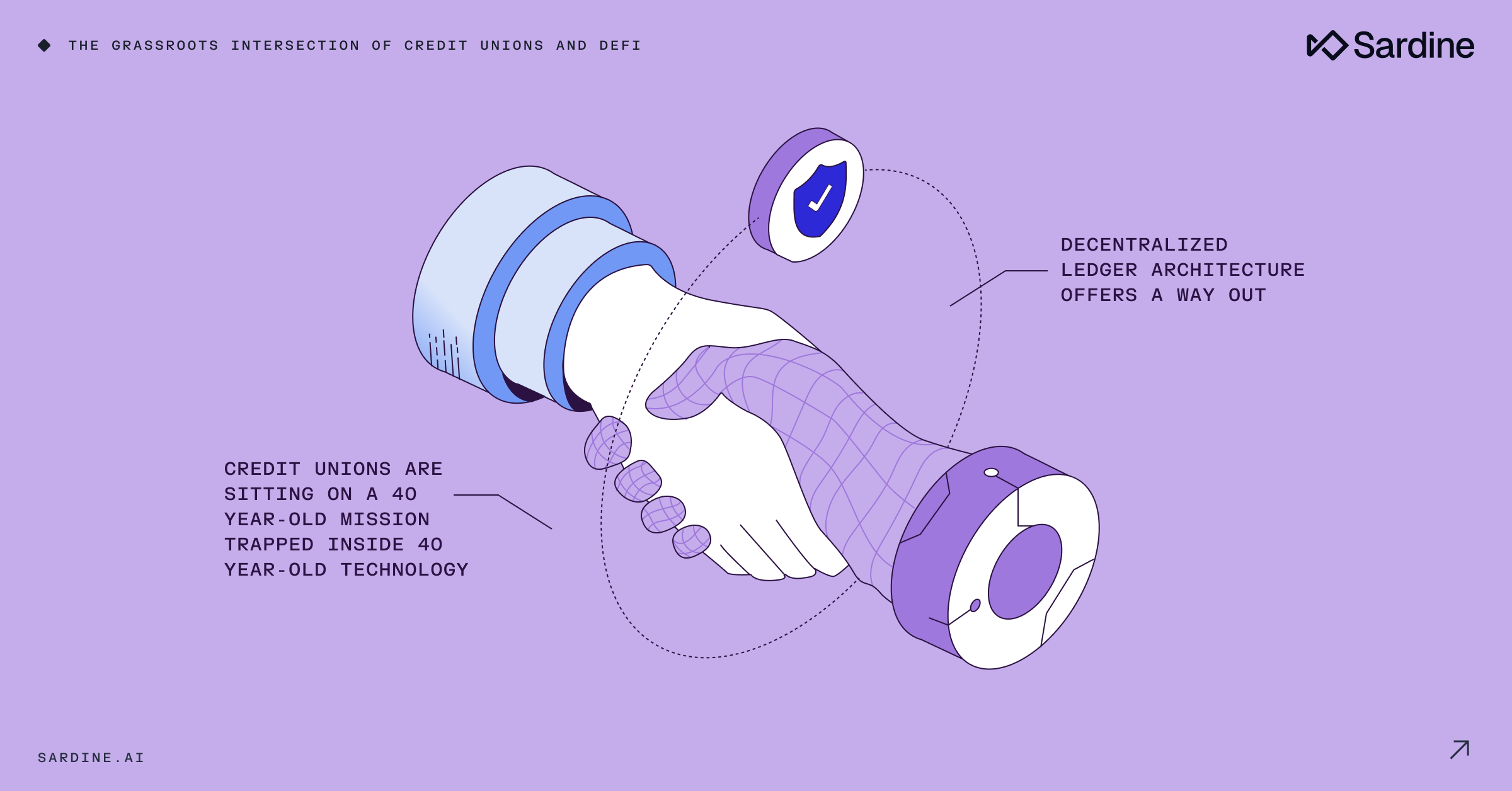
The current landscape of credit unions is in a standoff between a 40-year-old mission that remains as relevant as ever and 40-year-old technology that no longer is. As Becky and I discussed, the industry can no longer afford to play "checkers" with static, one-time KYC controls while fraud rings are playing "chess" with deepfakes and agentic AI.
Our threat research team broke down exactly what that chess game looks like in seven agentic AI attack vectors now live in 2026.
Realignment starts by moving validation to the very first interaction. Adopting the decentralized "verify-don't-store" model Becky advocates allows fraud leaders to stop being the "no guy" and start becoming partners in growth.
Trading the liability of a centralized honey pot for the cryptographic certainty of a distributed ledger removes the target from the institution's back. This shift ensures that credit unions stay resilient, building a future where members own their own data and their institution protects the trust.
FAQs about credit union fraud prevention and DeFi
What is the “honey pot problem” in credit union fraud prevention?
The honey pot problem is Becky Reed’s term for the risk created when credit unions (and every other institution) concentrate member PII in centralized databases. One successful breach gives an attacker a one-to-many payoff. Decentralized architecture forces fraud rings into a one-to-one attack, which is dramatically more expensive and rarely worth their time.
How does distributed ledger technology improve credit union fraud prevention?
Distributed ledger technology gives credit unions an immutable, hashed record of every transaction and data-state change. That record enables real-time transaction monitoring, shared visibility across institutions, and provable audit trails, three capabilities that siloed core systems cannot deliver.
What is self-sovereign identity, and why does it matter for credit unions?
Self-sovereign identity lets the member own and present their own credentials. The credit union verifies what it needs to verify (age, residency, account status) without storing the underlying PII. No stored PII means nothing to breach.
Do credit unions have to adopt crypto to adopt DeFi architecture?
No. The architectural pieces (immutable ledgers, verifiable credentials, decentralized identity) can be deployed without speculative crypto assets. The conversation on Fraud Forward is about the infrastructure, not the instruments.
How does this change the day-to-day work of a credit union fraud team?
Fraud teams stop reverse-engineering transactions through silos and start reading a shared, immutable history. False positives drop, real-time fraud detection becomes possible across institutions, and the team shifts from being the “no guy” to being a growth partner.