


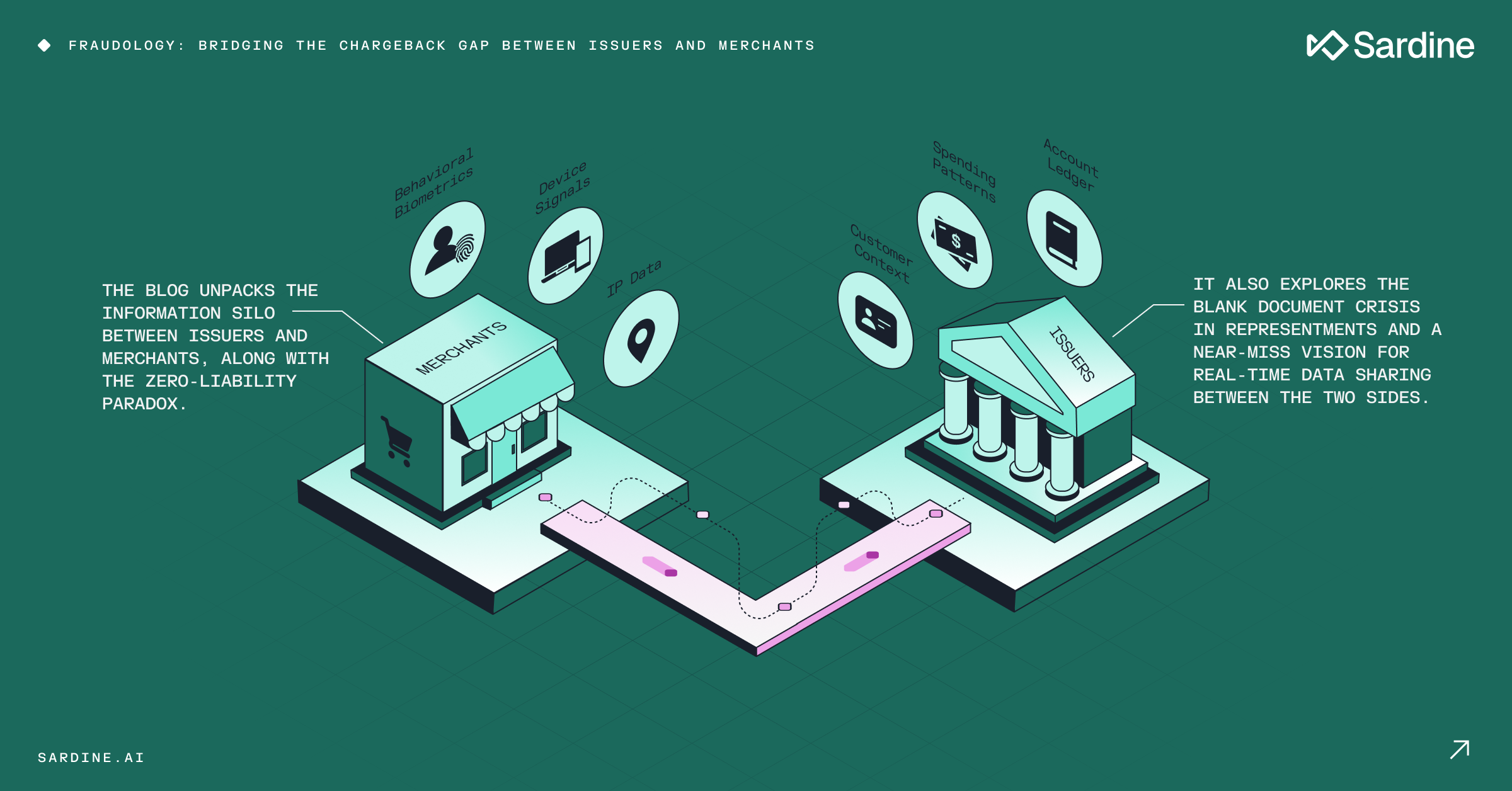
In a (somewhat) recent episode of the Fraudology podcast, host Karisse Hendrick and special guest Hailey Windham did something rare in the fraud industry: they sat down and compared notes. For years, merchants (the businesses fulfilling orders) and issuers (the banks providing the credit/debit cards, like Chase or Wells Fargo) have operated in a state of mutual misunderstanding. While they share a common enemy in fraud and those perpetuating it, they have historically been separated by a massive “information silo”.
As Karisse and Hailey peel back the layers of the chargeback lifecycle, they reveal a billion-dollar blind spot.
- The merchant’s view: They track a customer’s digital footprint, obsessing over behavioral biometrics, IP addresses, and GPS data.
- The issuer’s view: They monitor a customer’s financial history, focusing on account ledgers and spending patterns.
By bringing these two worlds together, the podcast highlights why the industry remains so reactive despite having so much data at the tips of their fingertips.
The information silo: why chargeback representment fails before it starts
Chargeback representment was supposed to be the merchant’s chance to fight back. In practice, the file lands in the issuer’s queue with the merchant’s strongest evidence stripped, mistranslated, or missing entirely. The device data lives on the merchant’s side, the account history lives on the issuer’s side, and neither side ever sees the other. That is the silo.
Until the data moves in real time, the merchant is defending a transaction with one hand tied behind their back, and the issuer is forced to choose between a customer’s word and a representment file that reads like a Mad Lib with every blank still empty.
The blank document problem: why chargeback representment files arrive empty
One of the most significant friction points Karisse and Hailey discussed is the marketing of “zero liability” when it comes to fraudulent transactions. To a consumer, this promise signals complete confidence by the issuer that fraud will never be held against them. It builds immense trust in the bank and is a significant draw, especially for those that have personally dealt with fraudulent transactions on their account.
However, as Karisse points out, this creates a “Hero vs. Payer” dynamic that is fundamentally lopsided since people interface with their bank more than any one merchant. She rightfully points out that in a significant number of cases, “the bank gets to be the hero… People say, oh, I called my bank and got my money back. When actually that money didn’t come from your bank.”
- The Hero: The bank gets to credit an account for the refund. The customer feels protected and remains loyal to their financial institution.
- The Payer: In the majority of Card-Not-Present (CNP) disputes, the merchant loses not only sale, but also the inventory, the shipping costs, and often an additional chargeback fee.
This disconnect creates very real resentment with merchants feeling like the villain in a story where they share no more blame than the hero. They are forced to subsidize the bank’s customer service through a system that favors the cardholder by default.
Sardine addresses this paradox by providing the high-fidelity data needed to prove when a transaction was legitimate. By giving issuers more confidence in the merchant’s data upfront, we can reduce the number of times a bank has to play hero at a merchant’s (literal) expense.
The merchant’s defense: chargeback representment as legal defense
In the chargeback process, the burden of proof rests almost entirely on the merchant. Karisse suggests that businesses should view these disputes as formal legal proceedings. When a cardholder initiates a claim, they act as the “Plaintiff,” and the merchant is cast as the “Defendant.” Without granular, verifiable evidence, the merchant effectively loses by default.
Winning this battle requires the merchant to effectively “reverse engineer” the moment of purchase to prove intent. This is especially difficult in cases of first-party fraud, where the cardholder or someone in their household made the purchase but later claims they did not. As Karisse notes, the merchant is forced into a defensive posture.
“What you’re being asked is, this what the plaintiff is claiming. You’re the defendant. What evidence can you provide as the defendant that what the plaintiff is claiming isn’t true or accurate?”
- The proof problem: For physical goods, this might mean carrier GPS data showing the package reached the porch. For digital goods, it means showing login activity or the consumption of a service.
- The information gap: Proving a cardholder’s intent requires data that the bank simply cannot see on their own.
The “information silo” makes this defense incredibly difficult. While the merchant possesses the digital proof, the bank often faces a binary choice: believe their customer or believe a representment file that lacks context. Sardine provides the “missing testimony” by capturing the deep device and behavioral intelligence that turns a merchant’s defense from a “he-said, she-said” into an open and shut case.
Breaking the silo with device intelligence and behavioral signals
One of the most glaring failures in the current dispute lifecycle is the data vacuum that occurs during representment. When a merchant attempts to defend a transaction, the information they provide often fails to reach the bank in a readable or useful format.
Hailey highlights a recurring frustration for issuers who receive these files only to find they contain no actionable intelligence. During the podcast, she recalls a specific instance of this breakdown: “I saw where this one merchant was actually sending back blank documents through the representment process. Name blank, email blank, IP address blank. Everything was blank.”
This data gap occurs for several reasons:
- Legacy integration issues: Many merchants rely on outdated systems that strip away technical metadata before the representment file reaches the bank’s portal.
- The 3D Secure tradeoff: Merchants often avoid robust authentication tools like 3D Secure because the added friction causes customers to abandon their carts. They trade long term security for immediate conversions, leaving them with no evidence when a dispute arises.
- Disconnected internal teams: Often, the team fighting the chargeback doesn’t have access to the raw technical logs captured by the fraud prevention team at the time of purchase.
A blank representment file is a guaranteed loss for the merchant. Without an IP address, a verified device ID, or behavioral markers, the issuer has no choice but to side with the cardholder.
Sardine eliminated this systemic weakness by automating the collection of deep device intelligence. Our platform captures hundreds of unique signals, including typing patterns and network characteristics, without adding a single second of friction to the checkout process. By providing merchants with a rich, technical profile for every transaction, we ensure their defense is backed by objective proof rather than empty fields.
Real-time data sharing is the only fix for chargeback representment
The era of reactive disputes has to end. Karisse and Hailey both agree: the only real fix is proactive data sharing, and that requires issuers and merchants to finally speak the same technical language.
The industry came close once. A startup built a direct API connecting the largest card issuers with top e-commerce merchants, enabling a true real-time handshake: merchants shared SKU-level purchase data, and banks sent back alerts when a card-on-file was replaced or flagged. The moment a cardholder called to dispute a charge, an issuer could instantly query the merchant's transaction data, potentially stopping a false claim before it ever became a chargeback.
Then one of the largest card issuers acquired the startup and shelved the project entirely. It's a familiar story: the middlemen who profit from controlling data flow have little incentive to open it up.
That conflict of interest is exactly what Sardine is built to work around. Our unified platform for device intelligence and behavioral analysis gives merchants the evidence they need and issuers the confidence to act on it, in real-time, without waiting on paperwork or a third party's permission.