Fraud and compliance decisions rarely come down to a single rule or API call.
Onboarding a customer, investigating an alert, or resolving a dispute can require multiple data providers, internal rules, AI agents, case management systems, and human reviewers. Most teams connect those steps with custom code, scheduled jobs, and one-off integrations that are difficult to monitor and maintain.
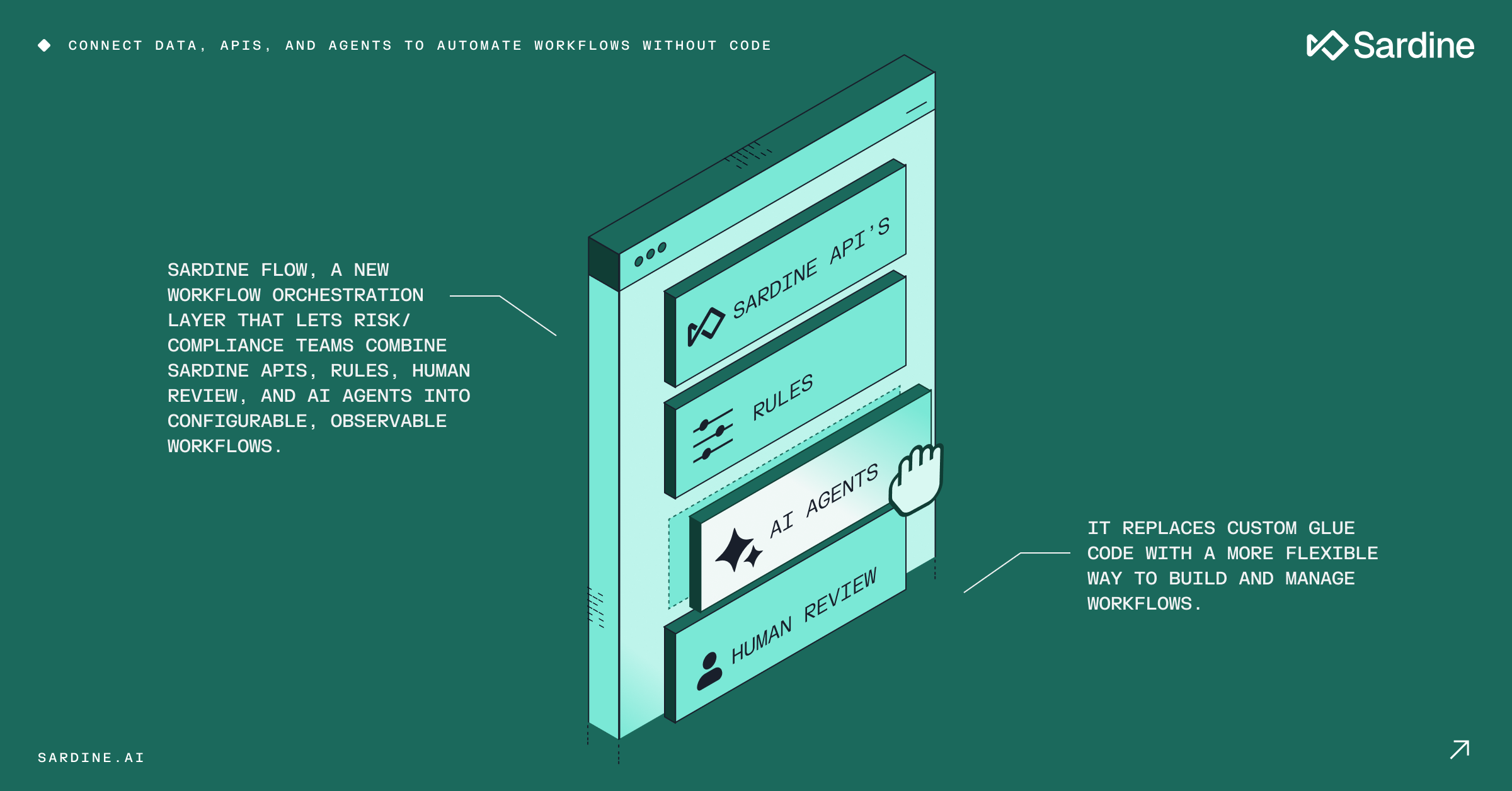
Today, we’re introducing Sardine Flow, a visual workflow orchestration platform for building, running, and monitoring fraud and compliance processes across Sardine products, third-party data, rules, AI agents, and human review.
Flow turns the individual steps behind a risk decision into a connected workflow, so teams do not have to choose between deterministic automation and AI. They can use predictable workflow steps where the process is known, AI agents where investigation or judgment is required, and human review where people need to make the final call.
The result is less custom code, greater visibility into how decisions are made, and a faster way to build and improve risk operations.
Why we built Flow
When we work with fraud and compliance teams, one of the first questions we ask is whether there is a documented SOP for the process.
If the answer is yes, much of that work can usually run deterministically. The steps are known, the conditions are defined, and the process can execute consistently without requiring an AI agent for work that is already well understood.
But many risk processes are not that clean. They involve ambiguity, investigation, unstructured information, or judgment that can’t be fully captured in a predefined workflow. That’s where an AI agent is the better fit.
In practice, most fraud and compliance operations require both. A single process might combine deterministic checks, AI investigation, external data, and human judgment. And that mix can change over time. A team might start with an agent when the process is poorly defined, then move the stable, repeatable parts into deterministic workflow steps as patterns emerge.
That’s why we built Sardine Flow: to give teams one place to combine deterministic workflows and AI agents, using each where it makes sense, rather than forcing every risk process into one model of automation.
The problem with glue code
Fraud and compliance workflows are rarely simple, and no two businesses run them exactly the same way.
The data providers, internal policies, approval steps, and actions involved depend on each company’s products, customers, risk appetite, and regulatory requirements. Even a common process like customer onboarding might require a unique combination of identity checks, device intelligence, internal data, risk rules, AI analysis, and human review.
Connecting all of those steps usually requires custom code. Teams build individual integrations, scripts, scheduled jobs, and decision logic for each process. As the business changes, that code becomes harder to maintain, monitor, and update. Adding a new vendor or changing a review step can turn into another engineering project.
It's a process, usually built once, patched repeatedly, and rarely observable end to end. When something breaks, you're debugging glue code instead of your actual risk strategy.
How Sardine Flow works
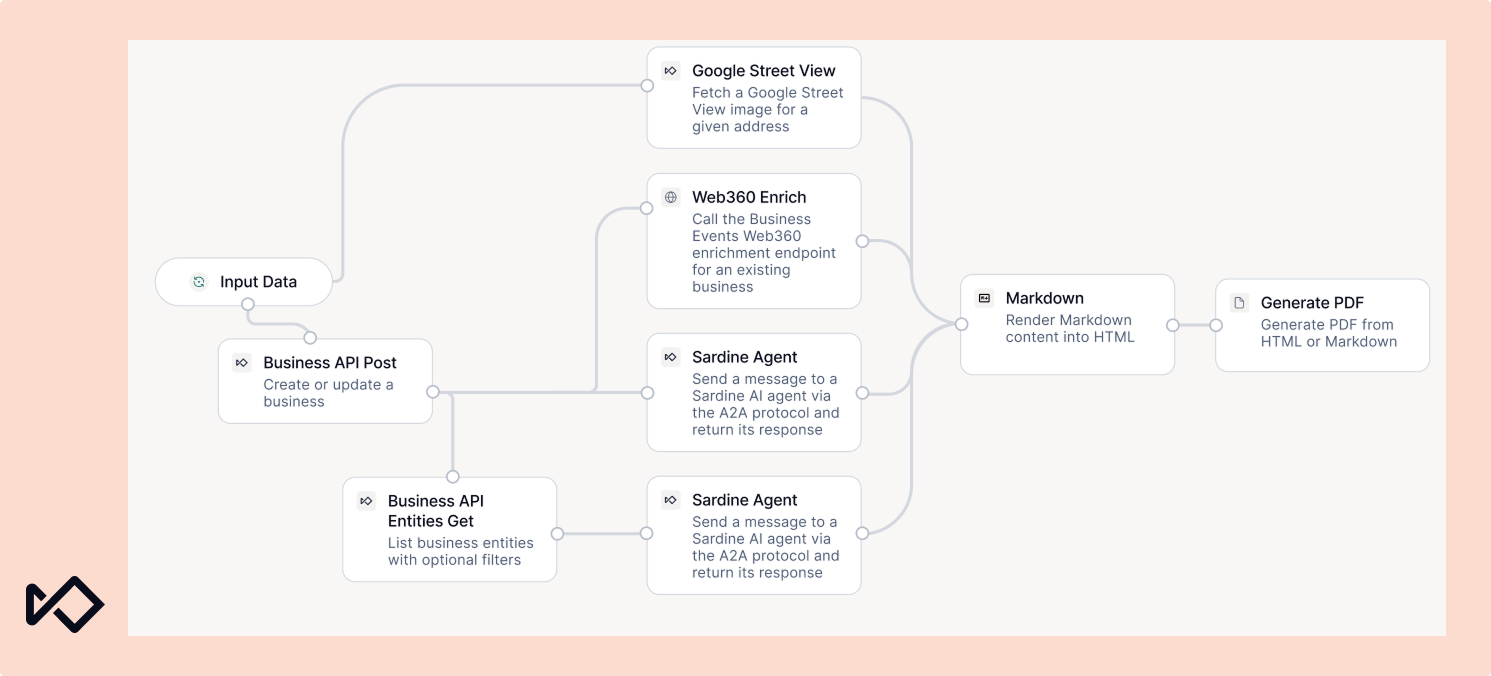
Sardine Flow gives teams a visual, drag-and-drop builder for assembling the steps behind a fraud or compliance process.
A workflow can:
- Start from an API request, event, or scheduled task
- Call Sardine products and third-party data providers
- Apply rules and conditional logic
- Invoke an AI agent to investigate or interpret information
- Route a case to a human reviewer
- Trigger actions in downstream systems
- Record each step and its outcome
Flow then runs the process consistently and provides visibility into what happened at every step. As Flow has moved into production, we’ve added more control and visibility for teams operating workflows day to day. Teams can control which nodes are available to different users, see performance and execution stats for each flow, and manage workflows through a more structured interface built for production use.
Two things make this different from a one-off script:
- Consistent execution. Each workflow defines what information it receives, how each step runs, and what it returns. That makes the process easier to test, monitor, and update than custom glue code.
- Support for different timelines. Flow can support low-latency decisions as well as processes that pause while waiting for a vendor response, scheduled event, AI investigation, or human decision.
That flexibility matters because risk and compliance work isn't uniformly the same speed. An onboarding or KYC workflow may include automated checks, vendor responses, AI investigation, and human review, with some steps completing immediately and others taking longer. Flow is designed to orchestrate both.
Built for real-time and long-running work alike
Because Flow supports different triggers, steps, and timelines, teams can use it across a wide range of fraud and compliance processes:
- Customer onboarding and KYC/KYB
- Transaction monitoring and risk scoring
- Dispute management
- Enhanced due diligence
- Manual review
- Periodic customer reviews
- AI-led investigations
For example, one neobank customer uses Flow in production to automate its false-positive allowlisting process. Every 15 minutes, the workflow retrieves alerts analysts have cleared as false positives, runs additional checks, and adds customers that meet the required conditions to a custom allowlist.
Instead of having an analyst repeat that process manually, Flow runs it consistently and records what happened.
Customers are also applying Flow to recurring due diligence reviews and dispute processes that previously required teams to move between multiple systems manually.
Rules, AI agents, and people working together
We don't think the future of risk decisioning is rules versus AI. The approach that actually works combines both, plus people, depending on what a given decision needs:
- Rules enforce policies, thresholds, and decision logic that must remain consistent
- AI agents investigate cases, analyze documents & other unstructured information, and summarize findings
- People resolve exceptions and make decisions that require accountability or judgment
Flow brings all three into the same process. Every rule result, agent action, and human decision appears as part of one workflow, giving teams a complete view of how an outcome was reached.
A useful way to decide where each belongs is to ask how clearly the work can be defined. If a team has a documented, repeatable process, it can usually be represented as a workflow. If the work involves ambiguity, investigation, or unstructured information, an AI agent may be the better fit.
The two can also evolve together. A team may initially use an agent to investigate a poorly documented process. As consistent patterns emerge, the predictable parts can be converted into lower-cost workflow steps, while the agent continues handling exceptions and judgment-intensive work.
From risk products to a risk operations platform
Every risk process is different, but the underlying building blocks are often the same: data, rules, decisions, reviews, and actions.
Sardine Flow makes those building blocks reusable. Teams can connect Sardine capabilities with their own policies, external providers, AI agents, and operational processes without building a new integration for every use case.
That gives fraud and compliance teams one place to configure how work gets done, monitor each execution, and improve processes as their risks and policies change.
If your team is stitching together vendors, rules, agents, and review steps by hand, contact us to see how Sardine Flow can simplify the infrastructure behind your risk operations.
FAQs
What is Sardine Flow?
Sardine Flow is a visual workflow orchestration platform for fraud and compliance operations. It lets teams build, run, and monitor multi-step processes that combine Sardine products, third-party data, rules, AI agents, and human review.
Why did Sardine build its own workflow tool instead of using something off the shelf?
We looked at general-purpose automation tools before building Flow. They're good at what they do, but they carry a lot of functionality a fraud or compliance workflow doesn't need, and they're missing the things it does need: native access to Sardine's rules, data, and case management, plus the ability to chain deterministic steps and AI agents together in the same process. Flow is purpose-built for that instead of adapted for it.
How is Flow different from Sardine's rules engine?
Rules and workflows solve different problems. A rule checks a specific condition and flags or blocks accordingly. A workflow is the bigger process around that decision: which checks apply, which vendors get called, who reviews what, and what happens next. Flow is where you build that process, and a rule check is simply one of the steps it can include.
Does Flow support AI agents, or only rules?
Both, in the same workflow. You can combine rules for the parts of a decision that need to be predictable and auditable, AI agents for the parts that involve judgment or unstructured information, and human review for final sign-off, all as part of one connected process.
What kinds of workflows can I build with Flow?
Both real-time and long-running workflows. That spans low-latency use cases like transaction monitoring and transaction risk scoring, and longer-running or scheduled work like onboarding, KYB/KYC, disputes, enhanced due diligence, manual review queues, and long-running agent investigations.
Is Sardine Flow generally available?
Sardine Flow is live in production today, with support continuing to expand across additional use cases and workflows.
How do I get started with Sardine Flow?
Contact our team to see how Flow fits your existing risk and compliance processes, or reach out to your Sardine account team if you're already a customer.