How Asoview chose to protect customer experience without compromise



Asoview operates two products: "Asoview!," a consumer booking platform for leisure and outdoor experiences across Japan, and "Urakata," a reservation management SaaS for facility operators. Together they serve approximately 6,000 partner businesses and 16 million registered members. When high-demand tickets go on sale and transaction volumes spike in seconds, any friction in the payment flow has a direct cost. That operational reality is what drove Asoview to build a fraud detection capability independent of its payment providers.
The challenge: A fraud posture tied to the wrong decisions
Asoview had been relying on fraud tooling bundled into its payment service providers. The arrangement worked until Junya Ebe, Senior Executive Officer and CIO, thought through what it actually meant over time. Every time Asoview switched PSPs, the fraud posture reset. Accumulated data, learned patterns, tuned rules: none of it transferred. "We concluded that having our security posture tied to the commercial decisions of a payment provider created a structural risk over the medium to long term," said Ebe.
For a platform where safety is a stated operating principle, that dependency was a structural problem. Asoview defines "safety" across three concrete areas: information security and data management, system availability under load, and seamless experiences for consumers and facility operators alike.

There was also a specific performance concern. Asoview's transaction volumes are uneven. When a popular ticket or experience goes on sale, demand spikes almost instantly and any latency added by a fraud check at that moment degrades checkout directly. The existing bundled tooling offered no meaningful performance guarantees for those conditions. As Ebe put it: "When high-demand tickets go on sale and traffic spikes sharply, transactions need to keep moving."
The solution: Behavioral signals at checkout speed
Asoview evaluated vendors across six dimensions: detection methodology, latency and throughput, implementation overhead, selective coverage by product category, cost structure, and long-term product trajectory. Processing speed was weighted most heavily.

Speed under load
Sardine's average response time of under 0.2 seconds, with the ability to handle hundreds of requests per second during peak load, cleared that bar. Sardine also allows coverage to be applied selectively by product category rather than uniformly across all transactions. For Asoview, that meant concentrating detection on higher-risk categories without adding overhead everywhere else, a more defensible cost structure than blanket coverage.
Behavioral biometrics and device intelligence
The detection approach that stood out was the combination of behavioral biometrics and device intelligence. Sardine analyzes subtle behavioral signals including mouse movement, typing cadence, and smartphone tilt to distinguish automated activity from real users. "In an era where generative AI makes it increasingly easy to fabricate personal information, unconscious behavioral patterns are far harder to spoof," said Ebe. "That's precisely where this detection approach has an edge."
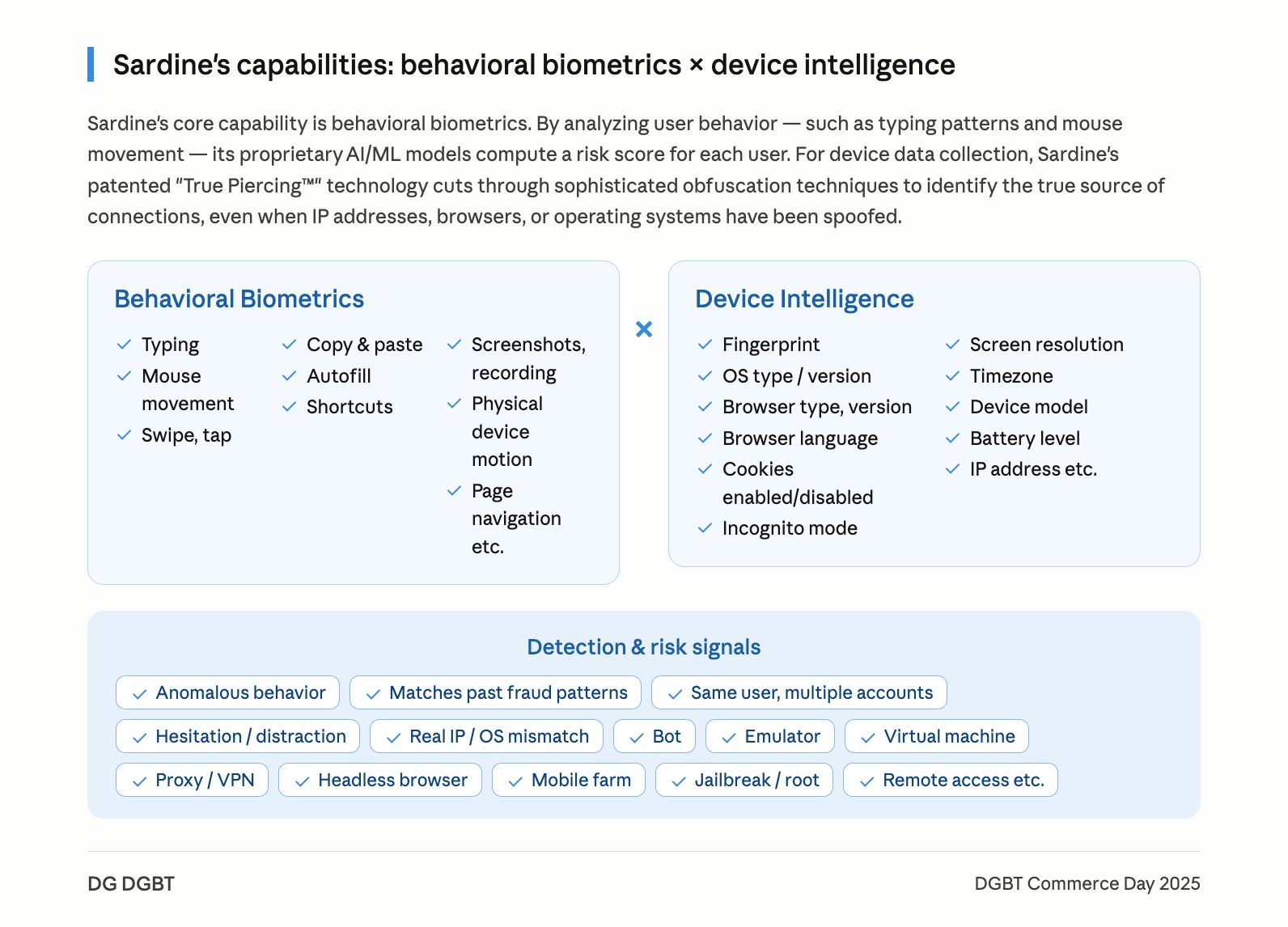
Sardine's ability to identify true connection origin even when IP addresses are manipulated to present overseas access as domestic was a practical differentiator. Asoview sees this type of spoofing regularly in its transaction data, and Ebe noted the impact was tangible from early in the deployment.
The hybrid architecture, combining AI and rules-based logic, addressed a gap that either approach leaves open on its own. Pure AI takes time to reach reliable accuracy on new patterns. Rules alone can't adapt quickly enough as tactics shift. The two layers compensate for each other, which is what matters in production.
Implementation and ongoing operations
Asoview's in-house development team handled the integration and was live in under a month, faster than anticipated. The initial configuration leaned on rules, with the AI model building accuracy as transaction data accumulated. Rule changes are handled by DGBT, Sardine's Japan distribution partner. Asoview passes fraud data and feedback through, and DGBT handles tuning without requiring internal engineering cycles. When an immediate block on a specific pattern is needed, DGBT's consulting team translates that into rule logic directly.
The results: Fraud down, false positives flat
Asoview went live in August, peak summer season. Fraudulent transaction rates dropped materially within the first month, during the conditions that put the most pressure on the system.
"We're now blocking fraud with surgical accuracy, using granular parameters like operating system, screen size, and behavioral signals without disrupting legitimate customers' purchasing experience."

Sardine is blocking fraud using granular signals including operating system, screen size, and behavioral patterns, without adding friction to legitimate customers at checkout. False positives did not increase. As fraud-related contacts declined, support capacity shifted away from incident handling and toward core service issues.
Looking ahead: Scaling as the attack surface grows
Asoview is expanding from activities and leisure into events and travel-adjacent categories, and accelerating internationally. New geographies and a broader product surface mean a larger attack surface.

The fraud data Asoview accumulates feeds back into Sardine's model, raising detection accuracy over time. The plan is to lean further into that AI model as data builds, shifting toward higher-precision detection with decreasing reliance on manual rules. "The fraud data we accumulate feeds into Sardine's model improvements, which in turn raises our own detection accuracy," said Ebe. "It's a compounding, mutually reinforcing relationship. That's the kind of sustained, win-win dynamic we intend to maintain."