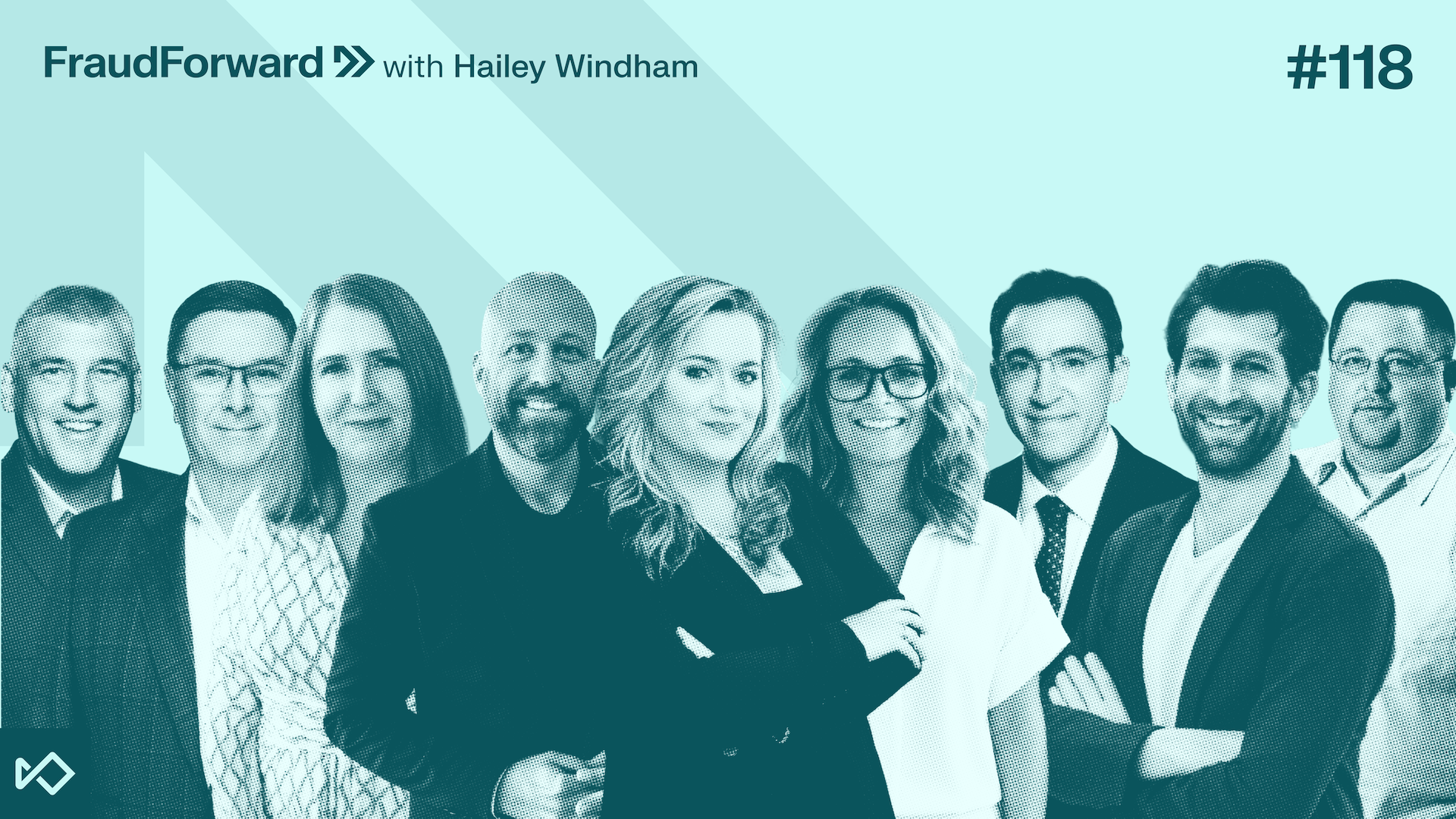
Hailey Windham Intro
00:05
What is up, fraud fighters?
Okay, in part one, you heard how fraud fighters are describing the current state of fraud: acceleration, chaos, fractured, explosive. And honestly, none of those words felt exaggerated.
But this part of the conversation mattered just as much to me because after asking people, you know, what fraud feels like right now, I asked them something different. I said, what is something your team does that you are really proud of?
And the answer shifted. You know, less fear, less pressure, more purpose. You start hearing words like collaboration, communication, empathy, innovation. Not perfect solutions. Just people who genuinely care about protecting others and figuring this all out together in real time. And that is what stood out to me most at Fraud Fight Club this year.
You know, not just the technology, not just the AI conversations, which, you know, are happening a lot now, not even the tactics, but it is the people. People willing to share ideas, people willing to admit that they do not have every answer, right? People building relationships outside of their own institution because they know that fraud is too big to fight alone.
You will hear that theme over and over in these conversations. You know, cross-functional teamwork, 314(b) information sharing, fraud teams working closer with AML, law enforcement working closely with financial institutions. And underneath all of it, a growing realization that fraud is not just a transaction problem. It is a human problem.
You are going to hear clips from fraud leaders talking about proactive outreach, member communication, AI, prevention strategy, operational agility, and the importance of empathy in moments where people are often at their most vulnerable. And honestly, it left me hopeful. You know, not hopeful because fraud is slowing down because, you know, it is not, but hopeful because the people fighting it are evolving, too.
And, you know, before we get into the rest of the interviews and conversations from Fraud Fight Club, I want to start this episode with three interviews that really capture, I think, the big picture of where the industry is right now. Three very different perspectives, but all connected by the same underlying theme. We cannot fight this alone anymore.
What is up, fraud fighters? A quick pause before we jump into today's episode because I want to point you to a blog that I think cuts through a lot of noise that is happening right now around AI agents in banking. There has been a ton of hype lately about AI replacing analysts and fully autonomous investigations, but Chen Zamir of Sardine wrote a blog that actually explains what an Anthropic-powered KYC agent really is and what it is not.
And the part that I appreciated most about it is that it does not frame AI like magic. It frames it like infrastructure because fraud teams do not need another flashy demo. We need systems that help investigators move faster, document decisions better, reduce that manual review fatigue, and still keep humans in control where it matters.
The blog walks through what these agents are actually doing behind the scenes, how they interact with KYC workflows, where human oversight still matters, and why governance, auditability, and operational design matter just as much as the model itself. So if your institution is trying to separate real operational AI from marketing buzzwords, this is worth your time.
So check out Chen's article, Anthropic KYC Agent: What It Actually Is. I will have it linked in the show notes. And yeah, so let us get into the episode.
So first, you will hear from Paul Raffile talking about where the industry is heading, why collaboration outside the walls of financial institutions matters more than ever, and the importance of shifting left before the scammers ever reach the bank.
I also got to hear Paul recently in person again at IAFCI Connecticut, and top-notch human.
Then Marc Evans will come on. He brings the conversation back to something we sometimes forget in all the AI and analytics discussions, and that is that fraud is still a human problem.
And finally, Kitboga. Yes, you heard that right. The Kitboga, who honestly represents one of the most unique voices, I think, in this space. You know, he is someone who is actively innovating, experimenting, and engaging directly with these scammers in ways most organizations simply cannot. But he will be on sharing a little bit of those insights that he has as well.
And, you know, these conversations really set the tone for everything else that you are going to hear in this episode. So let us jump right in.
Paul, we are here at Fraud Fight Club round three. And first of all, thank you so much for all you do in the industry. I am a big, huge fan of yours and just happy to have you join me today.
Thank you. It is a pleasure to be here.
Yeah. Okay. So again, we are at Fraud Fight Club round three. This is your second year back again.
Me too. Last year was really cool. This year, something feels a little different. What would you say about this year compared to last?
I think there are two big things. First, there is momentum building, which I feel really optimistic about. Secondly, we are seeing just a more shift towards AI technology. That is a big change in this industry too.
Yeah, I think it is one of those that it is like, hey, technology can be really cool. It is also really scary. How do we make sure that we can combat this effectively? And so those are some really interesting conversations that I am hearing around the event this year.
Yeah, I think that is where we need to catch up on because the fraudsters, the scammers, they are way ahead when it comes to technology. They are using systems that, you know, it will take us two years to even adopt here. So really interested to see the solutions that are here and also the challenges that we are facing these days too.
Yeah. Okay. So were there any sessions in particular that maybe you joined or spoke on, if you did a deep dive, that there was a lot of back and forth or collaborative conversation that really, you know, you enjoyed the most?
Yeah. You know, I think we all kind of know this, but financial institutions are at the back end of when a fraud or a scam happens, and there is 90% of the scam before that. And thinking about how to shift left of bang, you know, we are having great conversations about how to engage with social media platforms, messaging services, telecommunications. And I think that is a big part of the equation too.
Absolutely. So if you could tell one person who is like on the fence of like, maybe Fraud Fight Club is just too cool for me. Maybe they just had too much fun there and, you know, it is not really a conference because they are all just hanging out. What would you say to that person who is maybe looking for budget from the CEO that is like, I do not think you should go there, or, you know, whatever?
Check out the agenda. There is so much valuable information that we see on the agenda. The speakers are amazing. It is like the Fraud Avengers are all here. It is really wonderful.
I love that. I am so glad that you joined me. So glad that you are here again to bring us your information. Is there anything that you want to say specifically about the scam program that you are building as well? I would love to kind of have some teaser knowledge about it.
Yeah. So what we are trying to build here is a scam education program for youth specifically. Yeah, we know that they are being targeted by so many different scams nowadays than what we are used to, financial sextortion being one of them, the primary one and probably the most dangerous scam that there is out there. So just trying to put out recommendations, prevention, and guidance to prevent these incidents.
Marc, welcome to Fraud Fight Club round three.
Is this your second time?
My second time, yes. I came last year too.
So yeah. What is the difference, do you think, between last year and this year?
Last year, what I really liked about it is also for this year. I really like about it is kind of the shorter main stage ones because it gives people more time to connect, like really connect. It gives more time for the deep dives that we have got going on. Because I think this is probably the best networking conference that I have been able to attend, and everyone here is really passionate about taking the fight to fraud. So between last year and this year, that is what I like the best.
Yeah, for sure. So I just had the honor of attending your and Jen Lamont’s session on collaboration. Number one, phenomenal presentation. The two of you together really showed what collaborative efforts can do as far as bringing together a full investigation from credit union needing a law enforcement and law enforcement actually responding. That was one of your callouts.
So I just want to say, you know, any highlights that you want to give for people that maybe missed that session of like, what were the key points and takeaways from that?
I think the first key point is not being afraid to reach out. I know sometimes there is that fear of, oh, if I contact this person, they are just not going to respond. And my response was in a matter of a minute through a third party. It was not even directly between Jen and I. Jen reached out to someone who was able to reach out to me, and within a matter of five or ten minutes, we were in contact with each other.
And so I would say, do not be afraid to reach out. Do not be afraid to use your network. LinkedIn is a great network. A lot of us are conditioned to change my career. I mean, it changed my career. So I would say, do not be afraid to take that first step, and do not be afraid to talk to each other and be real with each other.
You know, we like to be professional about all things, but we have to actually have true, real conversations about what we can and cannot do, both from the law enforcement side and from the FI side. And if we do not have those real conversations, then we will never get forward in fighting fraud.
Yeah. So I have a fun question for you. Earlier, I was interviewing someone and they said that this conference or this Fraud Fight Club feels like it is the Fraud Avengers that are coming in. And as our own Fraud Hero, who would you say is your, if you were the fraud Avenger, which Avenger would you be?
Oh, if I was a fraud Avenger, I am a Captain America fan myself. I will be Captain America. I saw my socks.
Oh, please. You. I got you, Captain. Look, show socks. There you go.
Yes, I got the Captain America socks on. But I definitely would equate myself to Captain America. I am not Iron Man, and I am a big nerd, so do not get me talking on this stuff.
I love it, but I am with my nerds. They said yesterday that they referenced Harry Potter in their session.
But I would definitely go Captain America because I feel like I am more grounded. I am not really tech-based, and I feel like I am not Iron Man because I do not think everything is tech-based. And I think fraud is not just a tech problem. I think it is a human problem.
And I think that is kind of what Captain America encapsulates, is showing the human side of being a hero. And that is why I like to be humble. I humbled myself on stage today and said, hey, I did not respond to a message two weeks prior, so that is what I would equate myself to.
Yeah. And I think you really show the true value that us fraud fighters are, and you represent it so well where it is truly mission-oriented. You know, Captain America is that, you know, it is all for the greater good. And I can see that in a lot of what you do, especially with how you approach, you know, victims empathetically, how you collaborate, you know, effectively. And like truly, we appreciate having someone like you in law enforcement that shows that it can be done.
Also that shows us it is okay, reach out, make those connections. Because, I mean, as much as we want to, fraud investigators at a financial institution, we do not have the authority to arrest anyone.
But we can call friends that can. So I truly appreciate it. I appreciate you joining me today. Any parting words or thoughts from Captain America for fraud fighters?
I mean, I will quote Captain America in this. And this was in, I believe, the first Avengers movie. Me, my nerd stuff in the movie. No, it actually was not. It was Civil War. And in the movie, Captain America says, well, what if we fail? And he goes, well, we will fail together. And I think that should be the mindset of everyone. If we succeed, we will succeed together. But if we fail, at least we tried and we failed together and we did not fail apart.
I am going to cry. You are the best, Marc. Thank you so much for joining me and thanks for being a part of Fraud Fight Club.
Well, thank you. I am having fun being here.
I do not even know how to begin, but like, Kitboga. Hi.
You are here at Fraud Fight Club. First of all, thank you for agreeing to chat with me. Like, even for a quick second. I appreciate it so much. You are one of those in the industry that it is great because you help the fraud fighters get validation from the everyday consumer because they are like, oh, that guy. He messes with the scammers. And we are like, yes, that guy.
So first of all, I want to ask, like, super quick, just to, you know, how did that even come about? Like what made you start that?
Yeah. Nine years ago now, which is kind of crazy to say. Nine years ago, I got the tech support scam. If you are familiar with it, the fake virus pop-up that says, of course, Microsoft, your computer has been hacked. I saw the phone number. I called it. And immediately some guy told me that my computer has viruses on it, that he was in my computer right now.
And then I knew that it was a scam, right? I hung up the phone, but I thought my grandma 100% would fall for it. Alzheimer’s, dementia. And so I am like, I have got to do something. So I just started calling the numbers when I had free time, usually on the weekends. And I figured if I spent ten minutes on the phone, that was ten minutes they were not scamming someone’s grandma.
And eventually a clip wound up on Reddit and it blew up. It just took off. And everybody knows where I got the glasses. Like originally, I did not wear the glasses. And I am like, there are people watching me. I have got to hide. I have got to hide. No one can know who I am. And now it is just the thing.
And you make us cool to kids too. You know, my kids are like, you know Kitboga? And I am like, oh yeah, we are tight. We are so tight. You see him? He pointed at me in the picture, not the other way around.
So I would love to know, like, obviously Fraud Fight Club, there is a lot of hype here, but they seem to back it up each time. So I would just love your initial thoughts on Fraud Fight Club whenever you got involved. I know that you were here last year. Just want your thoughts on it.
Yeah. Last year was my first year. It was actually probably one of my first three or four fraud conferences at all.
Oh, wow. That was like your first experience of a fraud conference. It set the bar really high.
And it is. It is by far my favorite conference that I have been to. And I think it is genuinely the people, like meeting you, meeting so many. Ian Mitchell. Like, there are just so many really good people. I got the caring from HUG, right? It feels more like that hug. It feels like a, I do not know, fraternity is not the right word.
But that sort of felt like, to me, it is a club.
Thank you. It did not feel like a conference. It felt like, I think I said it on stage this year, but I am so proud and honored to be welcomed in and to join the fight with you guys. There are so many people here doing really good work. So I think that is the other reason why I like coming here and mingling with everyone is like, how can we actually fight together?
I think there are a lot of people where we are talking the same language. We are trying to do the same things, all the same problems, maybe from different angles. But some of the other places, there are good conferences, do not get me wrong. But you do not always find that camaraderie. Maybe that is a good word. Like, we are in this together.
For sure. For sure. I hope that was not too long ago, and I know I love that answer. I think it is a perfect answer. And I can let you go right after this question. I had someone earlier say that Fraud Fight Club felt like the Fraud Avengers have assembled. So my question to you is, if you were a fraud Avenger, which one would you be?
Oh my God, this is embarrassing. I do not know any of the Avengers.
Oh my. Please do not put this on the internet.
We will take that. I am just kidding. You can put it on the internet. It is funny.
I genuinely could not name a single Avenger.
Oh. Iron Man. Okay, fine. I would be okay. I do like the Norse mythology.
Yes. The hammer of, I do not know.
Just come on. Like hammer, hitting the scammers and coming in as like the, you know, when Thor comes in and like it is the big circle or whatever, you see the whole.
I kind of feel like that is you. You could be the Thor of Fraud Fight Club.
I appreciate that. I only know a little bit of what that entails now. But no, I also like, I see myself, and maybe I am overstepping here, but sometimes I get a chance to, I say I have even the privilege to, because of things like YouTube, get up there and try crazy stuff and see what works. It is like being able to prototype and innovate and see what happens, and then come here and say like, guys, I tried some cool things. Here is what worked. Here is what did not. Here is what the scammers fell for. Here is what I learned.
And I think it is sometimes a little bit harder for a bank to just try crazy stuff.
It definitely is. So you inspire all of us, and you also do the things that we wish we could do. Between you and the movie Beekeeper and they blow up. I was like, oh, there is some sort of a validation there that I probably should not feel pleasure from. I do, though. At the same time, you do that for us, and I just want to say like from one fraud fighter to obviously another, thank you for all that you do. And thanks for obviously contributing your time to us at Fraud Fight Club and then to the little bit of a podcast here today.
Yeah, of course. Appreciate it.
Obviously, I am a longtime fan of The Knoble and everything there. Obviously with the human aspect, that empathy, that really truly understand that there is a human behind every transaction. So a question that I have been asking everyone today and what I think will be really great coming from you is what is something that your team does well that you are really proud of? But I think, obviously, it is The Knoble network itself too. So you can speak specifically to the team and also the network if there is some really cool stuff going on.
Well, the network just continues to surprise me. We had a little coffee meeting this morning, and I just like, I get to meet people from all over the world now. But I get to meet people that it has gone far beyond just Ian and a small team. The network itself is an organism that literally is recruiting other people and opening their minds and giving them tools.
I mean, it has just become, I think that is the coolest part about me, is like back in 2018, it was an idea, and now it literally is a group of people with like-minded kind of beliefs that our job really matters. And that is the part I love. We are doing the World Cup project coming up, and we did the calculator on scams, on the ROI. I mean, so many neat tools there that I am hearing actually being used, like the scam calculator. I mean, we have a money mule thing. I mean, these are actually tools that people are putting in place, and I love that.
But just coming up and getting hugs from people I do not even know, but they are just realizing that their job matters, it is like that to me is the best part about what I get to do.
Yeah, I think probably one of my favorite things that you say anytime that you go on stage to talk about The Knoble and the work that is being done is you say, The Knoble is, well, it is all of you. And when you say that, it just, it really, I think, you know, speaking from somebody that comes from the audience, but also someone that has been able to participate in some of the initiatives, some of the conversations being had with the webinars and whatnot.
But being able to hear that and feel truly that I can be a part of something that is bigger than myself, that I can bring this crazy knowledge that we have that is like, why do I even have this knowledge, but use it for the better good, and that it can actually benefit someone. We can use it to be collaborative. We can use it to be innovative and really partner with others to truly understand what is going on.
I just want to call that out, that I just love that that is how you always start it because it means so much to us that is sitting in the crowd.
You are an embodiment of that. And then Donna Turner won a big award, and she is like, I mean, yeah, she is also that. It is like we work with so many good people in our industry and it is awesome. And I have to just tell you, you just got chills too. She is good. But there are so many of them, like, these are the leaders that exist.
But then the next wave of leaders, I hate to say it, are going to be ten times better than all the old ones like me that have been around for a while. And so you all, I mean, the future of fighting fraud looks bright, and with PJ and Ronald leading the charge and the party you guys had here the other night at the house. I mean, just the house party of fraud fighters. That was so cool.
I mean, it just is such a great community now. It is a great career. I met with a young woman who just got out of college last night, and she found herself in fraud, and she is so excited. What a career to jump into. It truly is full of meaning, purpose, and a whole lot of great people.
Absolutely. And it is all because of the leaders like you, though, that have taken the time to bring us newbie fraud fighters up under your wings and really help guide and lead. You know, I will always credit you for pulling me out of that moment of despair in my life as a fraud fighter. You know, sometimes days get really hard, but you were like, hey, there is a whole world out here of fraud fighting and things that we could do together, and I will forever be grateful to that.
So thank you for you, Frank McKenna, Mary Ann, the knowledge that you guys are willing to share. It has been like, you guys, I just, we are grateful.
Yeah, well, I love you too. And it is going to take a complex network, complex solutions to fight a complex problem. And with folks like you and some of the others, we are going to be in great shape. So thank you, Hailey.
Absolutely. One final question. I was talking with someone earlier today, and they referenced Fraud Fight Club as the place where the Fraud Avengers assemble.
If you were a fraud Avenger, who do you think you would be?
Oh, I do not know. What I can tell you is at the gym, the nickname for me at the gym, when I walk in, they all scream Batman.
What is something that your team does well that you are proud of?
One thing that our team, I think, does really, really well is find fraud rings for our customers. I think we have really interesting data that helps us on the auto lending side and personal lending side. It covers over 650 different lenders. So we are able to kind of find those patterns that hit lenders that they do not see on their own portfolios. I think we do a really good job. Our fraud team, that is all they do all day, is try to find those patterns. So I think we do that good. I am really proud of that.
Yeah, that is so cool. Best of all. Last question for you. I was interviewing someone and they said they described Fraud Fight Club as it is like where the Fraud Avengers assemble. And so I am curious, if you were an Avenger, which one would you be?
You know what is embarrassing? I do not even know one Avenger.
Why do you not tell me who you think I would be? That is probably better.
Well, so, you know, we have Iron Man, and he is really techy.
Oh, okay. Is it like a superhero?
Yeah, a superhero. So you can even think X-Men, if you want, or, you know, the Marvel. What do you think?
What about the Wonder Twins?
Because I would be the Wonder Twins with Mary Ann Miller.
Because we worked together so long, and we each complement each other really well. And so I think together, we are a better force than we are individually. So maybe the Wonder Twins.
The Wonder Twins. That guy and a girl, or two?
I do not know either. Maybe it does not matter.
Wonder Twins, whoever you want it to be. You and Mary Ann now. Thank you so much for joining me, Frank. I really appreciate it. This has been fun.
What is up, fraud fighters? Quick question. I have asked it, but I am going to continue asking it. How many times have you been asked, how do we compare to our peers? And if we are being honest, how confident did you feel answering that?
Because most fraud leaders today are trying to benchmark using call reports, vendor reports, or conversations with peers. And while some of that data is helpful, it rarely tells the full story. That is exactly why we launched the FI Fraud Benchmarking Survey for credit unions and community banks.
This is not just about fraud losses. We are capturing staffing and workload, alerts and case volume, program maturity, executive reporting, technology, and operational realities. Because two institutions can have the same losses and operate completely differently behind the scenes. And that context matters.
So again, this survey is fully anonymized and aggregated, administered by a third-party provider, built to create benchmarking data fraud leaders can actually trust. So if you work in a credit union or community bank under $10 billion in assets, we would love your participation. The link, again, is in the show notes. Let us build something this industry has needed for a long time. Fraud evolves and so do we.
What is something your team does really well that you are proud of?
My team is able to ask questions when we do not know the answer. So The Clearing House in my organization is only a year old, right? And that is my work anniversary too, right?
And so there is a lot of payment-level information and some of the specifications that you can really dig into, like the rules and operating rules and the interpretations. And there is just so much paperwork that I think it is impossible for anyone to know. And I think that it is a really important skill to say, hey, you know, maybe play the new guy card, maybe just say, hey, I do not know what is going on, or if you could just tell me a little bit more detail, and I am happy to circle back.
But it is an important skill to have. It helps to build that credibility and also helps to make sure that we are solving the problems as accurately as we can for our clients.
I love that so much and appreciate it. Okay, final question. Earlier in the day, I interviewed someone and they referred to Fraud Fight Club as where the Fraud Avengers assemble. If you were a fraud Avenger, who would you be?
Well, I think it for saying Marvel. Like Marvel Avengers.
Marvel. Okay, so I have taken this test. I have taken many. I am a nerd, so I have taken the test. I have had, you know, AI tell me who would I be. I have asked my wife this question. It is all kind of funny that we are talking about it now. Captain America.
Yeah. He is just the, you know, I tend to find myself in leadership positions. I tend to be able to move people together and, you know, put my, and also maintain strong moral and ethical perspectives when moving to bring everyone together. I think that would resonate. I think he resonates with me really well.
I agree, but my first choice for you is actually Hawkeye.
Just because, you know, the precision, first of all, right? I mean, he comes in, and he just like saves the day, but also the loyal aspect of Hawkeye. Like, he is really true to his team and his family. And I feel like that is what we are. And like, I just watched the Civil War again, and when he goes to save the Scarlet Witch, he is like, so all of this is just falling apart without me?
Now you get it, right? Right. So being in fraud, I know that also our team matters, right? And our team does some pretty remarkable things. One of my favorite questions I have been able to ask, you know, over the last few days is, what is something that your team does really well that you are proud of?
They do exceptionally well with member contact and communication. They are not afraid to pick up the phone, reach out to a member because that is good quality. That is the fastest way to resolve it. And also, you receive a lot of positive feedback from that. You know, sometimes people will say, oh, of course it was me, and not be as happy about it. But nine times out of ten, you get a very grateful response from that.
I love that, and I think it shows truly also the value of explaining the why. Like, hey, we are calling because this seems odd. It lets them understand, oh, well, maybe you are protecting me, right? And it also helps to kind of rationalize what the financial institution is doing to protect them.
If you were a fraud Avenger, which one would you be?
I would have to go with Hulk because every time we have a problem, we just smash it.
Yeah. That is right. Just smash all the walls in the way. I love it. Hulk smash!
Okay. I love that question of, you know, if you were a superhero or if you were a fraud Avenger, who would you be? I think it is just a fun way to end an interview. But listen closely, and it actually tells you a lot about how someone approaches this work. You know, Captain America, Batman, the Wonder Twins, Thor, Hulk. Although honestly, I still think Frank McKenna might actually be Vision.
But, you know, there is leadership, preparation, partnership, persistence, smashing through problems when you have to. Different personalities, different styles, same mission. And honestly, that might be the best summary of Fraud Fight Club that I could give. A bunch of people from completely different backgrounds bringing different strengths to the table and realizing we are all trying to solve the same problem, right?
So for the rest of this episode, I want to take you through more of these conversations. You are going to hear about communication, collaboration again, that operational agility, AI, empathy, prevention strategy, and what fraud teams are doing right now to adapt to an environment that keeps changing underneath them. And more than anything, you are going to hear people who genuinely care about this work. So here they are.
This is a question I have been asking everyone. What is something that your team does really well that you are proud of?
So we have actually deployed the use of AI and actually using it. A lot of companies say they are using it and on the journey there. We have actually completed the journey and we are seeing real-time ROI results on this. It is able for me to take a team of two analysts and act like a team of ten.
In our world, we have lots of data. Everybody has lots of data. And we are able to really use that tool along with the analysts to get to a position we could never get to before.
Very cool. I think it is great. I know that AI is one of those things that it is hard to adopt for the smaller organizations because there is that fear of replacing your teams, but in reality, it is not it at all.
No, it actually created some more work for us, not enough we cannot manage. But it definitely created some more work, which means we found more risk. It is not a bad thing.
No, definitely. You want to detect it before it becomes blatantly obvious in your losses.
Let us move this way left, right? Which is a great scenario for us. We do not want to be reactive. We want to be predictive. That is where AI has helped us.
Yeah, I love that so much.
I am really excited to ask this question, mainly because of what led you in your career and what you do. But what does your team do really well that you are very proud of? Fraud Fighter Amanda B. (31:47) Oh, they are just passionate. They are passionate about protecting our members and protecting our credit union. They are just as passionate about stopping somebody who is coming in to defraud us of a large loan as they are about stopping somebody from taking out $1,000 to give to a tech support scam. They are just so passionate and caring. I love my team. I am obsessed with them.
I love that. I think that we should all be obsessed with our teams, and if we are not, then maybe it is not the right team and we need to get the right people in the right seats so that we can, you know, fight fraud. But we can all do it passionately, happily, you know, with the right empathy and do remember that there is a human behind the transaction. Amanda B. (32:32) Exactly. 100%.
What is one thing your team does that makes you really proud?
Fraud Fighter Angela
32:36
Collaborate.
Second line risk management collaboration is key. You have to be able to collaborate with other risk partners because fraud is one risk discipline. But it also touches data risks, technology risks, cyber risk. So you have to be able to collaborate cross-functionally with other risk partners.
We have to be able to collaborate with fraud operations leaders that are, you know, fighting fraud at that ground level, creating processes, controls, trying to manage losses. So we have to support them. And having this overarching holistic view and help them navigate the complex environment on top of the prevention, detection, and strategies, like how do we implement good controls and how do we make those work for us in addition to everything else.
So I definitely am blessed for a super supportive, intelligent, collaborative team that consistently goes above and beyond. We nail that, and it is needed, and we are very, very proud.
Love that. Thank you so much for joining me today.
What is something that your team does really well that you are proud of?
Fraud Fighter Freddy
33:47
They talk to each other. They recognize each other. They collaborate with each other. There is no disconnect between the fraud and AML teams. Anytime there is an issue, we are pinging each other. Hey, I am filing the SAR. It is due to FinCEN by this date. We actually set something up in Power BI where it sends them an automatic notification now, so we are not having late SARs anymore.
I love that about a small bank. So being before with the bigger bank and now a small bank, I cannot imagine my life going back to a big bank.
Yeah. What does your team do really well that you are very proud of?
Oh gosh, I feel like everything, to be honest. I think we collaborate really well. We are very involved in a lot of different networks, IAFCI, the ACFE, some more local groups, things like that. I think we collaborate really well. We use 314(b), the FinCEN collaboration and information sharing platform, to try to stop and prevent fraud.
It is more than just, again, check marking boxes. We are not box checkers. We have hearts. We work together really well. We care. We express a lot of empathy. We take that time that maybe our frontline staff do not have to get to the heart of things and make sure that people feel supported through some of the tougher times.
So what does your team do that you are really proud that they do well?
What is the one thing that your team does really well that you are proud of?
Fraud Fighter Jessica
35:04
I am proud of how they are able to talk to and assist our frontline, and our frontline as well as my fraud team specifically are able to talk to and assist our members when things are going wrong.
I think that is so great. It is so important to truly understand how important that conversation is, making sure that we have empathy and just how we overall remember that there is a human behind that transaction, right?
Making them all realize that it is a conversation, not an interrogation. It is how you are phrasing things and how you are doing.
I love that you just said that. That is so perfect.
What does your team do really well that you are proud of?
Stopping fraud. I know this is cliche. I know it is very cliche.
But we are really good at targeting fraud, understanding fraud, and reducing losses. So we are really now moving into the space of fraud prevention instead of loss prevention and getting the awareness and the narrative and the executive sponsorship of understanding that is a part of fraud.
Can I use my cliche statement, please?
They say fraud prevention is the new customer service, and fraud is not friction. Fraud is the new friction.
Yeah, yeah. Love it so much.
What does your team do really well that you are proud of?
Again, they work as a team, so everybody works well, covers down on issues that are not able to be resolved at one time. So everybody, you do not just have one thing, not just checks or just ACH or just check, you know, whatever the type of fraud may be. They do not concentrate on that one thing. They all work together.
I love that. A real true team. What does your team do really well that you are proud of?
I have an amazing team. We work together. They communicate very well. And again, it gets back to knowing your customer and sharing knowledge. I think our group is, number one, dedicated to protecting our customers and the bank. And just training within the department and understanding each other’s roles and backing each other up. But I think customer interaction still and knowing those behaviors and communicating is huge.
Absolutely. All right. What stood out to me most while putting this episode together was how consistent the underlying message really was. Fraud fighters are tired, the environment is changing so fast, and the pressure is real. But there is also momentum happening right now.
You know, people are collaborating more, sharing more, building stronger networks, finding ways to move faster without losing that human side of this work. And I think that matters because the future of fraud fighting is not going to come from one tool, one platform, or one institution magically solving everything on its own.
It is going to come from people who are willing to share what is working, people willing to ask questions, people willing to pick up the phone and help each other. And, you know, that is what I saw at Fraud Fight Club. That is what I am seeing with the IAFCI. And honestly, that is what I hope listeners take away from this series.
Thank you so much to everyone who took a few minutes to sit down with me during the event and to share your perspective, and thank you to all who have been listening every week and continuing to push the industry forward. We are moving on to our 100th episode. And guys, I am kind of freaking out. It is really exciting.
So stay vigilant, stay informed, and keep moving fraud forward.
Hailey Windham Outro
38:51
Thanks for listening to Fraud Forward. Remember, every conversation, every connection, and every insight moves our industry one step closer to stronger fraud defenses. If today's episode sparked an idea, share it with your team or tag me on LinkedIn. I love hearing how you are moving fraud forward in your own organization. Until next time, stay curious, stay resilient, and keep moving fraud forward.