

Imagine this: a first time a customer calls in, swearing she didn’t just make a $1,200 payment, and it takes about 3 days to figure out that she had set up the recurring bill pay 14 months earlier, and forgot about it. The fraud team has an authorized transaction on a verified login but Compliance has a customer who said she didn't do it.
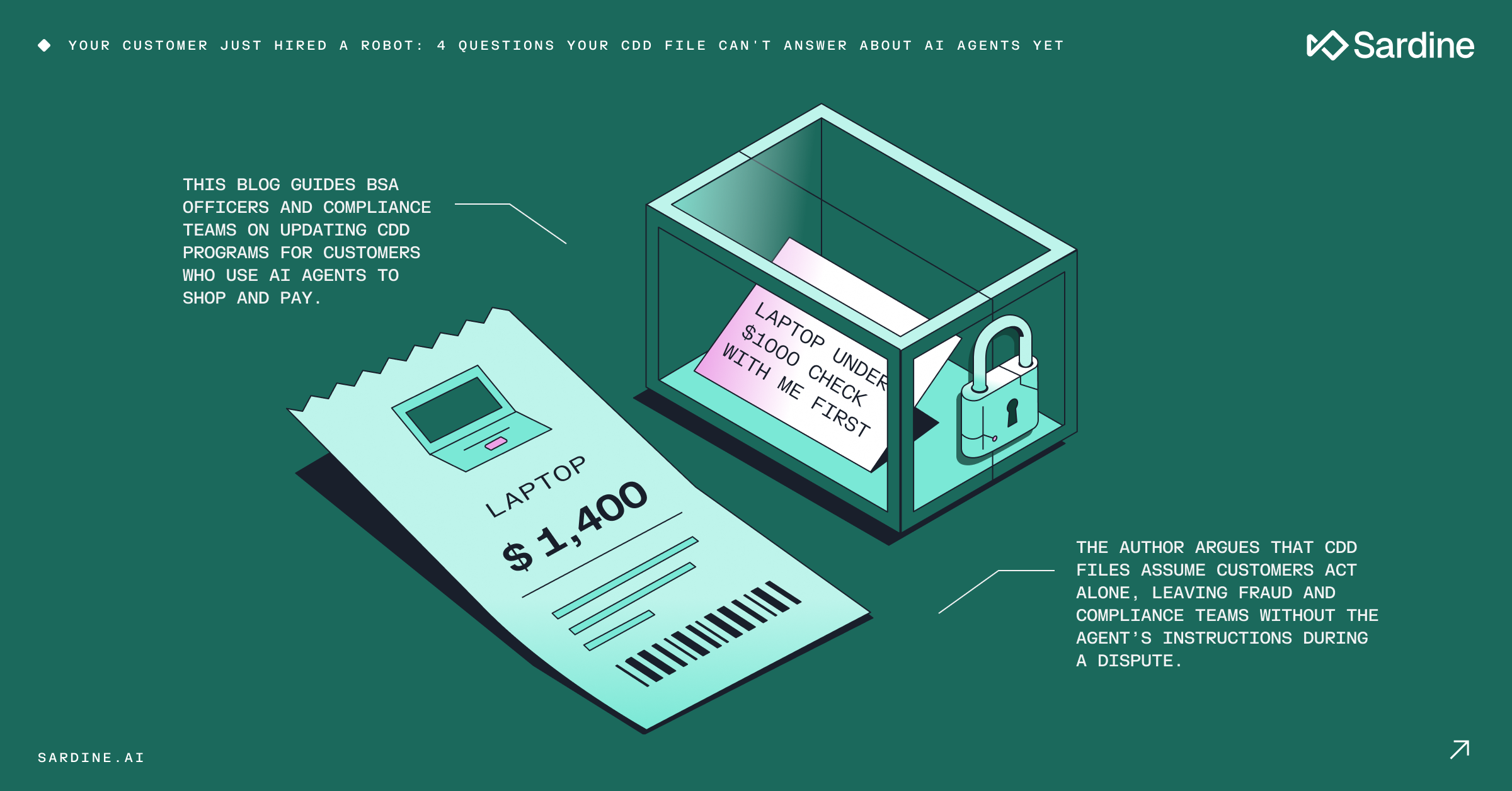
That was just one bill-pay rule. Now picture a customer who tells a shopping agent "find me a laptop under $1,000 and check with me first," and the agent buys a $1,400 laptop without asking. My colleague, Hailey Windham, wrote about that scenario last week from the fraud investigator's chair, and her question was “what would you even investigate?” Mine is: what does your BSA program say about a customer who delegates spending to software, and if the answer is nothing, what should it say by the next CDD refresh?
Two quick definitions:
- Customer due diligence, or CDD, is the part of your BSA program where you figure out who your customer is and what they're going to do with the account. The rule lives at 31 CFR 1020.210(b)(5) and asks you to understand the nature and purpose of each relationship, build a risk profile, and keep monitoring it.
- An AI agent, for this article, is software a customer authorizes to act for them. It can browse, compare, negotiate, and pay. The customer isn't on the keyboard when it does. The agent usually runs from a cloud browser on a data center IP, which is why merchant fraud systems have been blocking it as a bot.
The short version
An agent is a new channel, a new form of delegated authority, and sometimes a new counterparty you didn't pick, all at once. Your program is currently built around a customer who acts for themselves because not too long ago, that’s who was shopping. So before the first dispute lands, I would make sure 4 things are written down somewhere an examiner can find them: whether you allow agentic shopping, what a customer can delegate, how you'd see it in the data, and who owns the evidence when something goes wrong. The method below walks through each one.
Why now, and what's proposed versus final
No federal banking agency has issued a rule for AI agents acting on customer accounts, and I don't expect one soon. What we have to go on is a set of signals pointing the same direction.
On April 17, 2026, the Federal Reserve, OCC, and FDIC replaced the 15-year-old model risk guidance with SR 26-2, published by the OCC as Bulletin 2026-13 and by the FDIC as FIL-15-2026. In a footnote, the agencies put generative and agentic AI outside its scope. That means the governance for agents falls on your existing program and your own judgment, with no published roadmap.
On April 7, 2026, FinCEN proposed a rewrite of the AML/CFT program rule (91 FR 18704, printed April 10). The comment period closed June 9, and as of today there's no final rule. If it lands the way it was proposed, risk assessments will become a required, documented process that has to cover products, services, distribution channels, customers, and geographies, and you'll get 12 months to comply.
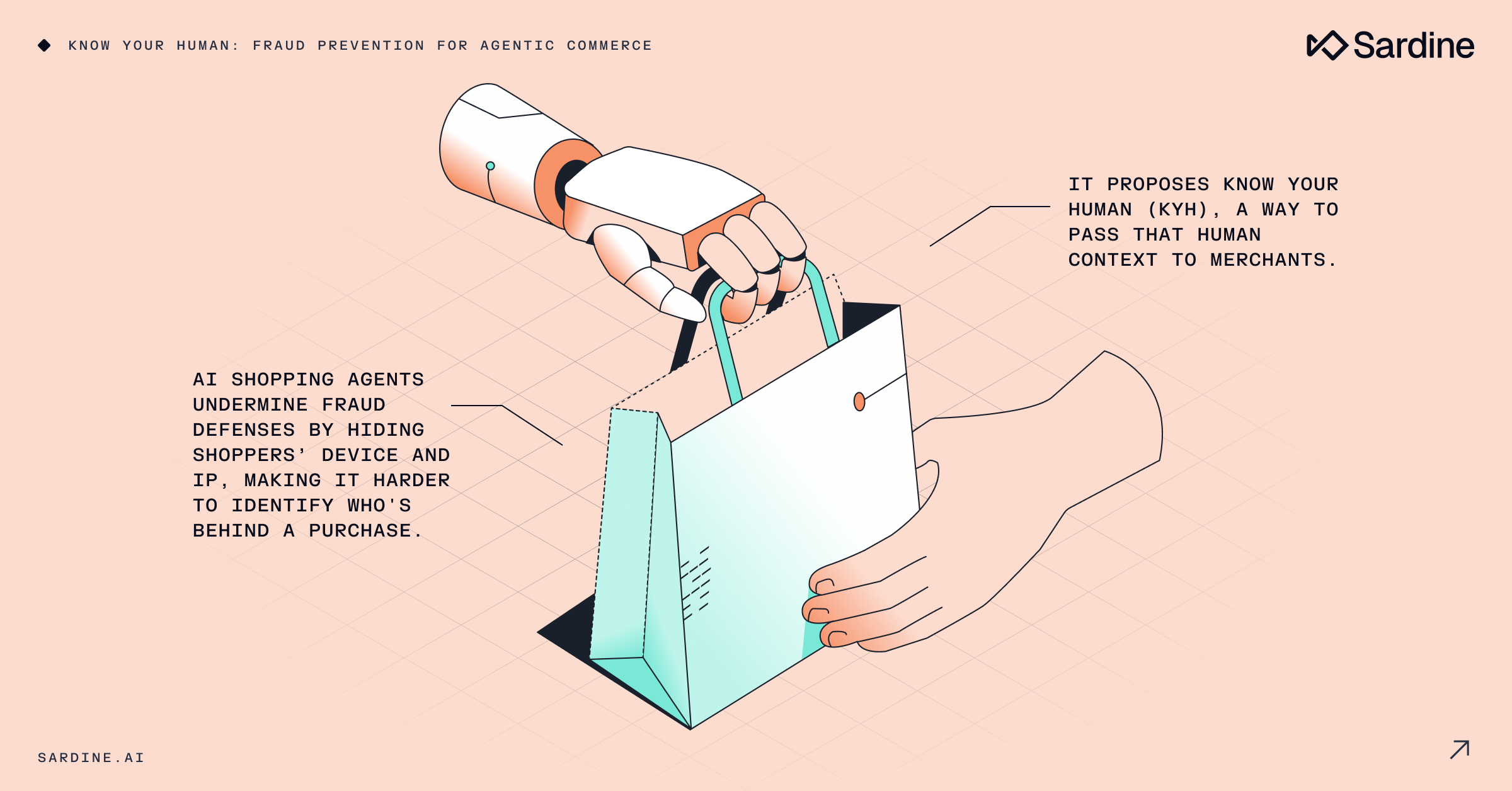
Meanwhile, millions of people have already downloaded shopping agents onto their phones. The merchants those agents shop at are building ways to tell a legitimate agent from a bot. Sardine's Know Your Human (KYH) launched this past week to pass a human's device and IP signals through the agent so a merchant can approve the purchase. That solves the "who is behind this" problem for the merchant, and it gives the issuer better evidence in a dispute. But it doesn't tell anyone what the customer told the agent to do, and that missing link is where the BSA questions live.
Where customer due diligence usually goes wrong
I’d start with the CDD file. When your team opened the account, they verified the human through your customer identification program (CIP). For a legal entity, they also collected beneficial ownership information under 31 CFR 1010.230 and asked who owns and controls the business. Nobody thought to ask whether the customer would hand spending over to software with a $500 monthly limit. So when the agent makes its first purchase, your processor treats it as an ordinary card authorization and any analyst reviewing it would have no way to tell it’s different.
Your fraud team usually spots the agent a few hours after that first purchase. They tuned their monitoring rules around how people shop, so when an agent comparison-shops 40 retailers at 3 a.m., they see a compromised card. The analyst on shift blocks it. After the customer calls to complain, someone on your service desk reissues the card. About 3 weeks later, your BSA team learns there’s a whole category of activity they never risk-rated.
Then the customer disputes a charge. “That’s my agent,” she tells your team, “but I never told it to do that” so your fraud analyst opens a Reg E claim. Over on the BSA side, someone starts asking whether she’s describing unauthorized activity that needs a SAR. Neither of them has the one piece of evidence that would settle it, which is the instruction she gave the agent. Hailey asked in her piece “who should hold that evidence”. Until someone answers that, I’d want a written position on what your team does without it.
The method: 4 customer due diligence questions to answer before the first AI agent dispute
1. Decide whether you allow it, and write the decision down.
You probably can't block agents outright, and I don't think you should try, but you can decide what "allowed" means. Does a customer need to tell you they've linked an agent? Does your online banking agreement cover it? If a customer gives an agent their login, is that a credential-sharing violation under your terms or a permitted delegation? Pick an answer, put it in the product's CDD write-up, and give it an as-of date.
2. Define what a customer can delegate, in tiers you can rate.
Treat delegated authority the way you treat any other risk factor. Here's a constructed scale you can copy. The dollar figures are placeholders, so set them where your own customers actually spread across the tiers.
Tier | What the agent can do | Inherent risk | Example control |
1 | View balances and transactions only | Low | Read-only token, no payment credential shared |
2 | Pay merchants from a linked card, under $500 a month | Moderate | Spend cap enforced at the issuer, step-up approval over the cap |
3 | Pay bills and move funds between the customer's own accounts | Moderate | Named payees and internal accounts only, daily limit, alert on new payee |
4 | Move funds to outside accounts or open new accounts | High | Customer approval per transaction, 24-hour hold on first payment to a new counterparty |
Most agents in the market today are currently in tier 2. The ones Hailey describes, which optimize savings by moving money between institutions, are tier 4. I'd want a per-transaction approval on every one of those until I'd seen 6 months of clean history.
3. Make sure you can see it in your own data.
If you can't tell which transactions came through an agent, you can't monitor them, rate them, or explain them. Ask your card processor and digital banking vendor what field, header, or flag marks a transaction as agent-initiated. Merchant-side protocols like KYH pass identifiers that name the agent provider and the session, so some of that data exists in the payment flow. Your job is to find out whether any of it reaches you and then tune for it. If you alert on 40 merchant visits in an hour, I’d set a different threshold for a known agent session than for an unknown one. Have your analysts write down why in the rule log, so the next person to tune it doesn’t have to guess.
4. Name who owns the evidence, and what you'll do without it.
Here's the handoff table I'd put in front of both the Fraud and BSA teams.
Question | Who answers it | Where the evidence lives today | What to do if it's missing |
Was the human behind the agent our customer? | Fraud | Device and IP signals, login records, protocols like KYH | Treat as unverified and step up |
Did the customer authorize this agent at all? | Fraud, then BSA | Online banking agreement, linked-app records | Ask the customer for the authorization date and the app name |
Did the customer authorize this transaction? | Nobody yet | The customer's instruction to the agent, held by the agent provider | Document the request you made, the answer you got, and the date |
Is this a Reg E error, a SAR, or neither? | BSA, with fraud's file | Your dispute record plus the two rows above | Decide on the facts you have, write down what was unavailable |
Today, the agent provider usually keeps the customer’s instruction, with no standard channel for your team to request it. Hailey proposed an Ethoca-style evidence exchange between issuers, merchants, and agent providers, and I think it's the right idea. Until someone builds it, your analysts need to say plainly in the SAR decision which fact they couldn’t get. "The customer states the agent exceeded its instructions. The agent provider did not respond to a request for the instruction record dated [date]." With a note like that, an examiner can see what your analyst asked for and who never answered. When an analyst stops at ‘Customer disputed, no further information,’ examiners tend to press a lot harder.
What the method doesn't solve
Even with all 4 answers on paper, your team will still run into a few gaps. Your fraud analysts can use KYH to confirm a real customer stood behind the laptop purchase. With it, they have far more to go on than a data center IP. Neither team can use it to prove whether the customer ever approved a $1,400 laptop, though. Until agent providers start sharing that instruction, your analysts will have to make the call without it.
Your team also has to enforce the tiers from step 2 in the authorization system. If they only wrote the $500 cap into the CDD file, the agent can spend past it at checkout. I wouldn’t give a cap like that any credit when I set residual risk.
Some customers will tell their agent to buy something and then dispute the charge anyway. Your fraud team already deals with a version of this, where a customer blames a family member for a purchase they made themselves. When they blame the agent instead, they’ll sound a lot more convincing. Your dispute team will need more than the customer’s word to tell an honest claim from first-party fraud.
You don’t need FinCEN’s final rule to write your position down. The next time an examiner reads your procedure, they’ll want to see when your team first thought about agents, even if your answer back then was incomplete.
This week, open your CDD procedure and search it for the word “agent.” If you get no hits, add the 4 questions above with today’s date, even if your answer to the first one is “we haven’t decided yet.”
The views in this blog are my own, and should not be considered legal advice.
Frequently asked questions
What does the customer due diligence rule require, and does it cover AI agents?
The customer due diligence rule, 31 CFR 1020.210(b)(5), requires a bank’s BSA program to understand the nature and purpose of each customer relationship, develop a customer risk profile, and conduct ongoing monitoring. The rule does not mention AI agents. A bank therefore has to decide how a customer’s delegation of spending to software fits the risk profile and the monitoring, and it should write that decision into the CDD file with an as-of date.
How do the customer identification program and beneficial ownership information apply to a customer’s AI agent?
The customer identification program verifies the human customer at account opening, and beneficial ownership information identifies who owns and controls a legal entity customer. Neither asks whether the customer will hand spending to an AI shopping agent. The CDD file therefore needs its own record of whether and how the customer uses one.
What is the difference between know your agent and know your human (KYH)?
Know your agent describes frameworks that verify an AI agent’s identity, ownership, and permissions before it acts for a customer. Sardine’s Know Your Human (KYH) works from the human’s side, passing a person’s device and IP signals through the agent so a merchant can approve the purchase in agentic commerce. KYH shows who is behind the purchase and does not show what the customer told the agent to do.
Does Regulation E cover purchases made by an AI agent?
Regulation E still governs consumer electronic fund transfers, and how it treats an AI agent’s purchase is unsettled. The rule defines an unauthorized electronic fund transfer as one initiated by a person other than the consumer without actual authority, and it excludes a transfer by a person the consumer furnished with the access device unless the consumer has told the institution that person is no longer authorized. The regulation does not say whether credentials shared with an AI agent trigger that exclusion. A dispute over an agent’s purchase can therefore reach the institution without a clear answer on whether it was an unauthorized transaction.
How should a bank limit what a customer’s AI agent can do?
A bank can limit an agent by rating delegated authority in tiers and enforcing each tier in its authorization system. A read-only tier needs only a token with no payment credential, a card-spending tier needs a monthly cap enforced at the issuer with step-up authentication above it, and a tier that moves money to outside accounts needs customer approval of each transaction. The dollar figures in any tier table are placeholders to adjust for the customer base, and a cap written only in the CDD file does not stop an agent from spending past it at checkout.
How should a BSA officer handle a dispute where the customer says the AI agent exceeded its instructions?
The BSA officer’s team should decide on the facts it has and record the facts it could not get. The customer’s instruction to the agent is the key evidence, and the agent provider usually holds it, with no standard channel for a bank to request it. The file should show what was requested, the date, and the answer received, which lets an examiner see what the analyst asked for and who never responded. Some of these disputes will be first-party fraud, in which the customer told the agent to buy and then denies it. The dispute team needs more than the customer’s word before a suspicious activity report decision.
What do SR 26-2 and the FinCEN proposed rule mean for AI agents?
SR 26-2, the interagency model risk management guidance issued April 17, 2026, places generative and agentic AI outside its scope and leaves banks to govern those systems under their own practices. The OCC’s November 4, 2026 supervisory framework gives examiners a non-binding guide to agentic AI. FinCEN’s proposed AML/CFT program rule would require a risk assessment process covering products, services, distribution channels, customers, and geographic locations, with 12 months to comply after a final rule. None of the three is written around agents that customers bring, so a BSA program has to record its own position.
References
- 31 CFR 1020.210(b)(5), anti-money laundering program requirements for banks, ongoing customer due diligence. https://www.ecfr.gov/current/title-31/subtitle-B/chapter-X/part-1020/subpart-B/section-1020.210
- 31 CFR 1020.220, customer identification program requirements for banks. https://www.ecfr.gov/current/title-31/subtitle-B/chapter-X/part-1020/subpart-B/section-1020.220
- 31 CFR 1010.230, beneficial ownership requirements for legal entity customers. https://www.ecfr.gov/current/title-31/subtitle-B/chapter-X/part-1010/subpart-B/section-1010.230
- FinCEN, Anti-Money Laundering and Countering the Financing of Terrorism Programs, Proposed Rule, 91 FR 18704 (April 10, 2026), Docket FINCEN-2026-0034, RIN 1506-AB72. https://www.govinfo.gov/content/pkg/FR-2026-04-10/pdf/2026-07033.pdf
- Federal Reserve SR 26-2, OCC Bulletin 2026-13, FDIC FIL-15-2026, Supervisory Guidance on Model Risk Management (April 17, 2026). Footnote excluding generative and agentic AI from scope.
- Interagency Guidance on Third-Party Relationships: Risk Management (June 6, 2023). Note: a principles-based replacement was proposed September 11, 2026 (OCC Bulletin 2026-46), comments due mid-November 2026.
- Hailey Windham, "We know the human, but do we know what they told the agent to do?" (November 6, 2026).
- Sardine, Know Your Human (KYH). https://www.sardine.ai/know-your-human