


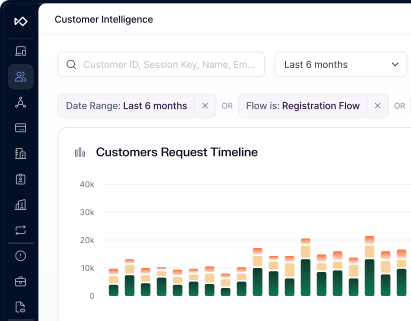
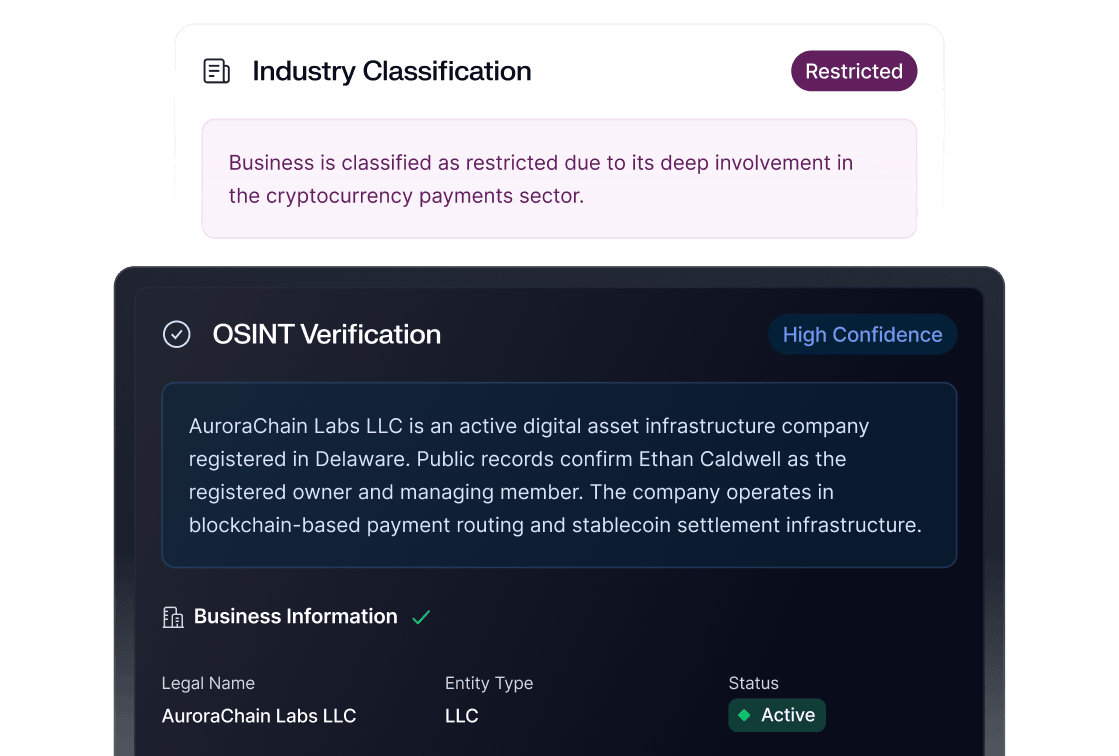





Case management is the end-to-end workflow that carries suspicious activity from an alert through investigation, documentation, a decision, and, where warranted, a SAR filing. It is the system of record where analysts pull everything together and build the file that has to justify whatever the program decides.
What is case management, in plain English?
An alert on its own is just a flag. Case management is the structured process that turns that flag into a defensible outcome. It bundles related alerts and subjects into a single case, gives it an owner, tracks it against a deadline, and holds all the work product in one place until it is closed or filed.
Inside a case, an analyst pulls together KYC records, transaction history, prior alerts, and counterparty information, sometimes including intelligence gathered through 314(b) sharing. The case becomes the container for the investigation and the audit trail behind the decision: what was reviewed, what was concluded, and why.
It sits at the center of a monitoring program. Detection feeds it, investigation happens inside it, and regulatory reporting flows out of it. A good case management system is less about software features and more about making sure the same subject is reviewed as one story, not as a scatter of disconnected alerts.
How a case moves through the workflow
- Intake — Alerts become a case. Related alerts and subjects are grouped, deduplicated, and assigned to an owner with a review deadline.
- Investigate — Gather and analyze. The analyst pulls KYC, transaction history, and counterparty data, and documents each source and finding.
- Escalate — Raise where needed. Cases beyond first-line resolution move to enhanced review or a SAR decision, with the reason recorded.
- Dispose — Decide and record. The case is closed with no action, referred for a SAR, or otherwise resolved, with reasoning tied to the facts.
- Retain — Archive the file. The full record and audit trail are kept for the mandated period so the decision can be reconstructed later.
Who touches a case?
Who | Their role |
First-line analyst | Works the initial alerts, gathers evidence, and either resolves or escalates the case. |
Investigator or senior analyst | Takes on escalated or complex cases and drives the deeper review and the SAR decision. |
QA reviewer | Samples closed cases to check that dispositions are sound, consistent, and well documented. |
BSA Officer or MLRO | Owns the program, approves filings, and answers for case quality and timeliness to examiners. |
What it looks like in practice
In practice
Three separate alerts fire on one small-business customer over two weeks: a structuring scenario, a high-risk counterparty match, and a sudden spike in international wires. In a weak setup, three analysts would work them in isolation and each might close as no action.
With proper case management, the system links all three to the same subject and routes them into one case. The assigned investigator sees the combined picture, pulls the KYC file and 314(b) input from a partner bank, and recognizes a layering pattern none of the single alerts revealed. The case is escalated, a SAR is filed, and the linked file shows exactly how the conclusion was reached.
Why it matters to operators
The single biggest failure in case management is poor linkage. When related alerts on the same customer are reviewed as fragments, the program misses patterns, repeats work, and reaches inconsistent decisions on identical facts. Two analysts closing two halves of the same story is how real activity slips through and how a program looks disorganized to an examiner.
The other pressure is time. Cases that age past their SLA are the direct cause of late SAR filings, which draw penalties. Case aging metrics, SLA tracking, and a clean audit trail are what let a manager see trouble before a deadline is blown and prove, afterward, that the program handled the work properly.
Operator notes
- Link before you work. Group all alerts and subjects tied to the same customer into one case so nobody reviews a story in pieces.
- Track aging and SLAs. A queue full of near-deadline cases is a late-filing risk; surface it early, not on the due date.
- Keep the audit trail clean. Every source pulled and reason reached should be captured; the case file is the evidence years later.
- Watch for duplicate cases. The same subject opened twice signals broken linkage and wastes scarce analyst time.
- Standardize disposition reasons. Free-text-only closures make QA and consistency review nearly impossible.
Quick questions
How is a case different from an alert?
An alert is a single flag from a monitoring scenario. A case is the container that may hold several alerts on the same subject, plus the investigation, documentation, and final decision. One case can absorb many alerts.
Why bundle alerts into one case?
Because coordinated activity often triggers several small alerts that only make sense together. Bundling lets one analyst see the whole pattern and avoids duplicate, conflicting reviews of the same customer.
What is case aging and why track it?
Case aging measures how long a case has been open against its target timeline. Tracking it prevents cases from stalling in a queue past SAR deadlines, which is a common cause of late-filing penalties.
Does every case end in a SAR?
No. Many close with no action after review, some are escalated, and only a subset become SARs. What matters is that each outcome is supported by documented reasoning tied to the facts.
What makes a case file defensible?
A clear record of what was reviewed, from which sources, and the reasoning behind the decision, all retained for the mandated period. Examiners and law enforcement rely on that file, sometimes long after the case closed.
Go deeper
- FinCEN ↗ — The US financial intelligence unit. Bank Secrecy Act rules, advisories, and SAR and CTR guidance.
- FFIEC BSA/AML Examination Manual ↗ — The manual US examiners use to assess BSA and AML programs.