
FinCEN's updated 314(b) guidance finally gives fraud fighters the clarity they've been asking for.
Remember this famous line from our childhood? "Yes, Virginia, there is a Santa Claus." It became famous because it answered a question that people desperately wanted settled once and for all.
That's exactly how I felt when FinCEN released its updated Section 314(b) guidance. For years, I've watched fraud investigators ask some version of the same question: "Can we actually share this information with another financial institution?" The answers usually sounded something like: "Maybe..." "Only if Compliance is comfortable..." "I'm not sure..." "Let's not risk it."
Meanwhile, the fraudster had already moved on to the next institution.
So allow me to borrow from one of history's most famous editorials: yes, financial institutions, you really can share information. At least, far more than many of us have been led to believe.
This isn't a brand-new law. FinCEN didn't rewrite Section 314(b). What they did was something practitioners have requested for years: they clarified the rules, expanded on prior guidance, and made it unmistakably clear that fraud belongs in this conversation. On June 12, FinCEN released updated guidance replacing the agency's 2020 fact sheet; and in the weeks since, the FDIC, OCC, and Federal Reserve have all issued their own follow-up guidance reinforcing the same message: participate, and use it. That's not a nudge. That's a full regulatory stack-up.
Why this matters
Fraud doesn't stay inside one financial institution. The same fraud ring that opens an account at your bank probably has accounts at three others. The mule account you're investigating today may receive funds from another institution tomorrow morning. The synthetic identity you're trying to onboard likely failed somewhere else last week. Fraud moves across the financial ecosystem. Historically, our information sharing didn't.
The updated guidance recognizes that reality by making clear that information sharing under Section 314(b) can include suspected fraud tied to specified unlawful activities, not just traditional money laundering investigations. The guidance is broad: mail fraud, wire fraud, bank fraud, securities fraud, pig butchering proceeds, romance scam funds, mule account activity, first-party fraud rings, and fraud connected to unauthorized access of a protected computer. If fraud is the underlying offense, 314(b) covers it.
The four biggest changes every fraud team should know
1. Fraud is explicitly within scope and the list is longer than you think
This is probably the biggest operational shift. You no longer need to think exclusively in terms of money laundering, or wait until you can connect the activity to a laundering pattern. Fraud offenses are specified unlawful activities (SUAs) under 18 U.S.C. § 1956, and that means the safe harbor applies.
In practice, this looks like a fraud investigator at a credit union identifies a mule account pattern: fast in, fast out, unusual payee history. She suspects it's connected to a pig butchering scheme that's been in the news. Under the old interpretation, she might have waited to confirm the laundering connection before calling another institution. Under the old interpretation, she might have waited to confirm the laundering connection before calling another institution. Under the updated guidance, she can call now. The suspicion of fraud is enough.
This is a meaningful operational change, especially for institutions where fraud and AML teams operate in separate lanes. The guidance removes the requirement to prove the money laundering connection before collaboration can begin.
2. You don't need certainty
Fraud investigators have always struggled with the question: "Do we know enough yet?" FinCEN's answer is refreshingly practical. Reasonable suspicion is the threshold; not proof, not a completed investigation, not a SAR already filed.
Here's what that looks like in the field: a community bank fraud analyst flags a newly opened business account. Deposits are inconsistent with the stated business type. The EIN traces to a shell with no public footprint. Nothing screams fraud outright, but the pattern is off.
Under the new guidance, that analyst can reach out to another 314(b) participant they've worked with before and say: "We're seeing something unusual on a business account that was referred by a third-party introducer. Have you seen anything similar from this address, this routing pattern, or this device signature?"
That conversation (which was often constrained by uncertainty) is now explicitly protected. The implication for operations is significant: you don't need a closed case to collaborate. You need a reasonable basis. Collaborating earlier is often what helps you get to the answer.
3. Real-time sharing is encouraged, and the format is flexible
This isn't limited to formal written requests after an investigation closes. The guidance specifically contemplates sharing in any format (verbal, written, or through electronic platforms) and in real time as activity is occurring.
Shareable information now explicitly includes:
- IP addresses and device fingerprints
- Video surveillance footage
- Transaction monitoring system alerts
- Cyber-related indicators
- Fraud patterns and behavioral signals
- Information about individuals and entities (even if they are not current customers of the receiving institution)
That last point deserves attention. You can share intelligence about a suspected fraudster with another institution even if that institution has never had a relationship with that person. The purpose is pattern recognition and prevention, not just reactive account-level review.
What changes operationally: fraud teams that already participate in 314(b) can expand how they use it. Instead of waiting for formal written exchanges, informal real-time calls and electronic shares are explicitly within the safe harbor; as long as both institutions are registered participants and the other conditions are met.
Fraud happens at machine speed. Our collaboration should too.
4. Associations can now play a much larger role
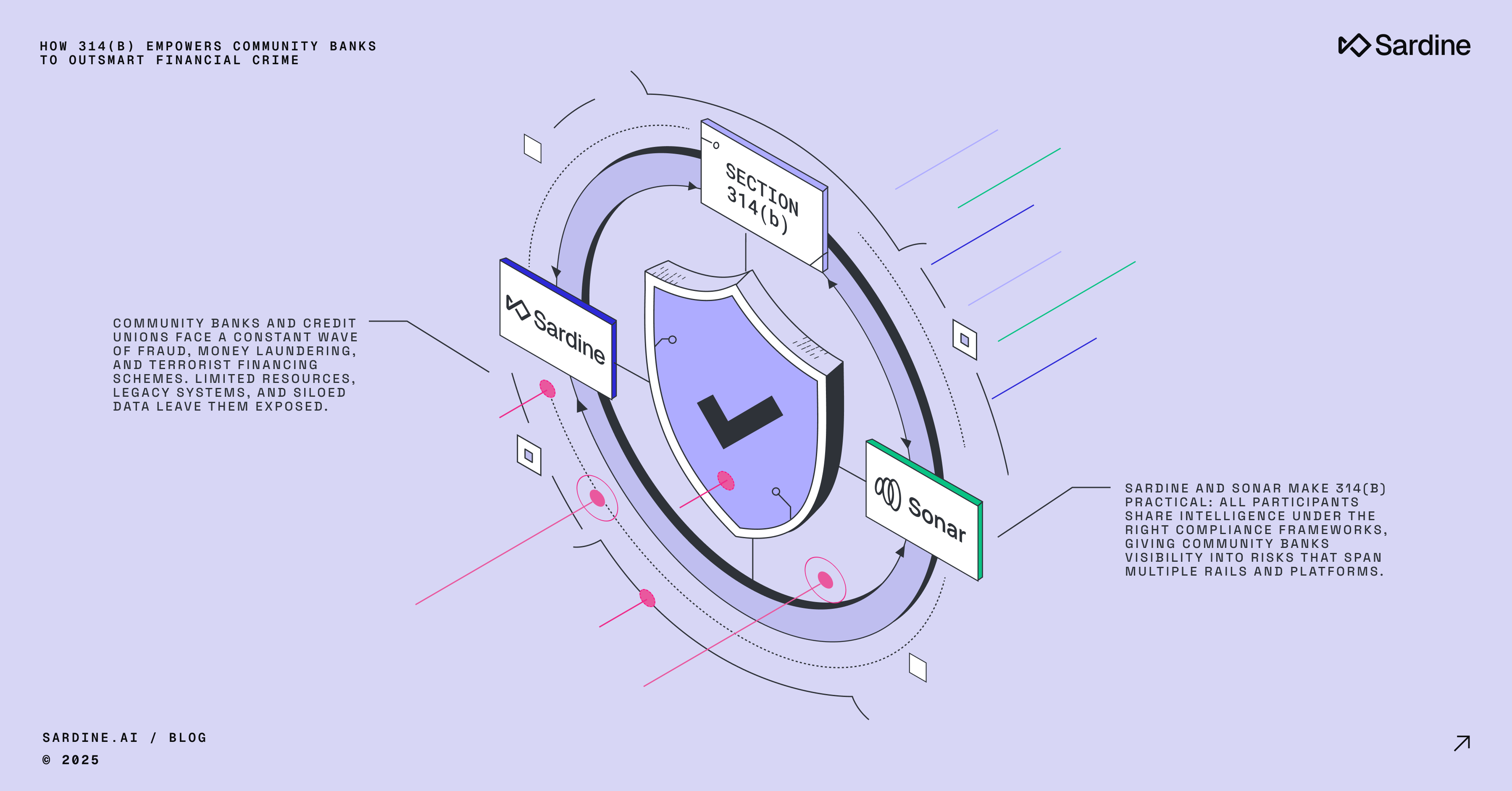
One of the most consequential parts of the guidance may receive the least attention. Associations of financial institutions can participate under 314(b). That means industry groups, fraud-sharing consortiums, and intelligence networks aren't just facilitating conversations; they're explicitly within the program's framework.
Think about what this makes possible. Instead of two institutions exchanging a phone call, you have a consortium with dozens of members sharing device fingerprints, account opening patterns, and fraud typologies in near real time. One institution's detection event becomes a signal for everyone else in the network before the fraudster has time to move to the next target. This is the architecture that fraud networks have used against us for years. Now we have a clearer legal framework to use it in our own defense.
For credit unions and community banks in particular, this matters. Individual institutions may lack the volume to detect low-and-slow fraud patterns on their own. Consortium membership gives smaller institutions the detection surface of a much larger network, without requiring them to build it themselves.
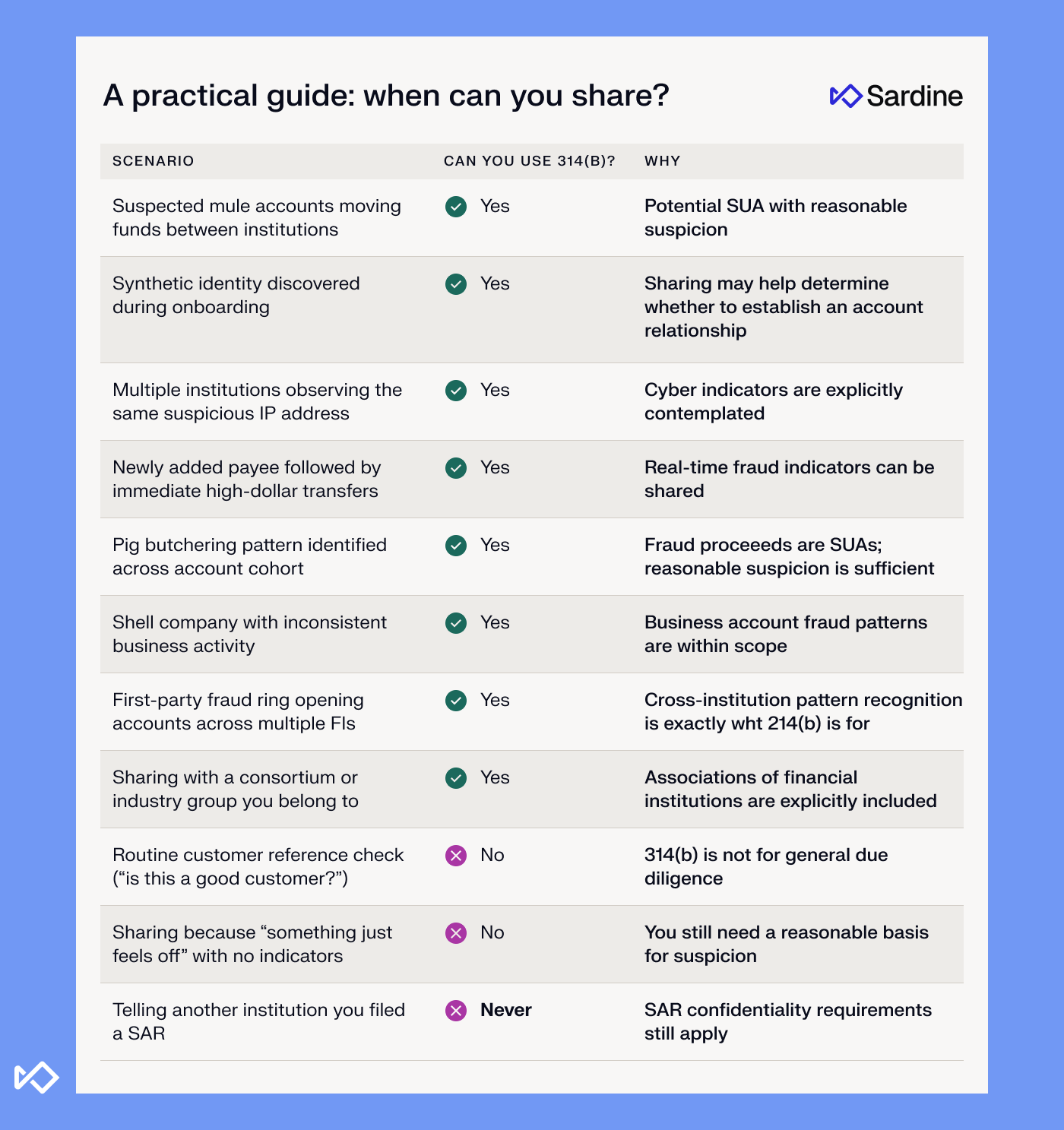
A practical guide: When can you share?
The four conditions that haven't changed
The updated guidance expanded clarity but not the rules. Before sharing, remember these guardrails:
- Both institutions must be registered 314(b) participants
- There must be a reasonable basis for suspicion
- Information may only be used for permissible purposes
- SAR confidentiality still applies: you cannot disclose that a SAR was filed
Registration matters more now. If your institution isn't already registered, that's the first operational step. Also, if the institutions you most want to collaborate with aren't registered, it's worth having that conversation with them directly.
How to actually operationalize this
Guidance is only useful if it changes behavior. Here's what putting 314(b) to work actually looks like:
Step 1: Confirm your registration is current. If your institution registered years ago and never revisited it, verify your contact information is up to date with FinCEN. Registration requires maintaining at least one point of contact.
Step 2: Build a short list of institutions you want to collaborate with. Think about who you're most likely to call in a fraud emergency. Are they registered participants? If not, share the guidance and make the case. The call you need to make at 2pm on a Tuesday is not the time to discover you can't make it.
Step 3: Revisit your internal escalation path. Who on the compliance team needs to be looped in before a 314(b) share? How fast can that happen? If your process requires three approvals and a written memo, you're not operating at the speed the guidance contemplates. Now is a good time to streamline it.
Step 4: Document your reasonable basis before you share. You don't need certainty, but you do need a documented rationale. A brief note on the indicators that triggered the share protects your institution and creates an audit trail.
Step 5: Explore consortium membership. If your institution isn't already part of a fraud intelligence consortium, now is the time to evaluate that decision. The guidance's explicit inclusion of associations creates a framework for scaled sharing that individual institution-to-institution calls can't replicate.
The bigger picture
For years we've invested heavily in detecting fraud. Now we're finally being encouraged to share what we detect. That's an important distinction because stopping fraud isn't just about building better models at one institution. It's about making sure one institution's intelligence becomes another institution's prevention, before the fraudster has time to move.
The regulatory signal here is unusually clear. FinCEN issued the guidance. The FDIC, OCC, and Federal Reserve all followed within weeks. The Treasury framed it as part of a whole-of-government effort to combat fraud. That's not a gentle suggestion. That's an expectation and while the gap once was legal authority, now it’s infrastructure.
Fraudsters already operate as a network. They share mule account lists, test onboarding controls across institutions, and know when one door closes and quickly move to the next one often before any single institution has connected the dots. The 314(b) update gives us the legal framework to respond in kind. The institutions that move first (that build real-time sharing relationships, join consortium networks, and operationalize this guidance rather than file it) will be the ones that actually benefit from it.
Maybe the biggest gift FinCEN gave fraud fighters wasn't a new rule. It was confidence. Confidence to pick up the phone. Confidence to collaborate earlier. Confidence to stop wondering whether you're allowed to share information when reasonable suspicion exists.
Fraud doesn't stop at your institution and thankfully, now, neither does the conversation. Let’s work together to keep moving fraud forward.