Your fraud AI produces output. The agent runs, proposals come out, the demo looked great. And yet somewhere between the agent's answer and the case actually getting closed (or the rule actually getting deployed) things slow down, break down, or just don't generalize the way the demo promised.
If that's where you are, you've probably started asking whether you need a better model. I want to save you that detour. The answer is almost always no, the model is fine.
It’s where the model runs that matters more.
I've watched this from both sides; building investigations on a native platform, and hearing from teams whose impressive-in-the-demo agent stalled the moment it hit production.
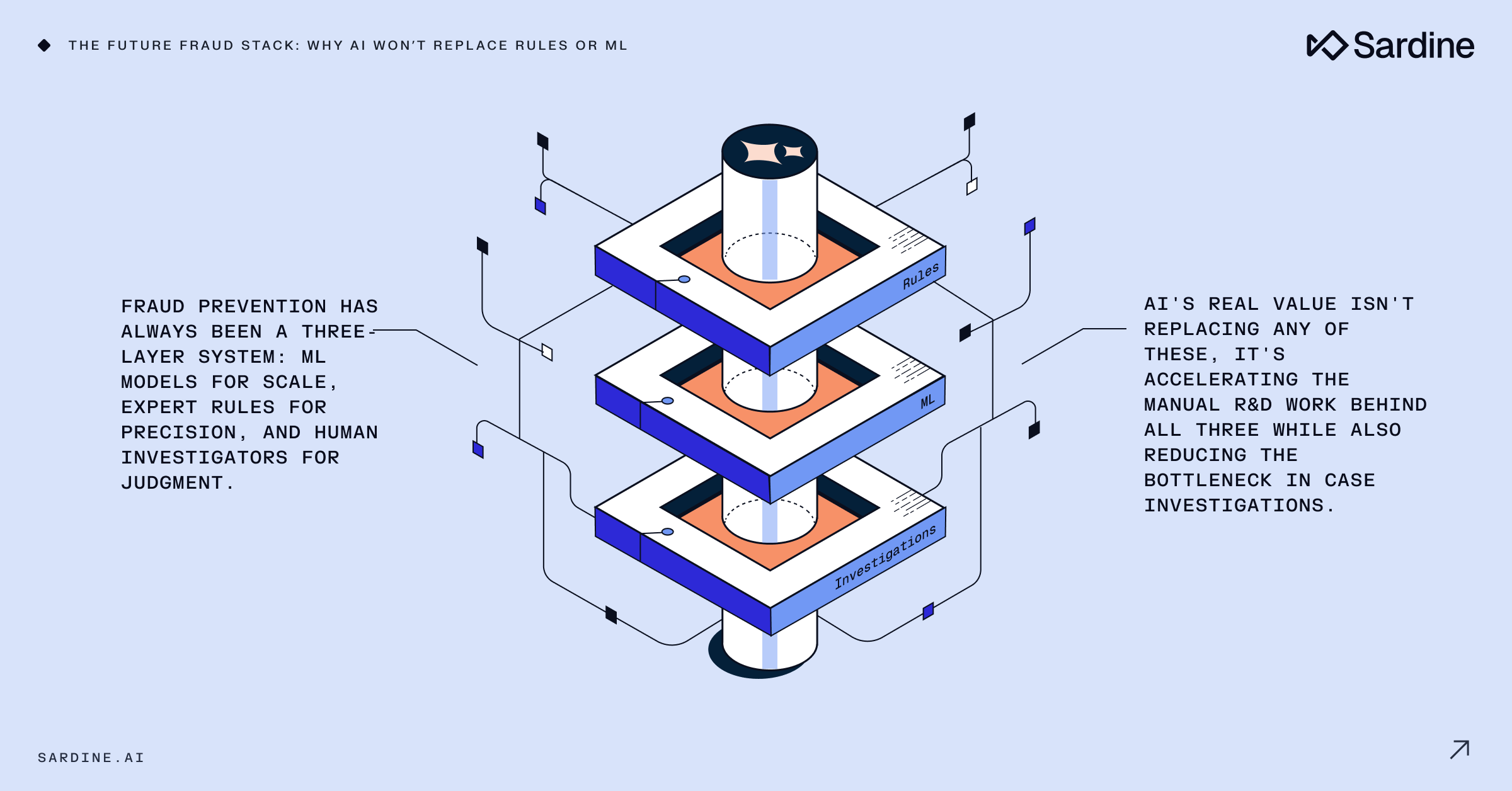
The pattern is consistent enough that I'd bet on it: the teams seeing real case closure aren't running smarter models. They're running their models within their fraud platform instead of on top of it.
What platform-native fraud AI actually means
A platform-native agent doesn’t have to be smarter than a general-purpose one. But it has context the general-purpose one doesn't. It knows what device fingerprints, session signals, partner IDs, fraud risk scores, and behavioral patterns mean on your specific platform
You don’t need to explain these in every prompt. It was built with that understanding already loaded.
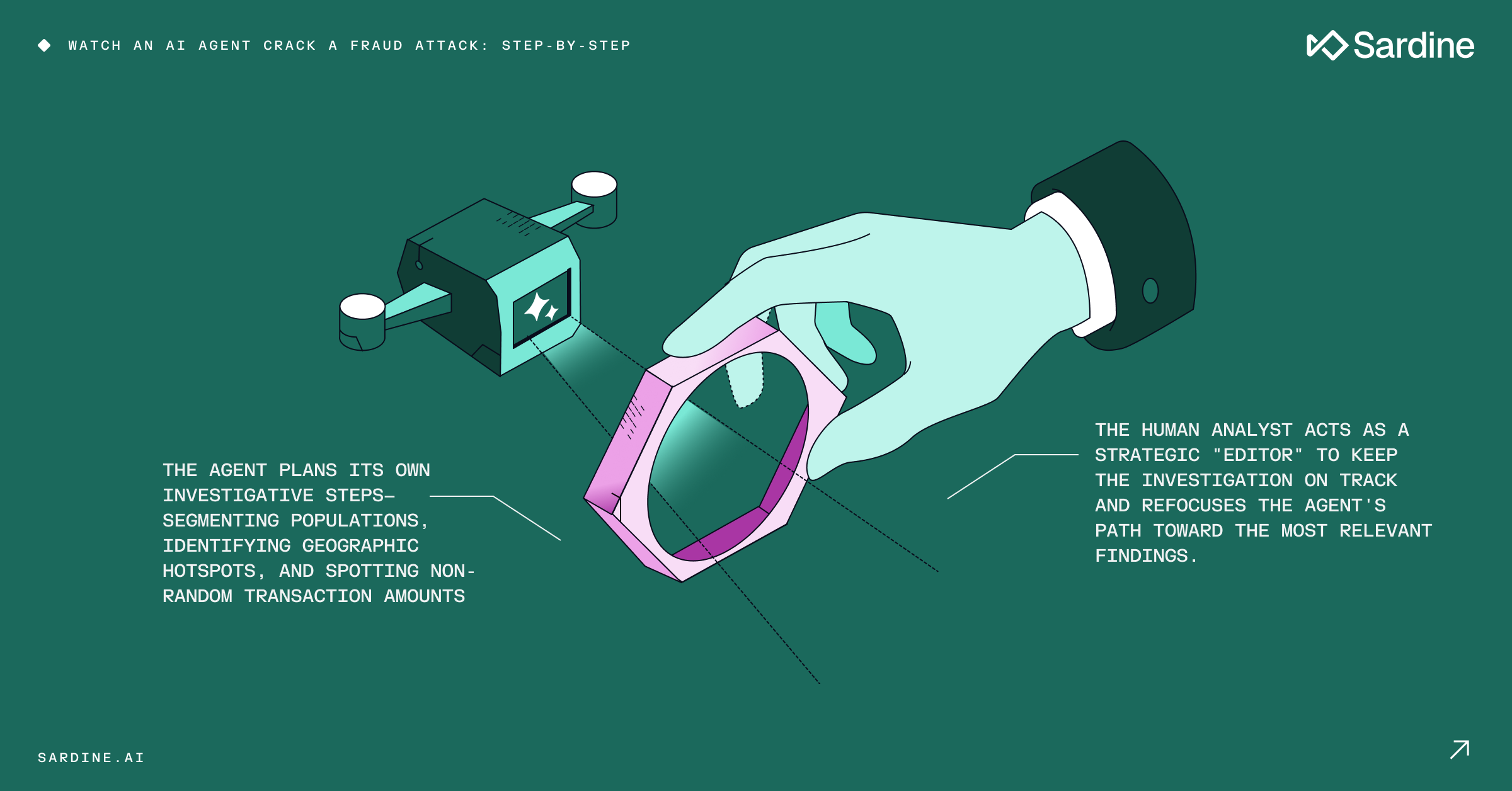
You see the difference the moment you watch a native agent work. When we ran a crypto on-ramp investigation, the analyst handed the agent a time window and a hypothesis. The agent didn't ask what medium-risk sessions meant or how to query the transaction table. It went straight to the right data, structured its output in terms the analyst could act on, and surfaced the pattern: a volume anomaly in low-risk sessions, geographic concentration, transaction-amount clustering, with no schema explanation at all.
Hand the same data to a general-purpose agent and it spends most of its first response figuring out the environment. That cost doesn't show up once, it compounds across every investigation you ever run.
The constraint on a fraud investigation used to be SQL: how fast you could write queries and how well you knew where the data lived. Native context removes that. The analyst is now limited only by the quality of the questions they can ask, which is exactly where you want a human spending their judgment.
The investigation-to-action gap between fraud investigation and enforcement
Another friction point almost every non-native build hits eventually is that the agent lives in one environment, and the actions, adding to a blocklist, writing a rule, adjusting a threshold, happen in another. Then it’s up to you to translate between what the agent called a signal and what the rule engine calls a feature.
You're checking whether the feature the agent used in its analysis even exists in the enforcement layer. You're re-verifying findings before acting because the two systems don't share a source of truth. And every re-verification is time the attacker keeps operating.
When investigation and enforcement live on the same platform, that work becomes redundant. The fingerprint the agent identified as the tell is the same fingerprint the rule engine blocks on. The blocklist the agent recommends adding to is the same one enforced at the edge. Investigation conclusion and enforcement action become one motion instead of two.
But it’s not only about speed or efficiency, because this gap often means a complete process breakdown.
If the agent reasoned over a signal your fraud platform doesn’t have, you either rebuild the signal downstream, or you drop it. Either way, the thing that caught the ring isn't the thing that stops it.
Your fraud prevention platform knows the fraud signal context your agent can’t
The investigation-to-action gap runs both ways. I just described one direction, where the agent reasons over a signal your fraud platform can’t act on.
But the reverse is harder to spot and does even more damage: your platform holds data your agent never gets to see. A deployed agent only reasons over the data it can reach. If it sits outside of your fraud platform, it gets a thin slice of what’s actually there. Best case.
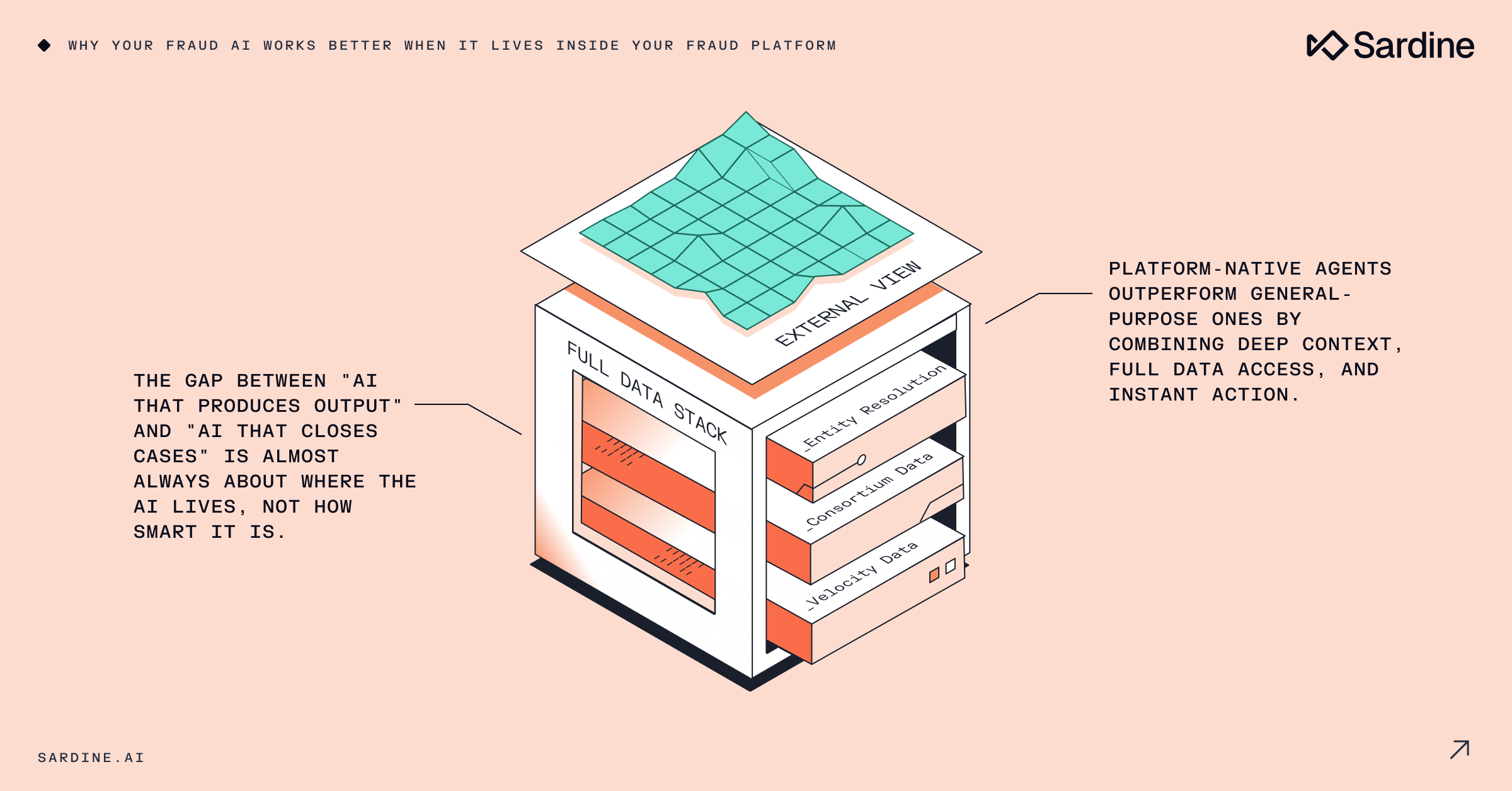
What’s missing then? Let’s start with entity resolution and network data. Your platform knows that 12 “different” accounts resolve to one entity through shared identifiers, and it has reach intelligence on that entity. If your agent sees only one account in your data, your context drops sharply and the chances it makes mistakes grows in correlation. That’s how false positives are born.
Then consider consortium intelligence: fraud signals pooled across many institutions, so a device or identity that burned someone else last week is already suspect before it ever reaches you. An agent scoped to your data alone can’t recognize a fraudster who’s a first-timer to you and a known quantity to everyone else on the network.
Then there's real-time fraud velocity: counts across your whole population, such as how many accounts a device has touched in the last hour or how many cards a session has tried. Unless you’re calculating velocity yourself (and I salute you if you do), your agent is missing the most critical fraud signal out there.
You can have the based agent workflow, but if you don’t feed it with all the data available to you, it’ll still make mistakes. And if most of your critical signals live under the hood of your fraud platform, only platform-native agents can access and reason over it.
It's not about a smarter model
If your AI agents for fraud detection are producing output but not closing cases, look past the model. The problem is almost certainly where they’re deployed.
An agent running on top of your platform is starved on the way in, because it can’t see all of your data, and stranded on the way out, because it can’t act through your enforcement layer.
Everything in between, from the translation, to the re-verification and context-switching, is friction that compounds with every case.
Platform-native agents close that gap and free you from the need to build your own data pipelines, hand-hold your agents, or prompt them to death at each turn.
If the argument here resonates, that where your agent runs matters more than how smart it is, the whitepaper goes deeper. It covers what a platform-native agentic system actually looks like, the headcount and skill mix it requires, the governance model for safe continuous learning, and the 18-month rollout sequence.
FAQs about fraud AI platform native agents
What does fraud AI platform native mean?
Fraud AI platform native means the agent runs inside the fraud platform instead of sitting on top of it as a disconnected tool. A platform-native fraud AI agent can access the platform’s signals, understand its risk logic, and act through the same enforcement layer the fraud team already uses.
Why does platform-native fraud AI work better than a standalone AI tool?
Platform-native fraud AI works better because it has more fraud AI context. A standalone tool may produce analysis, but it often cannot see the full data environment or act on its own findings. When AI agents for fraud detection run inside the platform, investigation and action happen in the same workflow.
How do AI agents for fraud detection help with fraud case closure?
AI agents for fraud detection help with fraud case closure by reducing the time between finding a suspicious pattern and taking action. If the agent can investigate signals, identify related accounts, and recommend enforcement inside the same system, the team spends less time translating outputs into manual case work.
What is the investigation-to-action gap in fraud AI?
The investigation-to-action gap is the space between what an AI agent finds and what the fraud team can actually enforce. If the agent identifies a signal that does not exist in the fraud AI enforcement layer, the team has to rebuild, translate, or abandon the finding before it can stop fraud.
Why does fraud investigation and enforcement need to happen on the same platform?
Fraud investigation and enforcement need to happen on the same platform because every handoff creates delay and risk. When the investigation uses one set of signals and enforcement uses another, teams have to re-verify findings. A shared fraud AI source of truth makes the investigation easier to trust and the enforcement action easier to execute.
What fraud signal context can a fraud prevention platform give an AI agent?
A fraud prevention platform can give an AI agent fraud signal context such as device fingerprints, session signals, partner IDs, fraud risk scores, behavioral patterns, entity resolution, network data, and velocity. That context helps the agent understand whether a signal is actually suspicious or normal for that environment.
Why are consortium fraud signals important for fraud detection AI?
Consortium fraud signals are important for fraud detection AI because they show behavior across a broader network, not just one company’s data. A device, identity, or account pattern may be new to one business but already suspicious across the consortium. That wider context can help reduce blind spots.
What is real-time fraud velocity?
Real-time fraud velocity refers to current activity counts across users, devices, cards, sessions, or accounts. For example, it can show how many accounts a device touched in the last hour or how many cards a session tried. Without real-time fraud velocity, an AI agent may miss one of the most important fraud signals.
How do session signals fraud teams use improve AI decisions?
Session signals fraud teams use can improve AI decisions by showing what happened during a user interaction, not just after it. Device behavior, login patterns, transaction attempts, and session-level activity can help the agent understand whether an event fits a normal pattern or looks coordinated.
Why does a fraud risk score matter for platform-native AI agents?
A fraud risk score matters because it gives the agent a platform-specific view of risk. The score is more useful when the agent understands how it was created, what signals influenced it, and how the fraud prevention platform uses that score in decisions.
How does agentic AI in fraud prevention depend on platform context?
Agentic AI in fraud prevention depends on platform context because agents need more than raw data to produce useful action. They need to understand the signals, the workflows, the enforcement options, and the source of truth. Without that context, the agent may explain a pattern but fail to help close the case.
What is platform-native fraud investigation?
Platform-native fraud investigation is an investigation workflow where the agent works directly inside the fraud platform. It can use the same signals, entity links, risk scores, blocklists, and enforcement rules the team already relies on, making investigation and action part of the same motion.