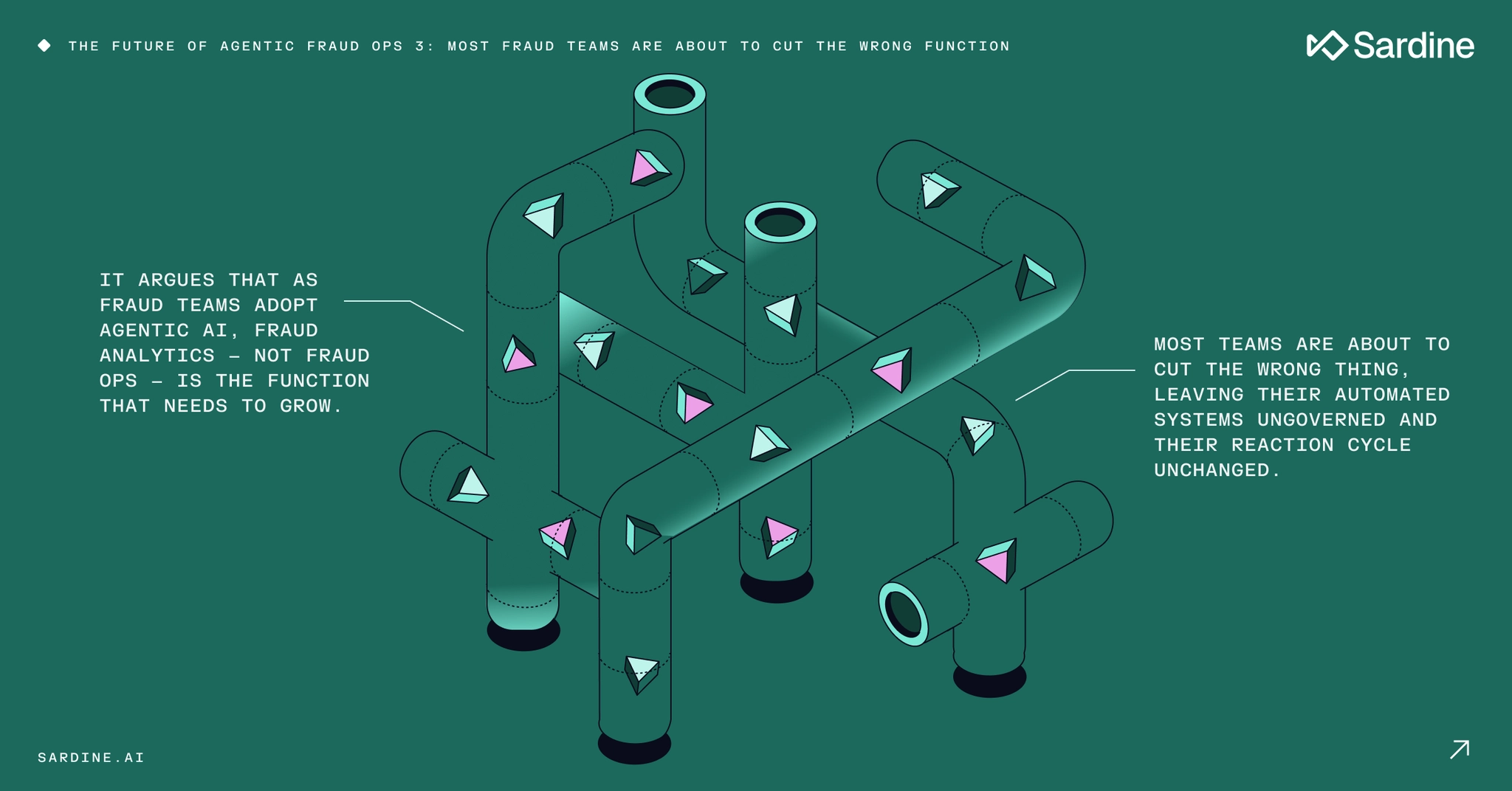
In part 3 of our series on the rise of Agentic Fraud Ops, we look at the second-order effect most teams aren't planning for: why Fraud Analytics doesn't shrink when you adopt agentic AI: it needs to grow. Catch up on part 1 here or part 2 here.
Every fraud leader I talk to is under the same pressure right now. Use AI to cut costs. And by cutting costs, I mean cutting headcount. But in fraud operations, the push for automation creates a dangerous question: what happens when teams reduce the very fraud analytics capacity needed to govern automated systems?
Most teams have already started mapping out what the transition looks like: more automation, fewer fraud fighters, lower operating cost. But while this is directionally correct, there’s also a lot of nuance in how to run this transformation, how your system should look at the end, and how fraud analytics governance should work when agentic AI starts making recommendations at scale.
Specifically, there’s a second-order effect almost nobody is planning for: one function on your team doesn’t shrink with AI adoption. On the contrary, it actually needs to grow, because fraud detection automation creates new oversight requirements that most teams do not have staffed today. And if you don’t account for it, you’ll end up with a smaller team that isn’t equipped to govern all the automated systems it runs.
That function is Fraud Analytics, and without it your system would break faster than you’d like to think. In an agentic fraud environment, analytics becomes the control layer that catches drift, monitors automated decisions, and prevents silent fraud pipeline failures.
Fraud Ops | Fraud Analytics | |
Primary work today | Alert review, rulings | Rules, monitoring, reporting |
What AI automates | Case assembly, lookups | Rule writing, threshold tuning |
New responsibilities | Review AI-assisted cases | Govern all automated pipelines |
Headcount direction | ↓ Shrinks | ↑ Grows |
The four fraud functions: Where fraud analytics fits in the modern fraud team
Most fraud teams are built from four functions:
Fraud Ops handles investigation: reviewing alerts, making rulings, managing chargebacks.
Fraud Analytics owns rules and monitoring: writing detection logic, tracking performance, analyzing attack patterns.
Fraud Strategy sets risk appetite and population treatment policies.
Data Science builds and maintains ML models.
But not every fraud organization has all four, as today’s bare minimum is Fraud Ops alone. Meaning, you can run a fraud function (inefficiently, but functionally) with nothing more than investigators reviewing alerts.
At the same time, Fraud Analytics exists in most mid-size and larger teams, though it’s often informal or undersized. That creates a real fraud automation oversight gap when these teams begin using AI agents to label cases, suggest rules, cluster alerts, or recommend population-level risk treatment. Fraud Strategy and Data Science usually only appear in the most mature and sophisticated teams.
This should serve as a warning sign, if you need analytical skills to govern agentic-powered fraud systems, most teams are behind where they should be. The traditional fraud analyst role was already important, but in an AI-enabled operating model, it becomes central to fraud system stability with AI.
But why do I think we’ll need a bigger Fraud Analytics function in the age of agentic AI? In one word, governance.
Two kinds of fraud governance in agentic AI systems
Not all agentic AI creates the same kind of work, and understanding the difference is what explains why certain functions on your team grow while others shrink.
When fraud teams first roll out agentic AI, they typically start with investigation assistance: the agent assembles the case and proposes a resolution, the investigator reviews and approves. That workflow is not so different from managing a junior analyst. The agent does the legwork and the investigator uses their judgment to validate. Your team already knows how to do that.
But fully automated pipelines are different.
Auto-labeling, case clustering, rule recommendations, model retraining - these don’t have a human reviewing each output. They run continuously, they operate at scale, and when they go wrong, they fail silently.
A labeling agent that starts misclassifying doesn’t raise its hand. It keeps labeling until someone checks. A rule built on a coincidental correlation looks fine in the backtest. A case clustering algorithm incorrectly grouping alerts due to a data quality issue keeps running, and every ruling built on those clusters inherits the error.
These systems fail silently, they fail at scale, and they fail fast. Unlike a human investigator who notices when something feels off, an automated pipeline doesn’t feel anything.
The governance they need isn’t just contextual judgment. It’s the same kind of analytical monitoring fraud teams already apply to their detection systems: KPIs, alerting, systematic performance review, automated pipeline monitoring, and root cause analysis when something drifts.
Does it sound familiar? Observing system performance through data, noticing issues, understanding what causes them, and fixing them: that’s Fraud Analytics work.
What happens to fraud analytic jobs as teams adopt agentic AI
The governance split maps directly to headcount. The obvious assumption when you start rolling out agentic AI is that the fraud team shrinks. For one function, that’s correct. For another, it’s exactly the opposite.
Investigators benefit most directly from what agents automate. The part of their day that consumed the most time, pulling transaction details, running IP lookups, checking device history, cross-referencing accounts, that’s exactly what agents handle. An investigation that used to take 30 minutes takes five.
Once you’re building cases at ring level rather than reviewing alerts individually, one ruling can cover what used to take a team working through individual alerts for hours.
The efficiency gains are straightforward because tasks that once were done manually are now automated. Naturally, the function needs fewer people.
But Fraud Analytics, on the other hand, moves the other way.
Right now the team observes data, compiles reports, writes rules when new attacks emerge, and tweaks score cutoffs when needed. But when agents take over those tasks, all the automated pipelines we just described become their responsibility.
You might think “wouldn’t I automate the manual processes fraud analysts use to get the job done?” and you’ll be right thinking that. But you need to remember that while some of their work is now automated, all the new automation you deployed - both in analytics and in operations - will now fall under their responsibility as well.
Instead of writing rules, the team reviews whether the rules agents are proposing are actually sound or just statistically valid on a coincidental pattern.
Instead of setting population thresholds once a year, someone has to evaluate a continuous stream of agent recommendations for how different user groups should be routed through different risk checks. That work requires stronger fraud analytics governance, not less.
None of those responsibilities exist on any org chart today, but all of them land in Fraud Analytics.
The mistake most teams will make with fraud detection automation
Hopefully, the argument I’ve outlined for why you’d actually need more analysts when you start automating has been convincing thus far. But the sad reality is that most teams don’t have a fully fleshed analytics team, and so are likely blind to the repercussions.
If you don’t manage existing automated pipelines today, or if engineering does it for you, odds are you have a blind spot there.
When such teams move under cost pressure, the case for cutting writes itself. Fraud Analytics is small, it doesn’t have the headcount numbers that make it a visible budget target, and absolutely nobody’s making the case to grow it when the mandate is to cut.
So the agentic investigation system goes live, cases are being assembled, labels are being generated, and rules are being proposed. But the Analytics team is still sized for quarterly rule reviews. The labeling pipeline has no error rate thresholds. Detection governance is happening once a month when it should be happening weekly. Nobody is catching the drift in automated systems that, at human speed, would have been caught in a weekly meeting.
The fraud system is more automated, but your reaction cycle isn’t faster. Even worse, your system is less stable and less safe than it was before. This is the core fraud automation oversight gap: automation scales, but governance does not.
This is the most common version of “we adopted AI but nothing actually changed” - except in this version, things actually got worse. Because it’s easy to forget that redesigning your system means also redesigning your team, and not just cutting it.
The new “bare minimum” for fraud analytics governance
The Fraud Analytics capacity the agentic model requires isn’t additional cost, but a redeployment. The savings from shrinking Fraud Ops should fund the growth of Fraud Analytics.
It might be that the target budget figure is higher than anticipated at first, but it’s mandatory to build the function the new system depends on most.
In 2030 we should expect fraud teams to have a new “bare minimum” skills makeup. Investigative capabilities will continue to be part of it, but not all of it. In addition to that, teams will have to include a strong analytical function to operate its agentic workers, monitor automated pipelines, evaluate recommendations, and maintain fraud system stability with AI.
Think of fraud analysts as your new AI team leaders. That’s the right framing.
Get the full picture on fraud analytics and agentic AI governance
The cost pressure on fraud teams isn’t going away and it’s likely that in the next 12 months we’ll see those cuts applied to Fraud Ops teams around the globe.
The question is whether teams would conserve and even grow Fraud Analytics at the same time, and whether they understand why that second move is the one that makes the first sustainable.
What you just read is the argument for why this rebalancing is important. If you want to go one level deeper, or get the fuller picture, you’d want to check out the whitepaper this post is drawn from.
It covers in detail why moving to agentic is a reality all fraud teams need to wake up to, how such a system should look like, the headcount and skill mix the new system actually needs, the governance model that keeps continuous learning safe at scale, and the eighteen-month rollout patterns - what works, where teams break it, and how to defend the sequence inside your organization.
What is fraud analytics?
Fraud analytics is the function that monitors fraud data, detection rules, system performance, attack patterns, false positives, and operational risk signals. In an AI-enabled fraud environment, fraud analytics also helps govern automated pipelines, validate agent recommendations, and identify when fraud systems are drifting or failing silently.
Why does fraud analytics matter more with agentic AI?
Fraud analytics matters more with agentic AI because automated systems can make decisions, generate labels, suggest rules, and cluster cases at scale. Without analytical oversight, these pipelines can fail silently, compound errors, and create risk before the fraud team sees the full impact.
What is fraud analytics governance?
Fraud analytics governance is the process of monitoring, validating, and improving automated fraud systems through KPIs, alerting, performance reviews, root-cause analysis, and drift detection. It gives fraud teams a structured way to oversee AI-driven decisions instead of assuming automation is working correctly.
How does fraud detection automation change the fraud analyst role?
Fraud detection automation shifts the fraud analyst role from manually reviewing every pattern or writing every rule to governing automated outputs. Analysts still need to understand fraud behavior, but their work increasingly focuses on reviewing agent recommendations, monitoring pipeline health, validating labels, and making sure automation supports the right risk decisions.
What are silent fraud pipeline failures?
Silent fraud pipeline failures happen when an automated fraud system breaks, drifts, or makes bad recommendations without immediately alerting the team. Examples include a labeling agent misclassifying cases, a rule recommendation based on a coincidental pattern, or a clustering system grouping alerts incorrectly because of a data quality issue.
Why should fraud teams avoid cutting fraud analytics?
Fraud teams should avoid cutting fraud analytics because automation increases the need for oversight, not reduces it. If teams shrink Fraud Ops but fail to grow analytics capacity, they may end up with fewer investigators but more ungoverned automated pipelines, slower reaction cycles, and less stable fraud systems.
What is the relationship between fraud governance and agentic AI governance?
Fraud governance defines how a team manages fraud risk, performance, controls, and accountability. Agentic AI governance applies those same principles to AI-driven workflows, making sure agents, automated recommendations, labels, rules, and retraining pipelines are monitored and controlled safely.
How can fraud teams reduce false positives with better analytics?
Fraud teams can reduce false positives by using fraud analytics to monitor rule performance, review approval and decline patterns, analyze customer segments, track downstream outcomes, and identify where legitimate users are being blocked unnecessarily. Strong analytics helps teams reduce friction without weakening fraud controls.