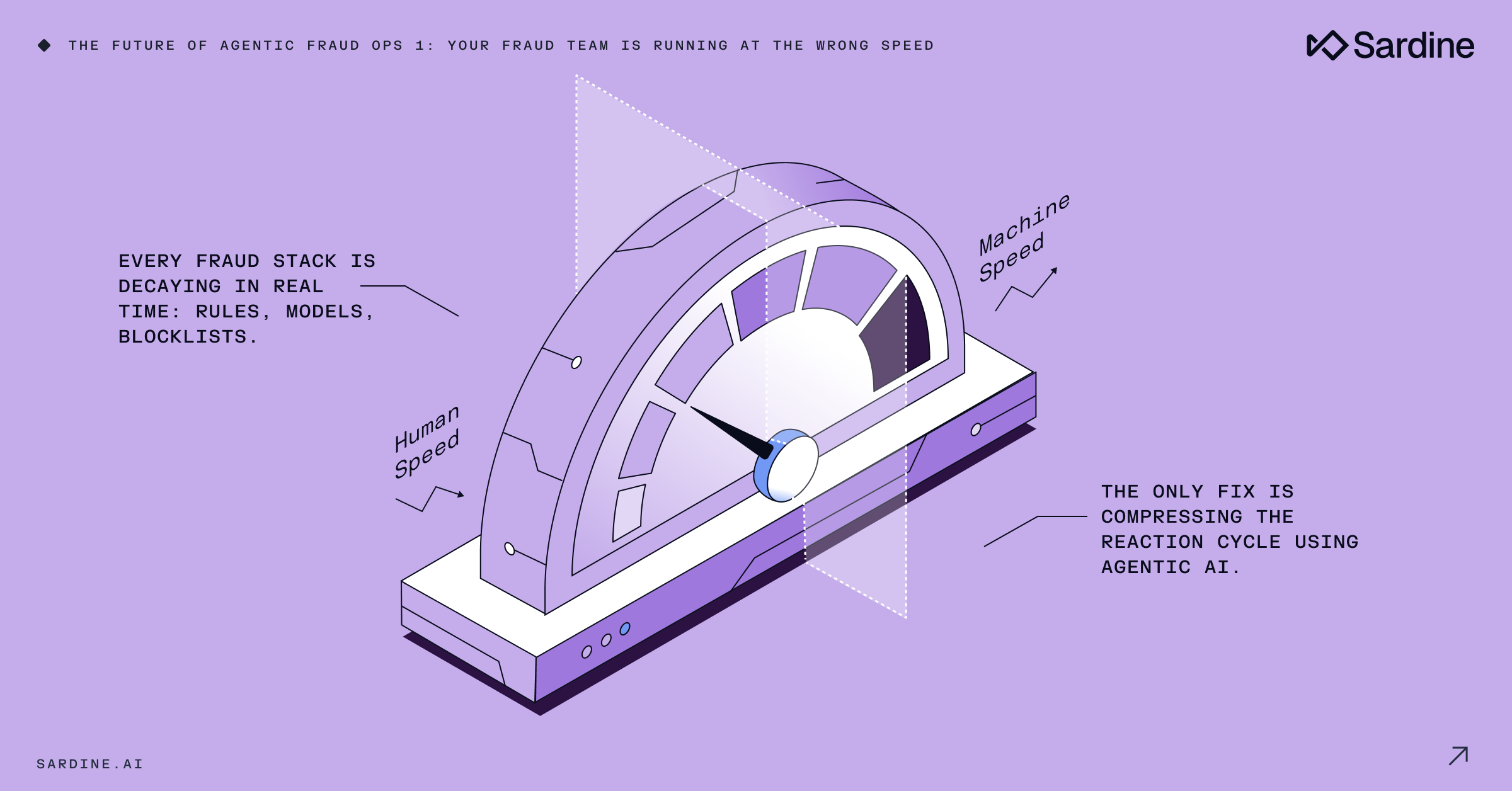
In part 1 of our series on the rise of Agentic Fraud Ops, we make the case for why the fraud stack you're running today was built for an adversary that no longer exists and why the cost-cutting pressure you're feeling and the decay of your fraud system are actually the same problem in disguise.
Key takeaways
- Every layer of a fraud stack decays the moment it ships: rules in days, blocklists at the same speed, ML models over weeks and months.
- Effectiveness is a function of how recently the system learned, not how sophisticated it was at design. The master KPI is the reaction cycle, the time from observing a gap to deploying a fix.
- Agentic AI is the only way to compress that loop to machine speed because it adds capabilities no human team had the bandwidth to deliver, real-time labeling, ring-level alert clustering, and continuous re-tuning.
- The cost-cut mandate from finance is the funding mechanism for the rebuild. Use it deliberately, or absorb it and end up smaller and worse off.
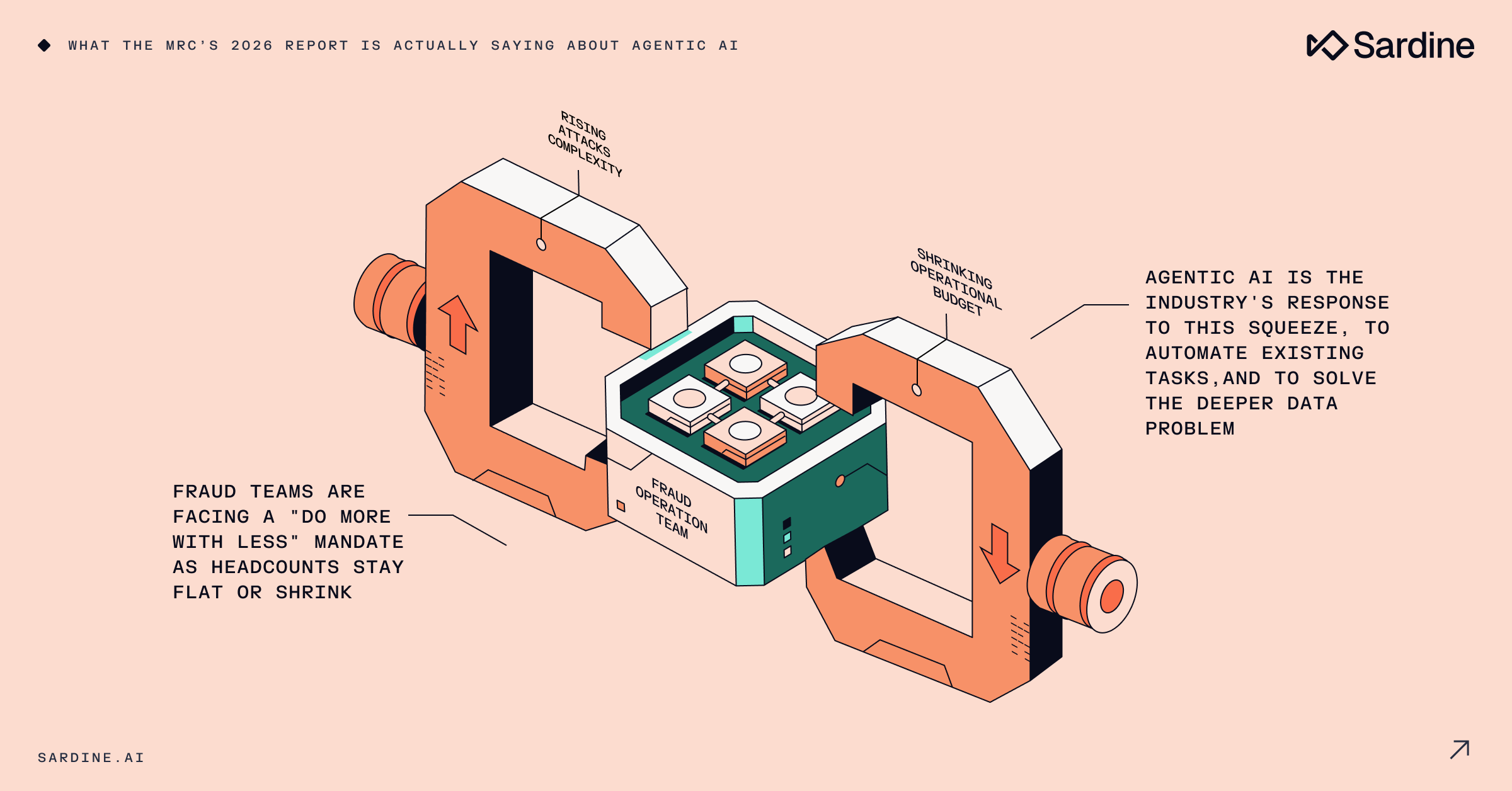
Every fraud leader I've spoken to this year has gotten some version of the same memo from finance: cut costs.
You've already had the argument. You've explained that fraud isn't a typical cost center, that the cuts being proposed will cost more in losses than they save in headcount, that your team is already running lean. None of it has changed the answer. The cuts are happening across the company, and they're happening in your org whether you push back or not.
So I want to make a different argument here, one that's harder to defend to your CFO but easier to act on once you've internalized it: use the pressure.
Your fraud organization is going to look meaningfully different two years from now whether or not you actively rebuild it. The system you're running today was designed for an adversary that moved at human speed, and that adversary is rapidly being replaced.
The team you've built around that system is going to come under strain regardless of what finance does this quarter, because the system is what's breaking, not the budget.
The cost-cutting mandate and the decay of your fraud stack are the same problem viewed from two angles. If you treat the mandate as the forcing function for the rebuild you should have started already, the cuts fund the transformation.
But if you treat it as a fight to defend the status quo, you lose the fight, your headcount gets cut, and the system you're left with is still breaking, just smaller.
That's the reframe I want you to walk into your next planning meeting with. The question isn't "how do we cut fraud ops costs?" It's "how fast does our system learn?". Because everything that matters, including cost, losses, false positives, approval rates, and what your team looks like two years from now, is downstream of that one number.
But here's the thing: the answer to both questions is also the same one: "with the help of agentic AI."
Every component of your fraud system is decaying right now
Look at any fraud stack and you'll find the same architecture: ML models at the bottom scoring the general population, rules in the middle catching what the models miss, and manual review at the top handling the gray zone that's left. It's the three-layer cake: it's familiar for good reason, and when it's well-maintained, it works.
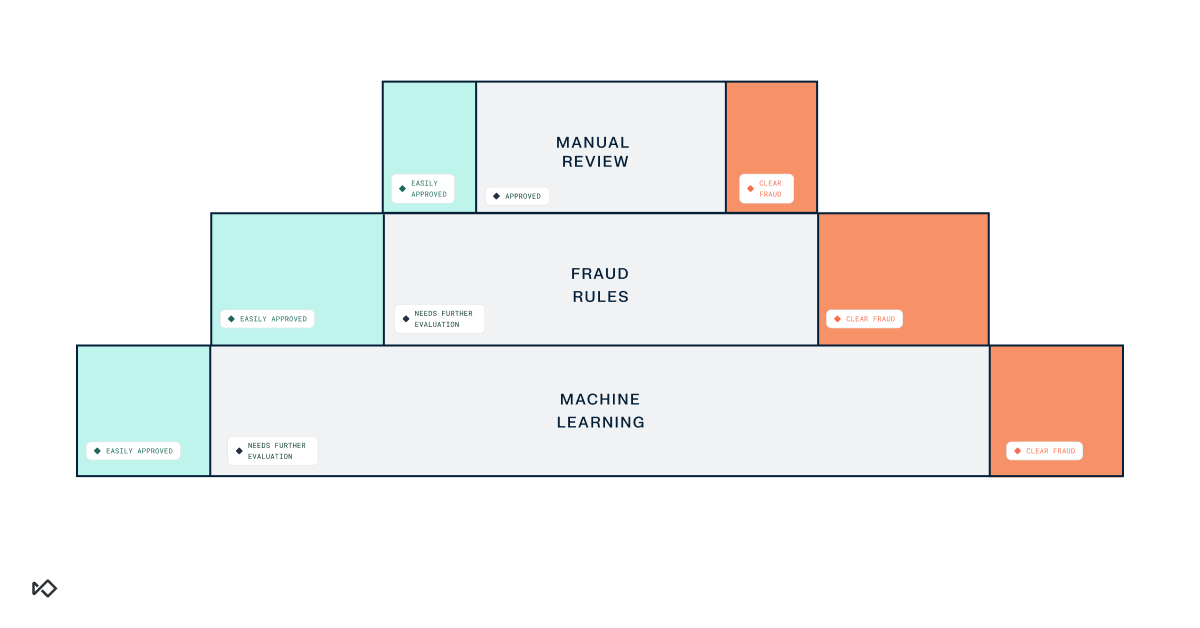
But here's what gets glossed over in every architecture diagram I've ever seen: every layer of that cake is degrading the moment it goes live.
Rules degrade the fastest. The minute you ship one, the adversary starts probing around it, and the pattern it was designed to catch shifts within days. Blocklists rot the same way, since a static defense is by definition pointed at a moving target.
ML models decay slower, but they're far more expensive to refresh. And a model refresh has a side effect most teams underestimate: when the new model ships, the score distribution shifts, and every downstream rule that was calibrated against the old distribution suddenly needs re-tuning. Hundreds of rules can break or behave unpredictably overnight, which is exactly why most teams put off the refresh as long as they can.
The only components of your fraud system that degrade slowly are the ones running on fresh data, human investigators reading what's in front of them right now, and, this is the part most teams haven't fully internalized, agentic AI that's doing the same.
Everything else in your stack is working from a snapshot taken weeks or months ago.
Your fraud detection workflow is only as good as the last time it learned
Here's the reframe the rest of this post rests on:
A fraud system's effectiveness at any given moment is a function of how recently it learned, not how sophisticated it was when it was deployed.
Most leaders evaluate fraud systems on a sophistication axis: better models, more features, smarter rules, tighter thresholds. They treat effectiveness as if it were determined at the moment of design. But effectiveness is actually determined at the moment of use, and the gap between those two moments is the variable that controls performance.
A rough rule shipped this morning will outperform a sophisticated one shipped two months ago against an attack pattern that emerged last week. The conclusion is straightforward: to avoid decay and ensure high performance, our systems need to learn more frequently.
The reaction cycle is the master KPI for your fraud detection workflow
If I could measure only one thing about a fraud team, it would be the time it takes to learn about a system gap and deploy a fix for it. I call it the reaction cycle, and it has six steps split across two phases.
The learning phase covers detecting the threat, scoping it, and finding the root cause. The acting phase covers designing a fix, testing it, and deploying it. Everything we do as fraud teams lives inside that cycle: the technology we run, the processes we follow, the skills on our team, the tools that assist us.
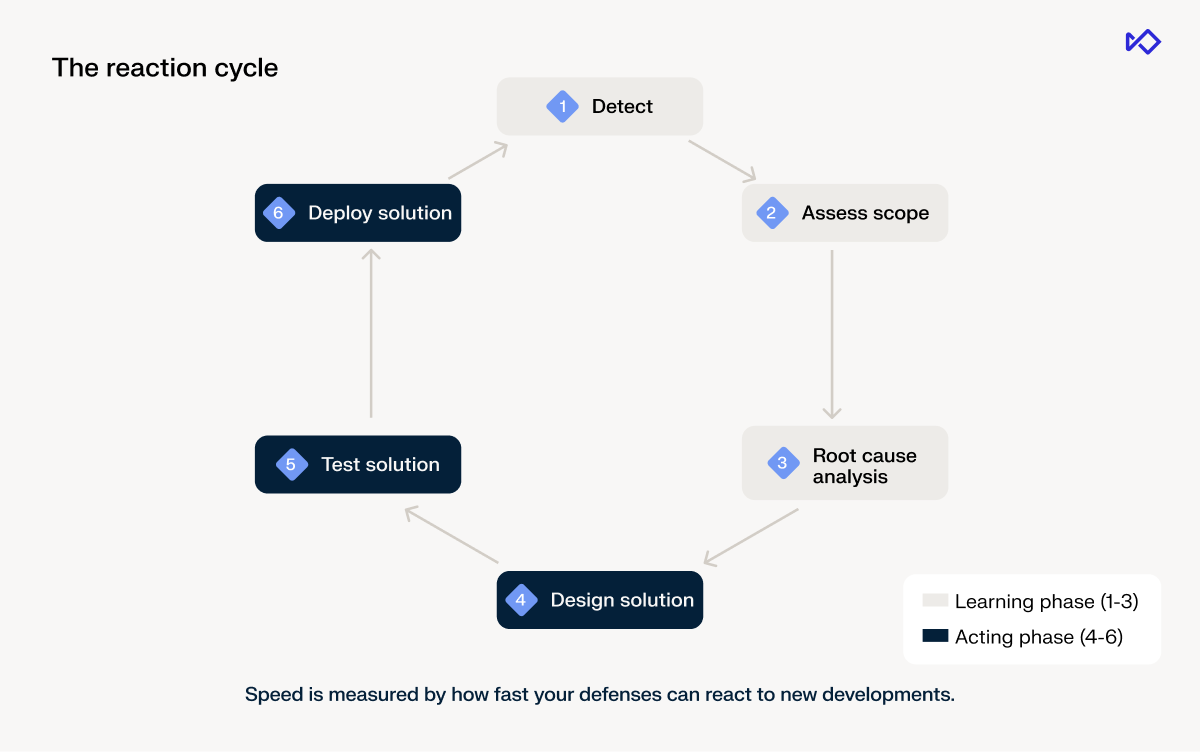
Want to reduce false positives? Compress the cycle. Want to cut chargebacks, lift approval rates, or shrink your investigation backlog? Same answer.
There is no version of "improve fraud outcomes" that doesn't run through this loop, because every other metric you report on, precision, recall, FPR, loss rate, conversion, is a downstream artifact of one upstream number: how fast you close the gap between observing something and acting on it.
But ask a fraud leader what their reaction cycle is right now and you'll get a long pause, then a guess. Almost no team measures it explicitly; they measure everything that depends on it instead. And that's exactly why the failure mode is so easy to miss.
Fraudsters didn’t get smarter, they got machine speed faster
Now let's consider what's happening on the other side. Fraudsters didn't get smarter over the last two years, they got faster.
What threat intelligence teams started flagging in 2025, and what I've now seen confirmed across multiple Sardine customers, is a new category of attack behavior: sub-second adaptation. A defense goes live, and the attack morphs around it before the deployment has even finished rolling out. Fraud AI agents on the other side are reading denial signals in real time, testing variations, and scaling up whatever works.
Teams have already been forced into blunt mitigations like shutting down cards from entire issuers for weeks at a time, or blocking significant shares of incoming traffic, because their defenses couldn't adapt fast enough.
But even setting aside the most sophisticated polymorphic attacks, the baseline has shifted. Fraudsters are using AI agents for the boring parts of their work, analyzing campaign performance, tweaking scripts, answering customer service emails to keep mule accounts alive, and the time those agents save is now being used to outpace you.
The system every fraud team is currently operating was designed for a world where the gap between attacker adaptation and defender reaction was manageable.
Your cycle was slow, but so was theirs, because the adversary was a human working with human-sized tools at human speed. That assumption is now dead, and the gap that used to be manageable is now widening at increasing speed.
Optimization won't save the current system
When you hit this kind of pressure, the instinct is to optimize: shorter meetings, better dashboards, more analysts, tighter SLAs on rule deployment, cross-functional task forces, or quarterly model refreshes pushed to monthly.
I've watched teams pour energy into all of those, and none of them produce the kind of speed the moment calls for. How come? Because they're optimizing the wrong layer.
Your reaction cycle isn't slow because the people running it are slow. It's slow because it was designed around human-speed learning. Models refresh on quarterly cycles, rules get reviewed in weekly cadence meetings, segmentation thresholds get revisited annually if at all, and feedback from investigations rarely makes it back to the detection layer in any structured form. And when it does, it arrives weeks after the events themselves.
Best case, you can squeeze 20% out of those steps. But no amount of incremental optimization fixes the fundamental design assumption, running at human speed just doesn't cut it anymore.
The fix for fraud workflow decay is already on the table
I want to be careful here, because the industry is full of bad framings on this point. I'm not arguing that you should use AI to automate tasks done today by humans. This framing is too simplistic, lacks direction, and is likely setting your organization up for failure.
The actual claim is more specific: The learning loop itself needs to run at machine speed instead of human speed.
This calls for more than just "replacing headcount with AI.” It's about redesigning the system itself and how it functions. To run reaction cycles at machine speed you need a different architecture, one that enables fast learnings. Automation alone would not get you there.
So what breaks if you stop at automation? Your team gets faster at the work it was already doing, but the work that actually moves your fraud rate is work no human was doing in the first place, and automation can't create work that didn't exist.
Nobody on your team is labeling fresh transactions in real-time, clustering alerts across thousands of accounts to find the ring they belong to, or continuously re-tuning segmentation thresholds as cohorts shift.
These aren't tasks to automate, they're capabilities most human teams never had the bandwidth to deliver. Make case review three times faster and you save investigation cost, but the reaction cycle doesn't move, because what limits the cycle was never how fast investigators worked. It's that labels arrive weeks late, rules are written reactively, and detection updates land long after the attack has moved on.
Ironically, the solution is the same one that compressed the attacker's adaptation cycle from weeks to seconds. Agentic AI is already on both sides of the board, the only question is who deploys it more effectively.
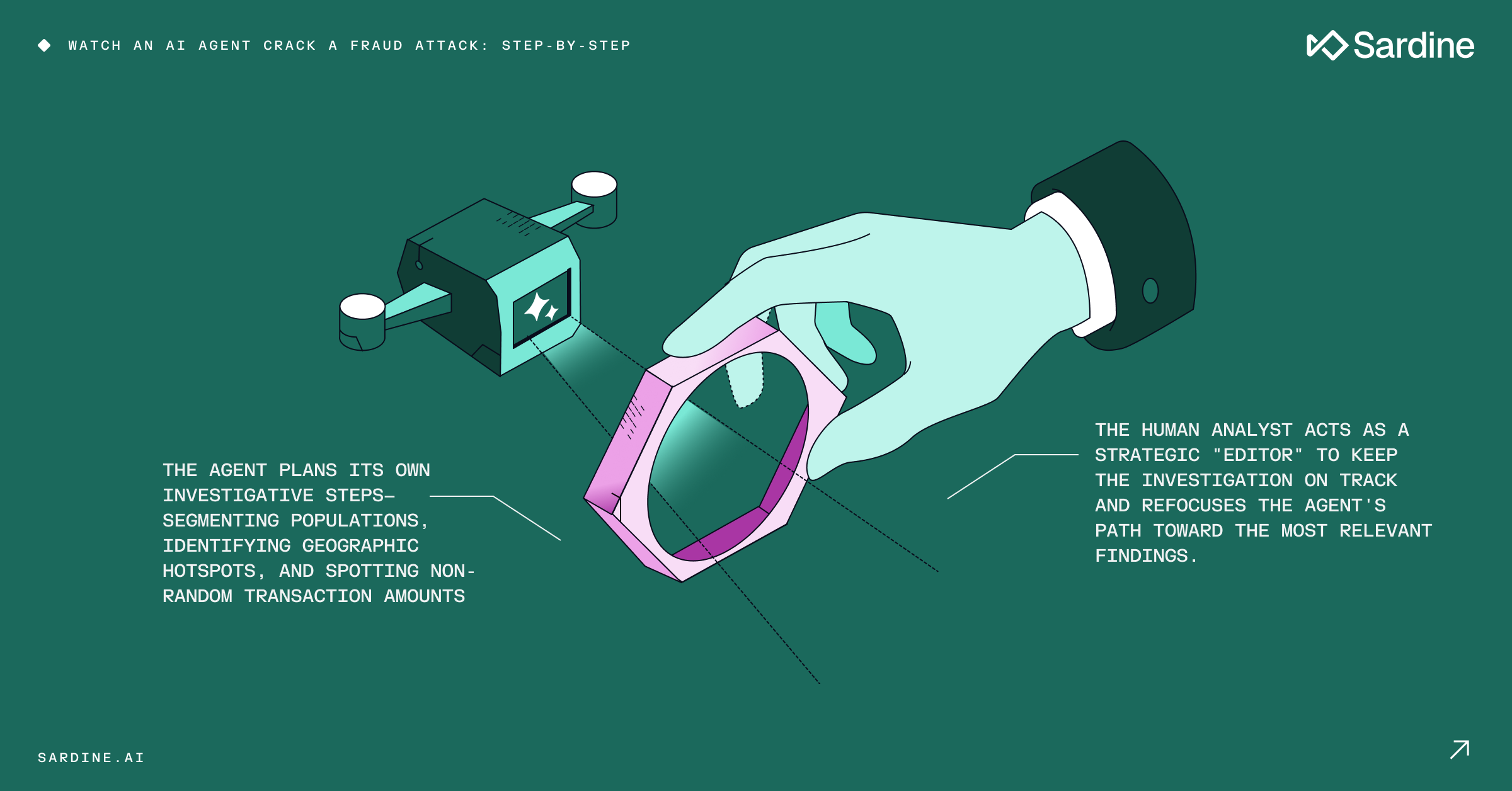
Agentic AI can cluster alerts into ring-level cases, so one ruling labels thousands of events. It can generate labels from fresh data continuously, closing the feedback loop in days. It can propose new rules and surface model-refresh candidates with backtests already attached.
The reaction cycle compresses because the loop is closing in places where it used to be open, and you're now reacting at machine speed because you added capabilities your team never had.
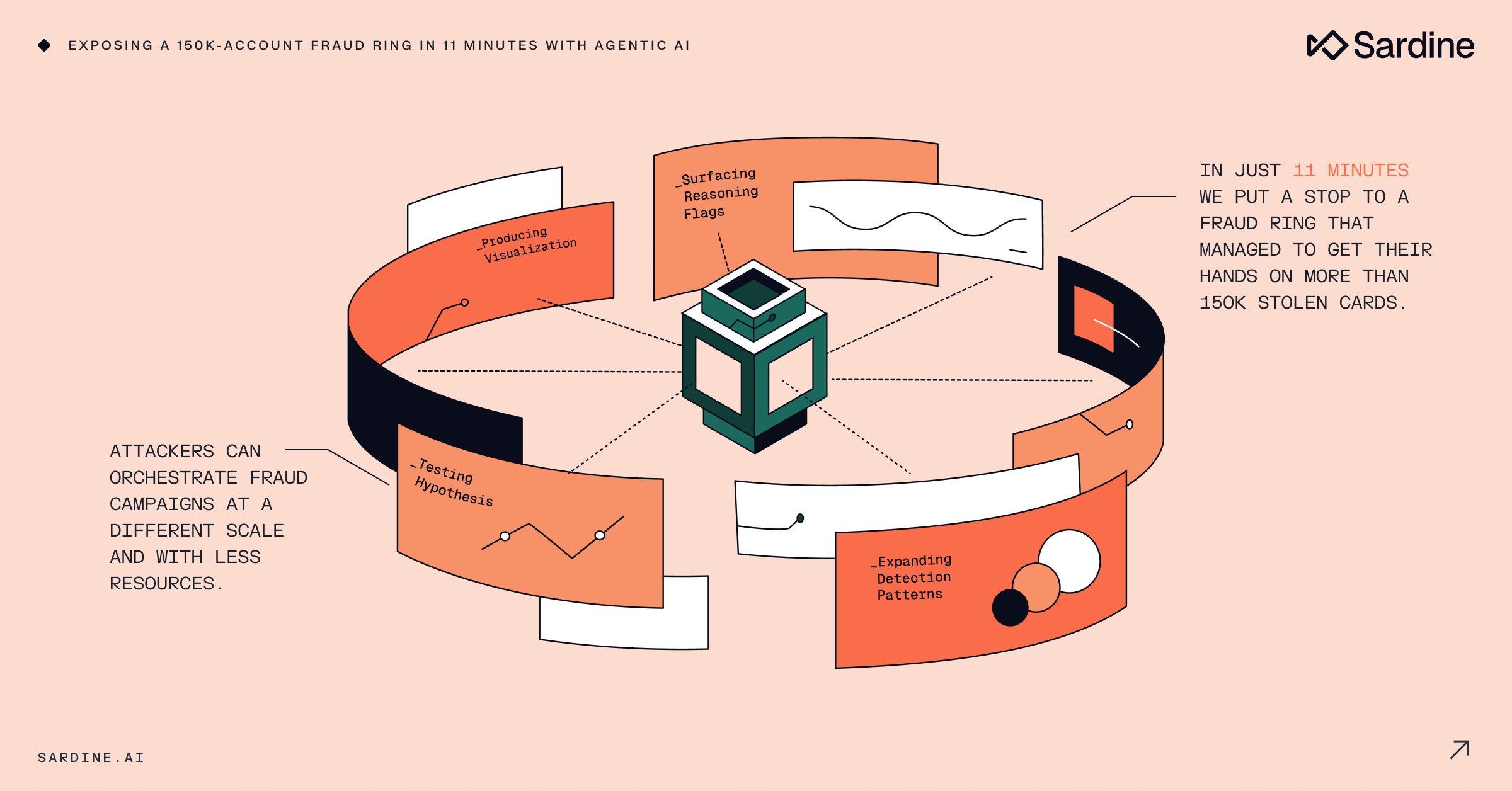
For a concrete agentic AI ring-detection case, see how we exposed a 150K-account fraud ring in 11 minutes.
The opportunity, not the trend
The pressure you're feeling from finance isn't going away. I've made the case for why fighting it head-on is the wrong move, but I want to close on what makes this moment different from every other budget cycle you've been through.
The rebuild and the cost cut don't have to be separate projects.
Cut Fraud Ops 30% on its own and you're running the same broken cycle with fewer investigators. Alerts pile up, fraud rate creeps up, and twelve months in you're smaller and worse off.
But rebuild the loop first and the same 30% drop in headcount comes out the other side as a consequence rather than the starting move. Finance sees the same number, only now you have a system that actually works.
Most fraud leaders are about to spend the next 18 months either resisting the cost pressure or absorbing it badly. The third path (when using it deliberately as funding for the rebuild your system needs anyway) requires you to walk into your next leadership meeting with a different argument than the one you've been making.
Not "don't cut my team," but "give me the mandate to rebuild it. Lower headcount would be a consequence."
That's the argument I want every fraud leader reading this to be ready to make. The fraud team you have today is going to break under the next 18 months of pressure either way.
The only question is whether what replaces it gets designed by you, or assembled by accident.
For the cross-discipline view of the same machine-speed argument applied to AML, see Sardine's agentic AI for AML.
The full fraud detection workflow rebuild
What you just read is a broad reframe of why agentic AI is the future of fraud ops and not just a cause for downwards pressure. If you want to go one level deeper or get the fuller picture, check out the whitepaper this post is drawn from.
It covers in detail why moving to agentic is a reality all fraud teams need to wake up to, including:
What such a system should look like
- The headcount and skill mix the new system actually needs
- The governance model that keeps continuous learning safe at scale
- The 18-month rollout patterns, what works, and where teams break it
- How to defend the sequence inside your organization
If you're the person at your company who's going to fund, sequence, and defend this work internally, you'll find many of the answers there.
What is the fraud reaction cycle?
The fraud reaction cycle is the time it takes a fraud team to learn about a system gap and deploy a fix for it. It has six steps split across two phases: a learning phase (detect, scope, root cause) and an acting phase (design, test, deploy). Every other metric a fraud team reports, false positives, chargebacks, approval rates, loss rate, is a downstream artifact of how fast that cycle closes.
Why is agentic AI different from rules and ML for fraud detection?
Rules and ML models both decay from the moment they go live, rules within days, models over weeks and months. Agentic AI runs on fresh data continuously: it labels new transactions, clusters alerts into ring-level cases, and surfaces model-refresh candidates with backtests already attached. The difference is not that agentic AI is smarter, it is that the system learns more recently.
What is model drift in fraud detection?
Model drift is what happens when an ML fraud model is trained on a snapshot of attack behavior and the attackers move on. The model still scores the way it did at deployment, but the population it is scoring has shifted, and performance silently degrades. Refreshing the model resets the baseline, but it also shifts the score distribution and forces every downstream rule to be re-tuned, which is why most teams put the refresh off.
What is the right deployment pattern for agentic AI in fraud operations?
The pattern that works in production is narrow agents on narrow tasks, not one end-to-end agent that tries to run the whole investigation. A label-generation agent on fresh data, a clustering agent that finds rings, a sanctions-check agent, a narrative-drafting agent for the SAR. Each one has a defined input, output, and evaluation. The work compounds because each agent does its job well, not because one agent tries to do every job at once.
How does agentic AI affect fraud team headcount and skill mix?
Headcount typically comes down, but the shape of the team changes more than the size. Detection and ML engineering grow share, Tier-1 case-clearing analysts shrink fast, investigators consolidate into a smaller and more senior tier on agent-escalated cases, and a new role appears for evaluating the agents themselves. Governance and model risk grow share. The planning conversation a fraud leader walks into should describe that shape, not just the cost line.