Fraud rates haven't spiked dramatically since generative AI went mainstream. If you compare your chargebacks dashboard from two years ago to today, the numbers probably aren't wildly different.
And yet, we’re starting to see the signs of a coming change.
The most dangerous attacks, the ones not visible to classic detection measures, have recently looked different. Faster, more dynamic, and highly precise when targeting vulnerabilities.
It’s still early. Fraudsters are still figuring out how to build and deploy these attacks at scale, and most haven't fully cracked it yet. But the attacks that do work are fundamentally different from anything fraud teams have defended against before.
When these techniques spread, and that’s our current prediction, the teams that haven't updated their thinking are going to feel it in their numbers.
These are polymorphic fraud attacks.
Here's what they are, why they breaks the conventional fraud stack, and what you actually need to do about it.
What a polymorphic fraud attack actually looks like
In a conventional fraud attack, fraudsters commit to a tactic and run it until detection catches up. This would include their device and network infrastructure, their target and attack vector, and the exact action sequence.
Once your system detects the attack (quickly, hopefully), it blocks it. At that point the fraudster would have to regroup and rethink their options. Should they work on a variation of the attack and try again, or should they move on to another target?
A polymorphic attack doesn't work that way. Instead of a human dictating how it would be executed, it is delegated to an agentic AI fraud system to do that. The human decides on the strategy, what they want to gain, what resources are available for the agents, and the budget.
But the real threat is not so much the automation as much as it’s reaction time.
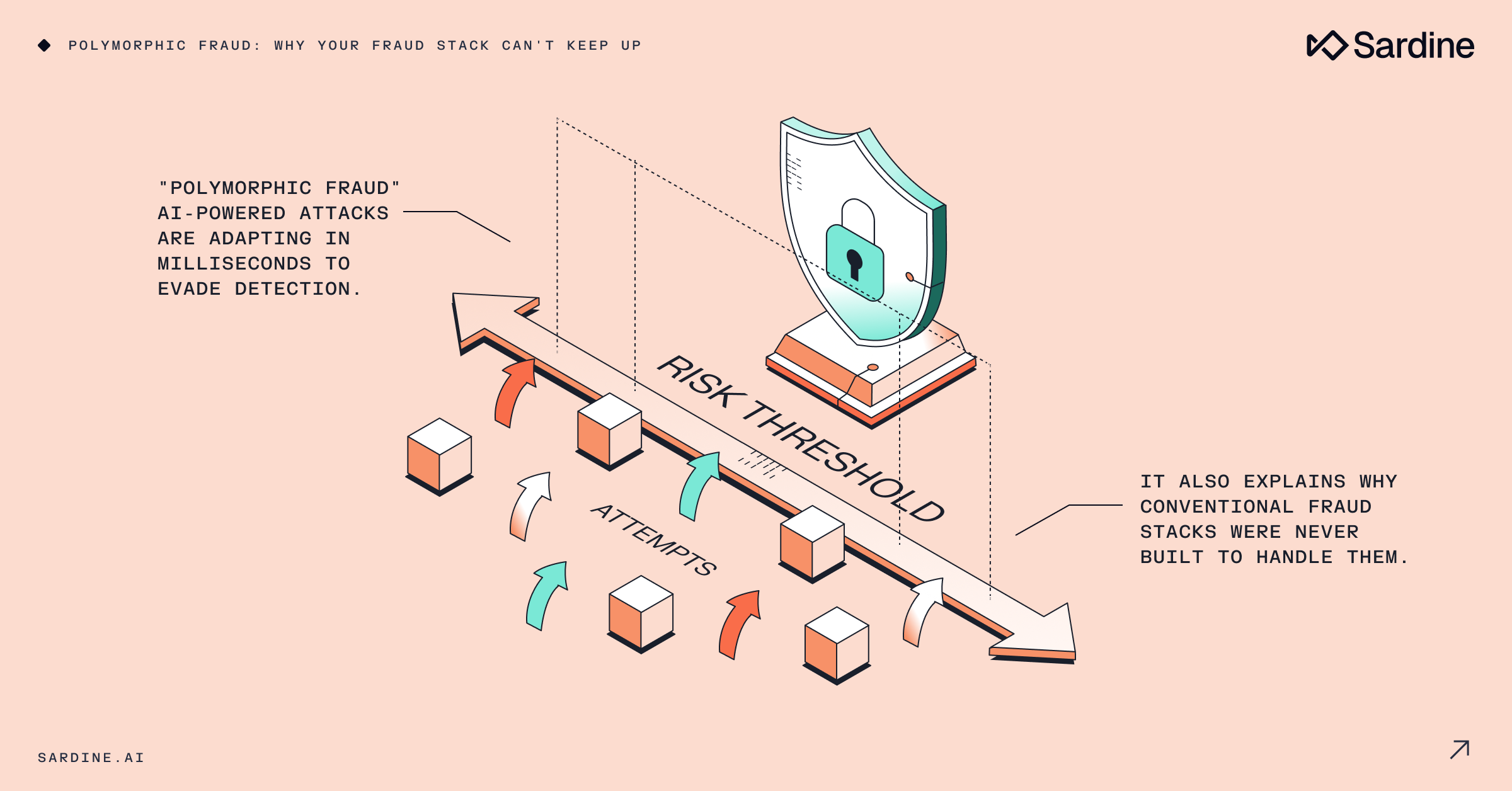
When an AI agent gets blocked, it reads the denial signal, adjusts its parameters, and tries again. Not over days or even hours, but in sub-second fraud attacks.
Each blocked attempt becomes a data point about where your fraud prevention threshold sits, and the attack reconfigures itself in real time to sit just outside it.
Think about what that means in practice. Fraud prevention teams rarely can react within days, sometimes weeks from when they spotted a new attack. Now the adversary is reacting in milliseconds.
This fight was never fair, but it’s now getting even worse.
In practice, the only options many teams find themselves with are bad ones: accept ongoing losses while trying to build a faster response, or reach for something blunt like blocking traffic from an entire geography, or suspending whole card categories.
Both options are symptoms of a defense built for a different kind of adversary.
Why agentic AI fraud makes the accessibility problem worse
Running sophisticated automated attacks used to require real technical depth. It required both coding expertise as well as understanding how fraud prevention systems work.
Indeed, same as top fraud prevention teams, sophisticated attacks used to require a team to execute well. The skill set required was just too wide. In turn, it increased the upfront investment and raised the entry bar even higher.
Agentic frameworks have changed that.
You can now use AI agents to perform a complex machine-speed fraud attacks at scale without writing a single line of code or knowing anything about how fraud prevention works on the other side.
The barrier to running sophisticated fraud is slowly shifting from skill to intent.
The consequence isn't just larger attacks from the same actors. It's more actors, less predictable attack patterns, and a broader threat surface. When volume goes up and the average attacker's profile shifts toward people with less experience and less sophistication, the attacks become more chaotic and harder to model.
Finally, there’s also something to be said about how agentic attacks “help” reduce moral inhibitions by creating a gap between the fraudster and their target. This is especially true for policy abuse, synthetic identity fraud, account takeover fraud, and payment fraud. The types of attacks that are often perceived as “victimless” fraud.
Why your conventional fraud stack can't keep up with machine-speed fraud attacks
The conventional fraud architecture, a rules engine sitting on top of a machine learning model, was designed for a world where attackers adapt over days or weeks.
You see a pattern, document it, write a rule, and push it through fraud rule deployment. But even great teams would struggle to react within 24 hours. Often I see that this can take teams up to a week.
Model retrains are even worse. You need to accumulate a big-enough fresh dataset (including labels) to actually make a difference. That can easily take months.
So far, teams somehow were able to survive with such reaction time because the adversary was human too. Their adaptation cycle was slow as well. You were always a step behind, but the gap was manageable.
Human-paced attack | Polymorphic/agentic attack | |
Adaptation cycle | Hours to days | Milliseconds |
Attack variation | Manual, deliberate | Automated, real-time |
Skill required | High technical expertise | Intent only |
Learning from blocks | Regroup and rethink | Reads denial signal, adjusts instantly |
Detection surface | Repeating patterns | Shifting parameters, borderline events |
Defense gap | Manageable | No longer manageable |
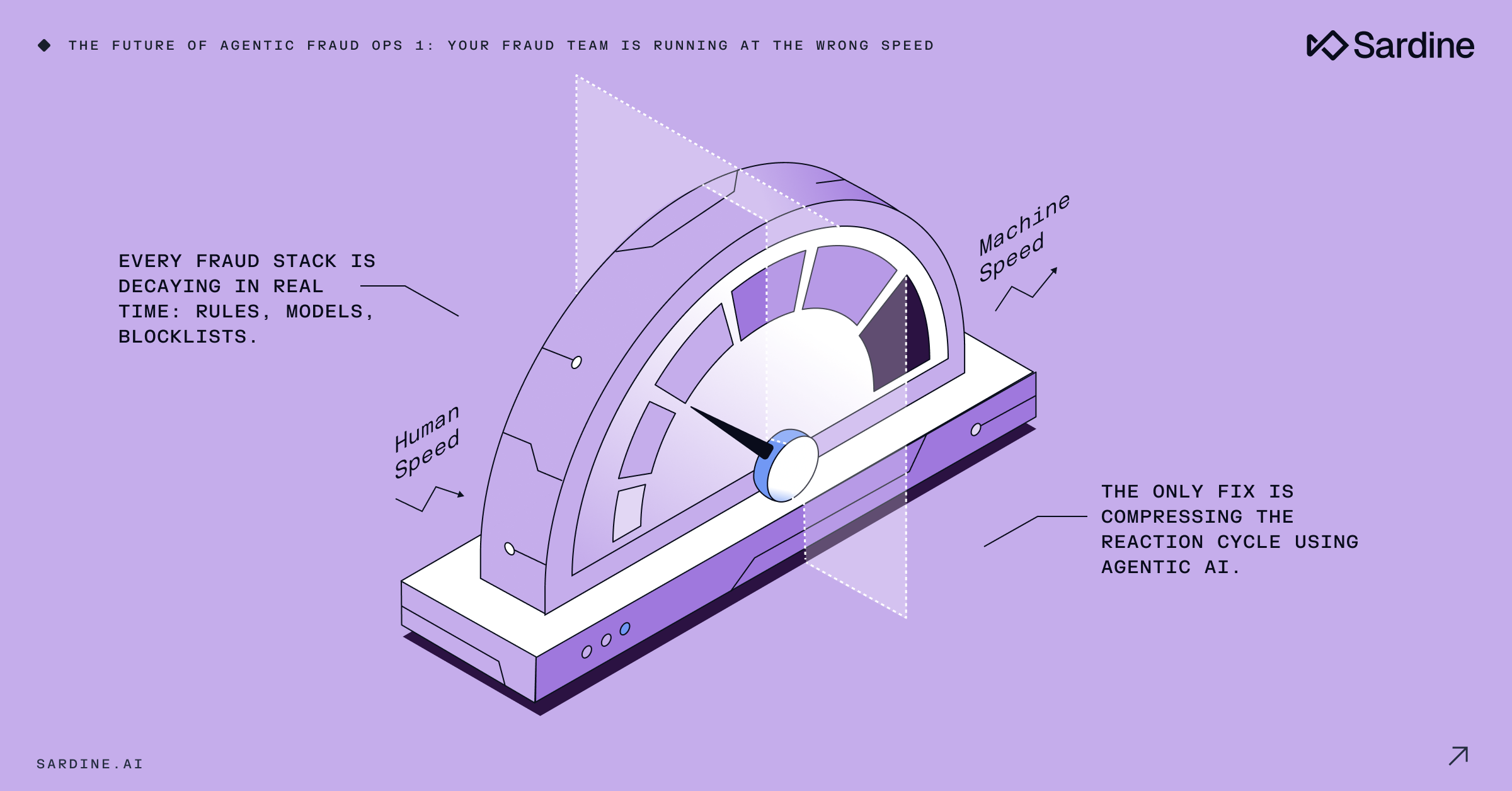
But the gap isn't manageable anymore.
The design is the problem here. No number of faster analysts or tighter thresholds fixes a badly designed system. A fraud system that needs a human in the loop to respond at machine speed is already behind by construction.
To be able to keep up with the fraudsters, fraud teams need to rethink their approach entirely. And their secret weapon is the same as the bad actors’: agentic AI.
The basics still have to work first
The obvious answer to machine-speed attacks is a faster, more automated detection system. We discussed this in our recent webinar, you can catch up here.
But here's the tension I keep running into when talking to fraud teams about this: a faster system built on broken foundations doesn't help you. It just speeds up the noise.
If your learning loops aren't airtight, adding agents won’t close this gap. If your labels are three months stale, or you can’t tell how many false positives you produce, AI agents would simply make you reach faster the wrong decisions.
Think about what a polymorphic agent actually needs from the defending side. It needs to read denial signals, learn from them, and adapt faster than the attacker can probe. That requires clean data pipelines, detection logic you can observe, and feedback loops that close.
But most fraud prevention teams, especially ones that support systems that move at human speed, often lack that basic infrastructure. Data is often fragmented across different systems, is not processed for consumption by machines, and sometimes exchanged only in physical conversations.
The idea that AI is a magic solution that can overcome these limitations on its own is a misconception. Or at least, not without extra costs, time, and degraded performance.
The number one mistake I see fraud teams make when they rush to leverage AI is making that decision before they’ve checked they were ready for it.
Is your data clean and well-structured? Can it be accessed by processed in a single environment? Are your labels accurate? Are you able to deploy rule changes in a stable, safe, and quick manner?
None of this is glamorous. Cleaning up data pipelines and shortening label cycles doesn't make for exciting internal pitches. But it's the prerequisite for everything else.
An agentic detection system that can't learn from clean, timely signals is just another system that decays faster than the attacker adapts.
What fighting back actually requires
At this point, you might be thinking: if the attack adapts in milliseconds, what does getting labels faster actually achieve? Even near-real-time feedback isn't close to millisecond response.
That's fair. But it misses something important about how these attacks actually look in the wild.
Polymorphic attacks are often not as invisible as they sound.
Each individual event might look borderline on its own. But at scale, these attacks leave a clear trail with hundreds or thousands of attempts sharing the same underlying fingerprint, even as the specific parameters shift. When you look at the full picture, the attack is usually obvious.
And that’s what makes it so frustrating, it just learned to operate under the thresholds you've set. The problem isn't that you can't see it. It's that your system isn't built to look at the right level.
Getting there requires three things working at the same time.
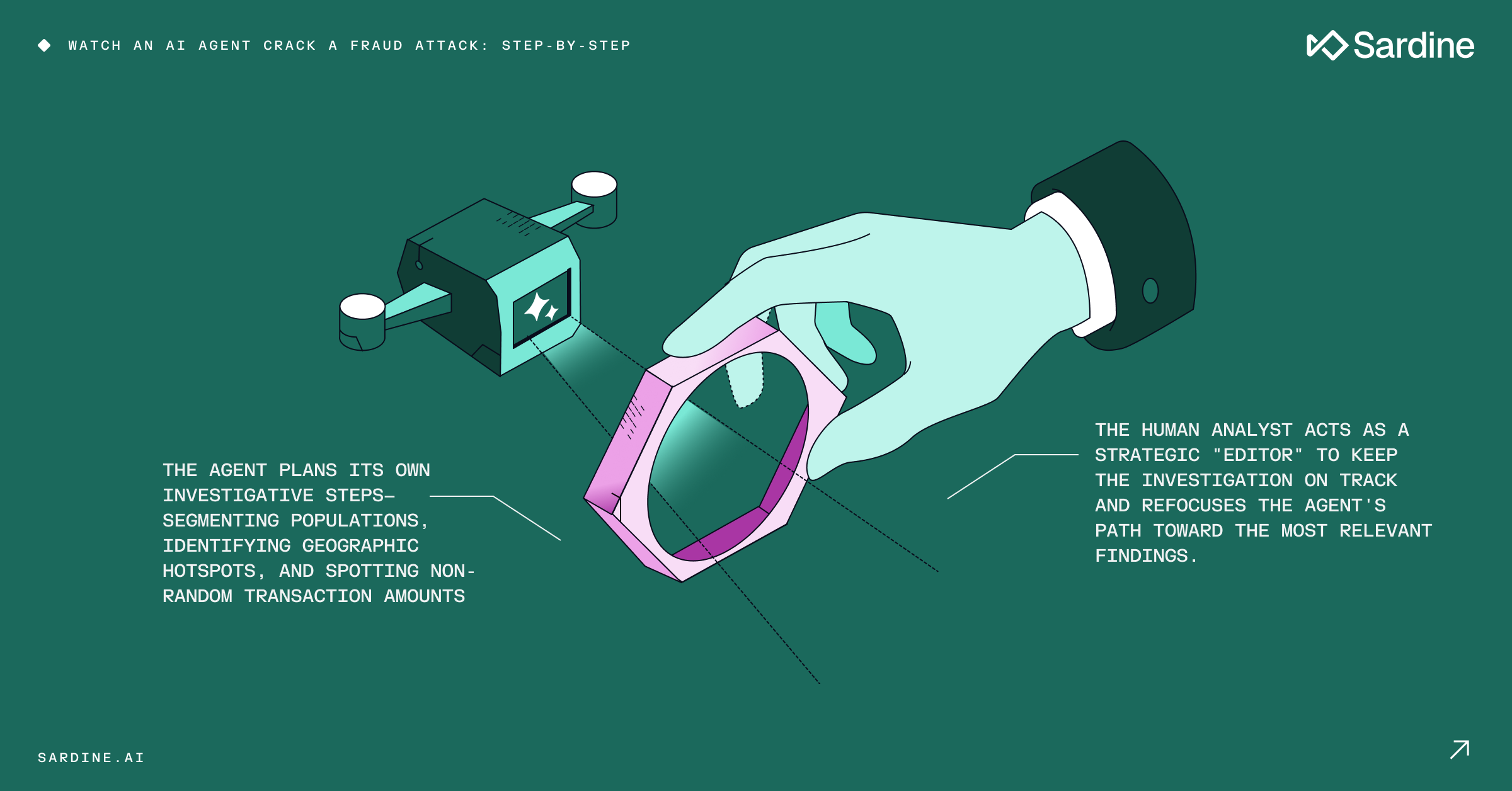
First: cluster events into cases.
Your detection fires on individual transactions, which is exactly what polymorphic attacks exploit. Each event stays borderline while the ring is unmistakable.
An agent that groups seemingly unrelated events by shared device characteristics, behavior, and timing gives you the right unit of analysis. Once you're looking at the ring instead of the events, the attack is usually easy to see.
Second: reason over the case to identify the pattern.
Once you're at the case level, you need an agent that can query the full data, identify the anomalies, and compare what it's seeing to previous attacks.
Polymorphic attacks are often evolved versions of something that already hit you. Recognizing a new ring is strongly linked to a known attack is almost a prerequisite to act against it.
Otherwise, you’re running too much of a risk of declining legitimate users.
Third: turn the pattern into a rule change, safely.
Spotting the attack is only useful if you can act on it quickly. That means an agent that can access your rules engine, understand its features, and back-test a proposed change against historical data before they get deployed.
Without it, the risk of deploying a change that introduces a catastrophic amount of false positives is too high.
In my experience, that last step is where most teams underestimate the risk. The instinct when an attack is active is to move fast. An agent that can move fast and show you what a rule change does to your false positive rate before it goes live is what actually protects you.
Step | What it does | Why it matters |
1. Cluster events into cases | Groups related events by shared device, behavioral, and timing signals | Reveals the borderline individual transactions as well as the fraud ring |
2. Reason over the case | Queries full data, identifies anomalies, compares to known attacks | Reduces false positives and connects new rings to prior patterns |
3. Back-test rule changes | Tests proposed rule against historical data before deployment | Lets teams move fast without introducing catastrophic false positive spikes |
The gap is the risk
Most fraud stacks are going to encounter polymorphic attacks before they're ready for them. The teams that come out ahead won't be the ones with the tightest rules or the most accurate models at the moment of impact.
They'll be the ones whose systems can learn and adapt within the same time window the attack is operating in.
The gap between how fast the attack adapts and how fast your defenses can respond is the actual metric that matters. It's worth figuring out how wide that gap is in your organization before you're measuring it in losses during an incident.
Want the full picture?
What you just read is an overview of why polymorphic attacks break the conventional fraud stack.
We have a few resources on this topic:
This webinar is available on-demand and dives into what makes fraud systems work, and why that's changing.
Our white paper The Rise of Agentic Fraud Ops goes further, mapping out the full reaction cycle, walks through how to redesign each stage of your fraud ops system for learning velocity, and lays out a five-phase sequence for getting there without breaking what already works.
If you manage a fraud program and you're thinking about where AI actually fits in, that's the right place to go next.
FAQs About Polymorphic Fraud Attacks
What is a polymorphic fraud attack?
A polymorphic fraud attack is a fraud attack that changes its behavior in response to your defenses. Instead of repeating one tactic until it gets blocked, the attack reads denial signals, adjusts its parameters, and tries again. That makes it harder for a conventional fraud stack to detect with static rules or slow manual review.
How does agentic AI fraud change fraud prevention?
Agentic AI fraud changes fraud prevention because attackers can now adapt at machine speed. A human fraudster might take hours or days to adjust after getting blocked. An AI agent can test, learn, and reconfigure the attack in milliseconds, putting pressure on fraud teams that still rely on human-speed response cycles.
Why are machine-speed fraud attacks harder to stop?
Machine-speed fraud attacks are harder to stop because they move faster than most fraud operations teams can investigate, label, write rules, test changes, and deploy fixes. If your fraud rules engine, labels, and feedback loops move slowly, the attacker gets more chances to probe your fraud prevention thresholds before you respond.
Why does a polymorphic fraud attack break the conventional fraud stack?
A polymorphic fraud attack breaks the conventional fraud stack because that stack was built for slower adversaries. A rules engine machine learning model setup can work when attackers adapt over days or weeks. It struggles when attacks mutate in real time and learn from every blocked attempt.
What role do fraud feedback loops play in AI fraud prevention?
Fraud feedback loops determine how quickly your system learns from new attacks. If labels are stale, data is fragmented, or detection logic is hard to observe, AI fraud prevention gets weaker. Faster feedback loops help teams identify patterns, update rules, and adapt before the attack has already caused material losses.
Why are stale fraud labels a problem for AI fraud detection?
Stale fraud labels are a problem because they teach your fraud system about old attack patterns. If labels arrive weeks or months late, your AI fraud detection is always learning from the past while attackers are adapting in the present. Polymorphic fraud makes that lag much more dangerous.
What does AI-ready fraud prevention require?
AI-ready fraud prevention requires clean data, observable detection logic, accurate labels, fast feedback loops, and safe rule deployment. Adding AI agents on top of broken infrastructure does not solve the problem. It just helps the system reach the wrong decision faster.
How can fraud teams detect polymorphic fraud?
Fraud teams can detect polymorphic fraud by looking beyond individual transactions and clustering related events into cases. Each event may look borderline on its own, but the broader fraud ring often reveals shared device characteristics, behavioral signals, timing patterns, or other links that expose the attack.
Why should fraud teams cluster events into cases?
Fraud teams should cluster events into cases because polymorphic attacks are designed to stay just under individual detection thresholds. When teams cluster events into cases, they can see the full pattern instead of isolated attempts. That makes fraud ring detection easier and gives analysts a better unit of analysis.
How do back-tested fraud rules help with real-time fraud response?
Back-tested fraud rules help teams move quickly without creating unnecessary false positives. Before a rule change goes live, fraud teams can test it against historical data to understand how it would affect legitimate users. That makes real-time fraud response safer and more precise.
What is learning velocity in fraud detection?
Learning velocity in fraud detection is how quickly a fraud system can observe an attack, understand the pattern, update its logic, and respond. In a world of sub-second fraud attacks, the gap between attacker adaptation and defender response becomes one of the most important risk metrics.
What is agentic fraud ops?
Agentic fraud ops is a fraud operations model where AI agents help detect, investigate, label, cluster, and respond to attacks faster than traditional manual workflows. For polymorphic fraud attacks, agentic fraud ops matters because the defense needs to learn and adapt closer to the speed of the attack.