A few months ago, one of our analysts watched a fraud spike form on a crypto on-ramp. Using an AI agent, she had the shape of the attack on her screen, all before she'd normally have finished writing the first SQL query. That's where agentic AI ROI starts to show up.
One analyst, one agent, and one question: is the same ring that hit a different on-ramp last week back again?
She didn't ask the agent for an answer. She asked it to test the idea. Medium-risk session volumes were flat. Low-risk sessions had nearly doubled in the same window. From there she drilled down by state, by transaction amount, and by behavior. The attack had a face within minutes.
Speed isn’t the only point that matters.
The point is that the question could be asked at all, by someone who isn't a data engineer, inside a platform that already speaks the language of the data. One of the clearest agentic AI capabilities for fraud teams is letting operators investigate patterns, test hypotheses, and move from suspicion to action without waiting on a data queue. That's a capability your system didn't have yesterday, not a faster version of an old one. In the agentic AI vs traditional AI conversation, that distinction matters: traditional AI helps score or classify, while agentic AI can investigate, reason across steps, and help coordinate the next action.
Agentic AI doesn’t just make your existing system cheaper, it makes it capable of outcomes that would have been impossible to produce before. That is why the agentic AI cost-cutting myth misses the real value: the biggest payoff comes from capability expansion, not only expense reduction. And those outcomes turn into dollars, the same dollars you'd count in an FTE savings model, just from the other side of the ledger. The business case is fraud loss reduction through a narrowed fraud loss window, faster response, and better detection of attacks that would otherwise scale.
Let me show you what I mean.
Three agentic AI capabilities that change fraud ROI in fraud detection
I'll keep these concrete and focused on real results and agentic AI outcomes, versus obsessing over shiny technology.
Use real-time fraud detection to catch a fraud ring before it scales
Go back to that crypto on-ramp. The analyst confirmed the anomaly, identified the behavioral pattern, then asked the agent to find every account that matched it. The ring expanded from a handful of suspicious sessions to the full population in the time it takes to read this paragraph.
That timing is the whole game. A coordinated attack is a race between how fast it spreads and how fast you see its shape. When the seeing takes half a day of manual SQL, the ring has already moved to the next target by the time you've drawn the map. When it takes minutes, you catch the ring while it's still pointed at you.
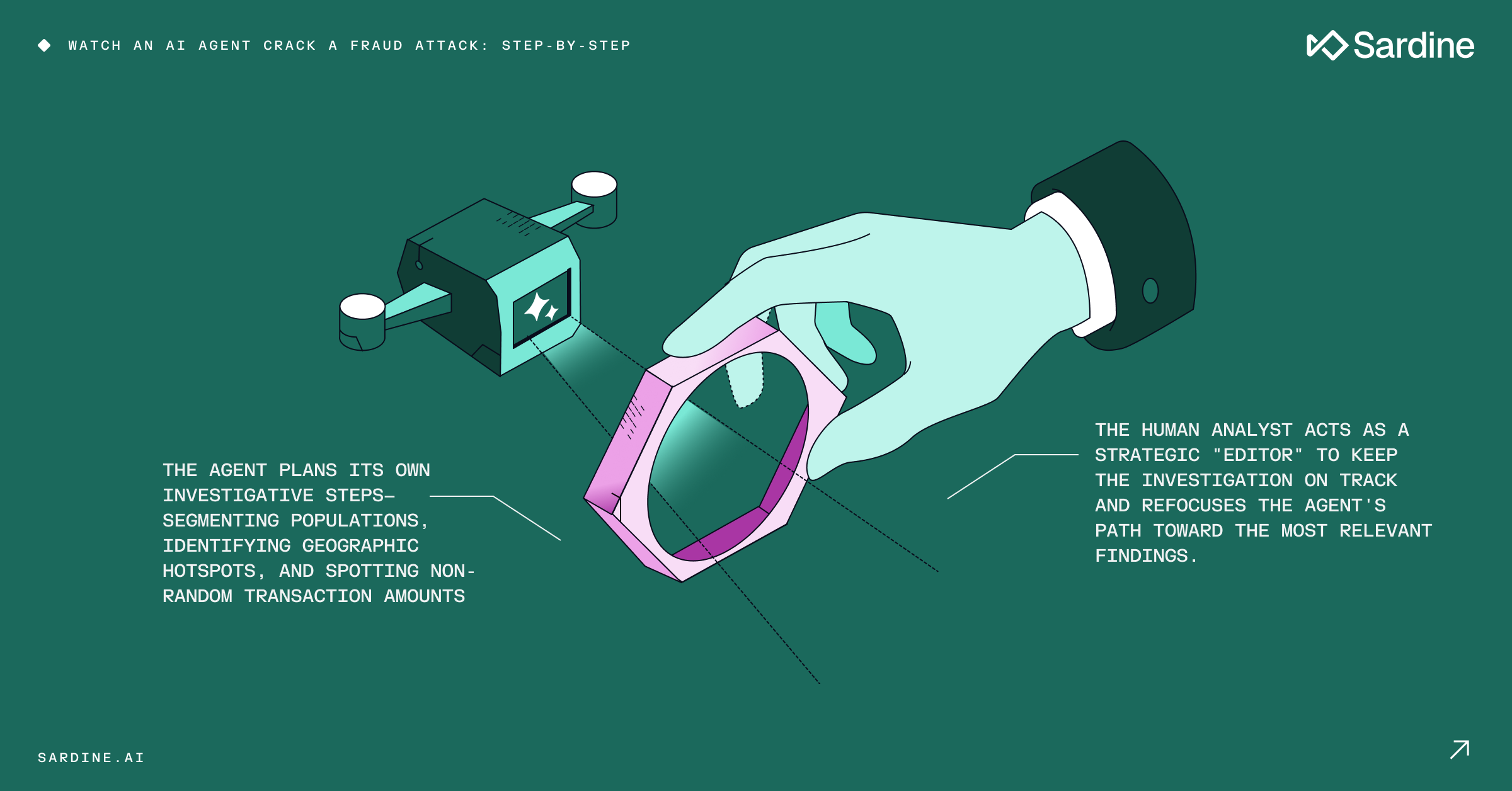
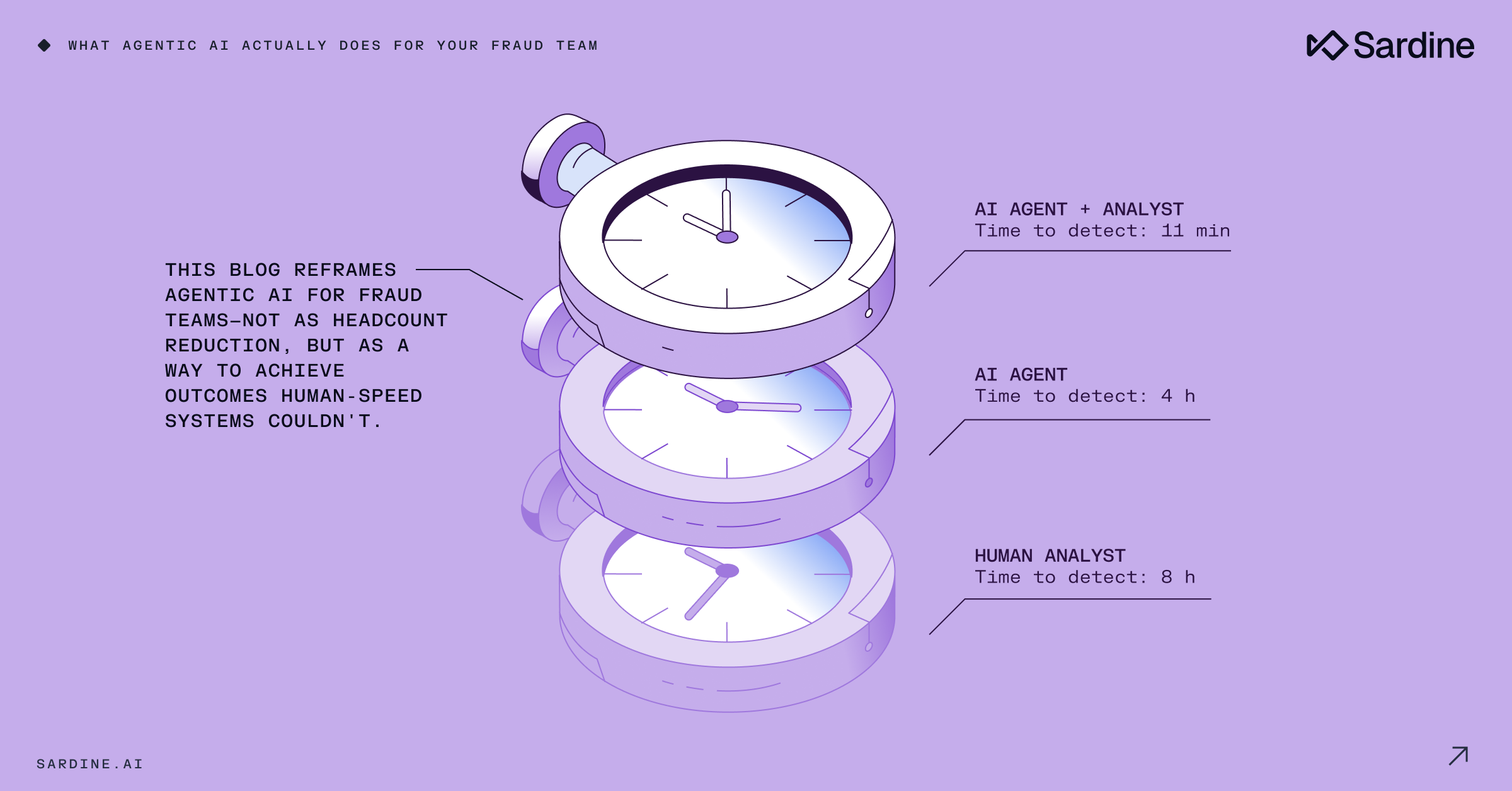
We watched this play out twice. In one investigation, an agent expanded a single suspicious device fingerprint into a 150,000-account fraud ring in 11 minutes. In another, the step-by-step crack of a crypto on-ramp attack, an analyst ran the whole thing end-to-end with three prompts. Neither was possible at that speed before, and that speed makes the difference between stopping a ring and documenting one.
It's worth being precise about what the agent actually did, because this is where the new capability lives. In the 150K case, the tell came from multiple signals together: device fingerprints reused across accounts that rotated their device IDs, combined with true IP detection that pierced the proxy and showed registrations claiming the US while the user sat in Germany or the UAE.
A fingerprint alone is weak. A geo mismatch alone is weak. Evaluated together, across accounts, the signal strengthens fast, and the agent could test that combination across the whole population without anyone writing a query. Then one ruling on the ring labeled all 150,000 events at once. That turns one confirmed pattern into fraud labels at machine speed, giving the detection system fresh signal without waiting for every individual chargeback or manual review.
Generate fraud labels for machine learning so detection logic can learn
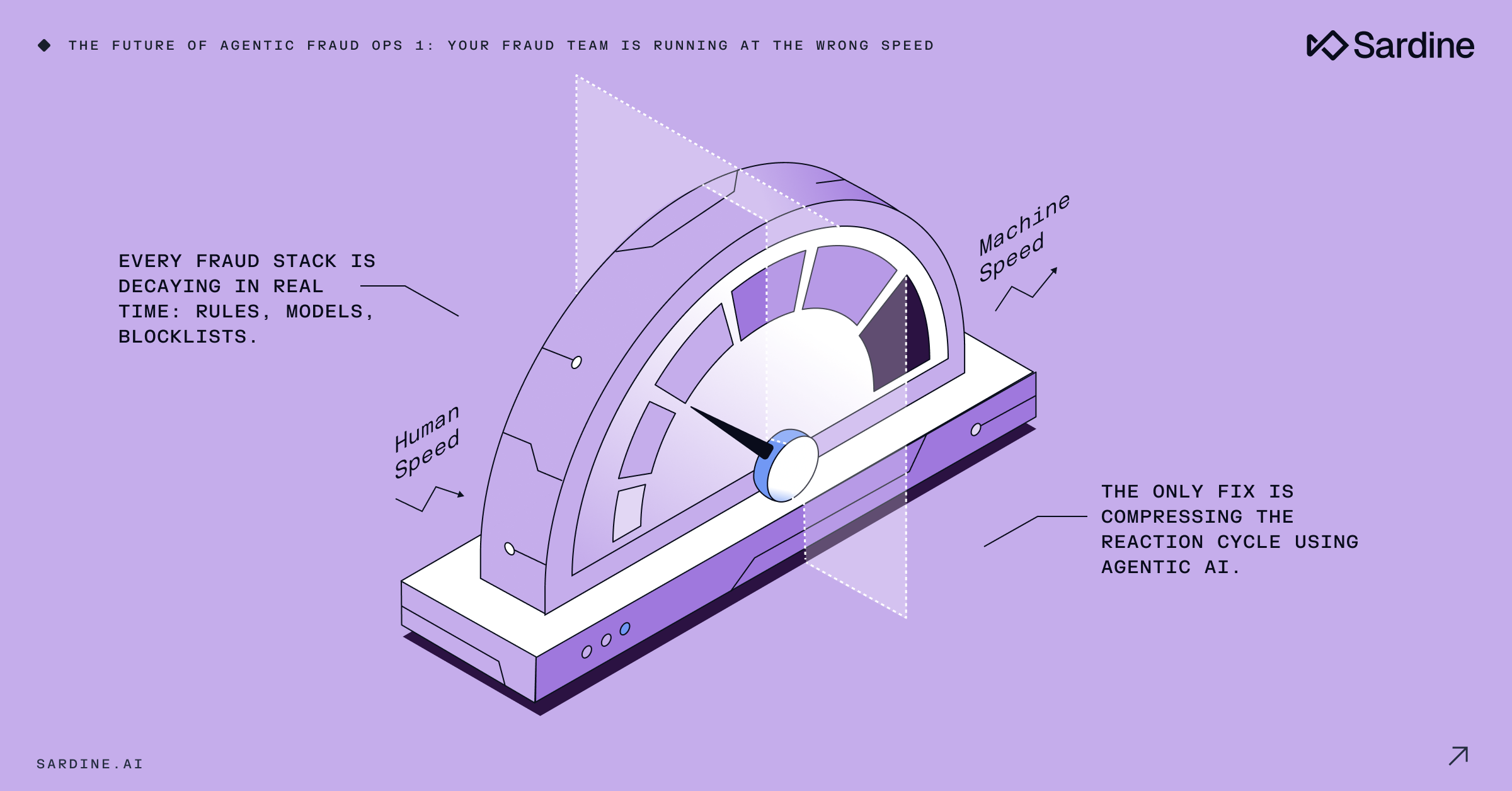
Your detection logic learns from labels. Your labels arrive at chargeback speed: weeks, sometimes months. So your model is forever training on last month's attack patterns, then meeting this month's attack in production. This slow fraud feedback loop limits how quickly even a strong model can improve.
You can have a beautiful rule library and a state-of-the-art model and still lose, because the data teaching them is stale.
Agentic labeling changes the time constant. An agent reviews fresh events continuously, applies the patterns it has learned, and tags them as likely fraud or likely legitimate, without waiting for a chargeback to confirm it.
The labels aren't perfect, but they don't need to be. No customer gets declined because an agent labeled a past transaction suspicious. Your models already run on noisy data. What they've never had is fresh data.
And every label that does arrive goes further. When a label lands, whether from a chargeback, an investigation ruling, or the agent itself, it extends to all connected events through linking. Confirm one ring and you've labeled the whole cluster. That's the difference between feeding your model a trickle of stale truth and feeding it a steady stream of fresh signal.
This moves label latency by an order of magnitude, and label latency is the constraint underneath most teams that think they have a model problem.
I've seen teams with state-of-the-art detection that still underperform, and the reason is almost always the same: they can't learn fast enough because they can't label fast enough.
Notice fraud detection drift before it costs you
Segmentation, the layer that determines which users get routed through which checks, is the one nobody revisits. It’s set once and reviewed annually, maybe. The threshold that made sense last year stops making sense, and the first time you find out is when losses or false declines move enough for someone to ask why.
The pattern that says a threshold is drifting is in your data right now. Nobody catches it because no human is watching it continuously, and watching it continuously was never practical.
An agent doing that monitoring isn't magic, it's the monitoring work that was always theoretically possible and never feasible to staff. This is agentic AI capability expansion in practical terms: the team can now monitor more signals continuously without adding a person to every workflow.
This is the layer with the most impact and the least attention. Segmentation decides which populations warrant human review, where friction lands, and how your resources get spent. Get it wrong and you're either burning analyst hours on low-risk traffic or waving through a population that has actually shifted.
But an agent that flags the drift the week it starts changes how fast you can react to everything downstream of it.
Agentic AI ROI is a fraud prevention business case, not just FTE savings
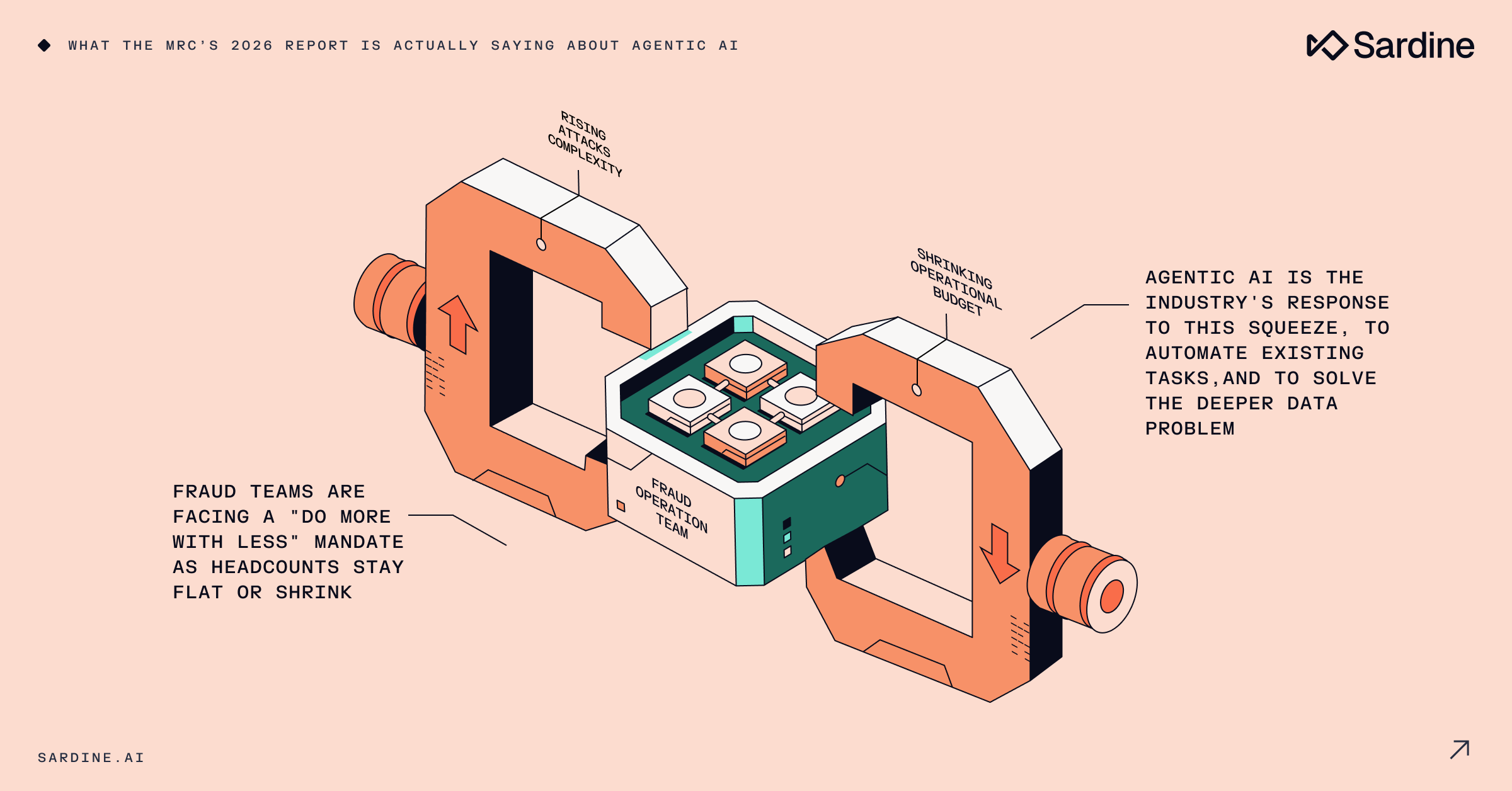
The real gain of using agentic AI is narrowing your fraud loss window, not lowering headcount.
Say it takes your team two weeks on average to notice a fraud trend and ship a fix. Compress that to two days and you've eliminated roughly 85% of the exposure window for that attack. That is the clearest agentic AI ROI calculation: fewer days of exposure, fewer dollars lost, and a faster path from detection to action. It's a direct path to fraud loss reduction, calculated the same way you'd calculate dollars saved by cutting an analyst, only larger.
Put a number on it the way you'd put a number on headcount. If an emerging attack bleeds $40,000 a day and your team historically takes 10 working days to spot it and ship the fix, that's $400,000 of exposure per incident. Cut the window to two days and you've kept $320,000, on a single attack, before you've cut a single FTE.
Run that across a year of incidents and the savings can dwarf anything you'd find on the staffing line. The numbers are illustrative, but you get the picture: the money is in the narrowed fraud loss window, not the headcount.
But there's a second-order gain that is harder to put on a slide but just as important: faster detection deters.
Fraud rings are businesses, and they optimize against platforms where exploitation is cheap and the time-to-detection is long. Compress that window consistently and the economics of targeting you shift. Eventually you’ll make fraudsters understand that they’ll get better ROI elsewhere. That’s your real goal.
Faster, more accurate decisions also cut false declines: good customers who got treated like fraud. Total revenue and damaged trust are both recoverable when your system learns faster.
Ask a fraud leader for last month's chargeback count and you'll get a precise number. Ask how many good customers got blocked by mistake and you'll get a shrug. The loss window sits on both sides of that line.
FFind the fraud detection blind spots in your agentic AI ROI strategy
If the goal is to detect fraud earlier and keep more of the money, the better question is which of these three constraints is hurting you most right now, not how to adopt AI in the abstract. Agentic AI ROI depends on matching the capability to the bottleneck whether it be investigation speed, label freshness, or treatment logic drift.
The answer is different for every team. Some are bottlenecked on investigation speed. Some on label freshness. Some on treatment logic nobody has touched in a year. Each one creates a different kind of fraud detection blind spot, and each one needs a different agentic AI capability. You won't fix the cycle by buying the most impressive-looking capability, you’ll fix it by finding where it actually stalls and starting there.
Get the full picture on agentic AI ROI for fraud teams
If you want to learn more about Agentic AI ROI and how these capabilities can be implemented in your own fraud prevention team, check out this whitepaper. It covers the full picture: why moving to agentic is a reality all fraud teams need to wake up to, how such a system should look like, the headcount and skill mix the new system actually needs, the governance model that keeps continuous learning safe at scale, and the 18-month rollout sequence that turns agentic AI capabilities into measurable fraud outcomes.
The whitepaper is built for that conversation. It won't make the case for you, but it'll help you explain why the strongest AI ROI comes from fraud loss reduction, faster learning, and a narrower window between detection and action.
FAQs about agentic AI ROI
What is agentic AI ROI for fraud teams?
Agentic AI ROI is the measurable business value fraud teams gain when AI agents help reduce losses, speed up investigations, improve fraud labels, and shorten the time between detection and action. The strongest ROI often comes from a narrowed fraud loss window, not just lower headcount.
What does agentic AI do in real-time fraud detection?
Agentic AI can help fraud teams investigate patterns, connect related accounts, test hypotheses, generate labels, monitor thresholds, and surface risks faster than manual workflows. In fraud detection, the value is not just automation, but the ability to produce outcomes the system could not produce before.
How is agentic AI different from traditional AI?
Traditional AI typically scores, classifies, or predicts based on a defined model. Agentic AI can take multi-step actions, reason across data points, investigate connected patterns, and help coordinate next steps. For fraud teams, that difference matters because agentic AI can support faster investigation, labeling, monitoring, and response.
How do agentic AI capabilities improve fraud detection?
Agentic AI improves fraud detection capabilities by helping teams see coordinated attacks earlier, generate fresher fraud labels, and monitor risk thresholds continuously. These capabilities reduce blind spots created by slow manual analysis, stale labels, and fraud detection at chargeback speed.
Why does the agentic AI cost-cutting myth miss the real ROI?
Agentic AI ROI is not just about cutting costs because the biggest financial benefit often comes from reducing exposure to active fraud. If a team can compress a 10-day detection and response cycle into two days, the savings come from fraud loss reduction, not just from reducing staff.
What is a narrowed fraud loss window?
A narrowed fraud loss window is the shorter period between when a fraud attack begins and when the team detects, understands, and responds to it. The smaller that window becomes, the less time attackers have to exploit the system, which can directly reduce fraud losses.
How can agentic AI help with real-time fraud detection?
Agentic AI can support real-time fraud detection by analyzing fresh events, surfacing anomalies, connecting related accounts or behaviors, and helping teams identify coordinated attacks before they scale. This gives fraud teams a faster path from signal to investigation to action.
Why do stale fraud labels hurt the fraud feedback loop?
Stale fraud labels hurt fraud detection because models and rules learn from old attack patterns instead of current fraud behavior. When labels arrive weeks or months later through chargebacks, the system may already be behind the next attack. Agentic labeling can help provide fresher signal sooner.
What is the slow fraud feedback loop in fraud detection?
The slow fraud feedback loop happens when fraud teams detect an attack, wait for labels or chargebacks, update rules or models, and then respond only after the pattern has already caused losses. Agentic AI can help shorten that loop by generating faster labels and surfacing patterns earlier.
How can fraud teams calculate agentic AI ROI?
Fraud teams can calculate agentic AI ROI by comparing the cost of fraud exposure before and after automation. For example, if an attack costs $40,000 per day and the response window drops from 10 days to two days, the team can estimate avoided losses from the eight days of exposure removed.
What are the best use cases for AI agents for fraud teams?
The best use cases for agentic AI in fraud teams are areas where speed changes the outcome. These include coordinated attack detection, fraud ring expansion, fresh label generation, threshold drift monitoring, investigation acceleration, and real-time fraud response.
How does agentic AI reduce the fraud exposure window?
Agentic AI can reduce fraud losses by helping teams detect attacks earlier, label connected events faster, and respond before fraud rings scale. The goal is not only to make existing fraud workflows cheaper, but to help teams act while there is still time to prevent more loss.